Video Production Services in Shenzhen 06/10 · ONCE Guide to Video Production Services in Shenzhen
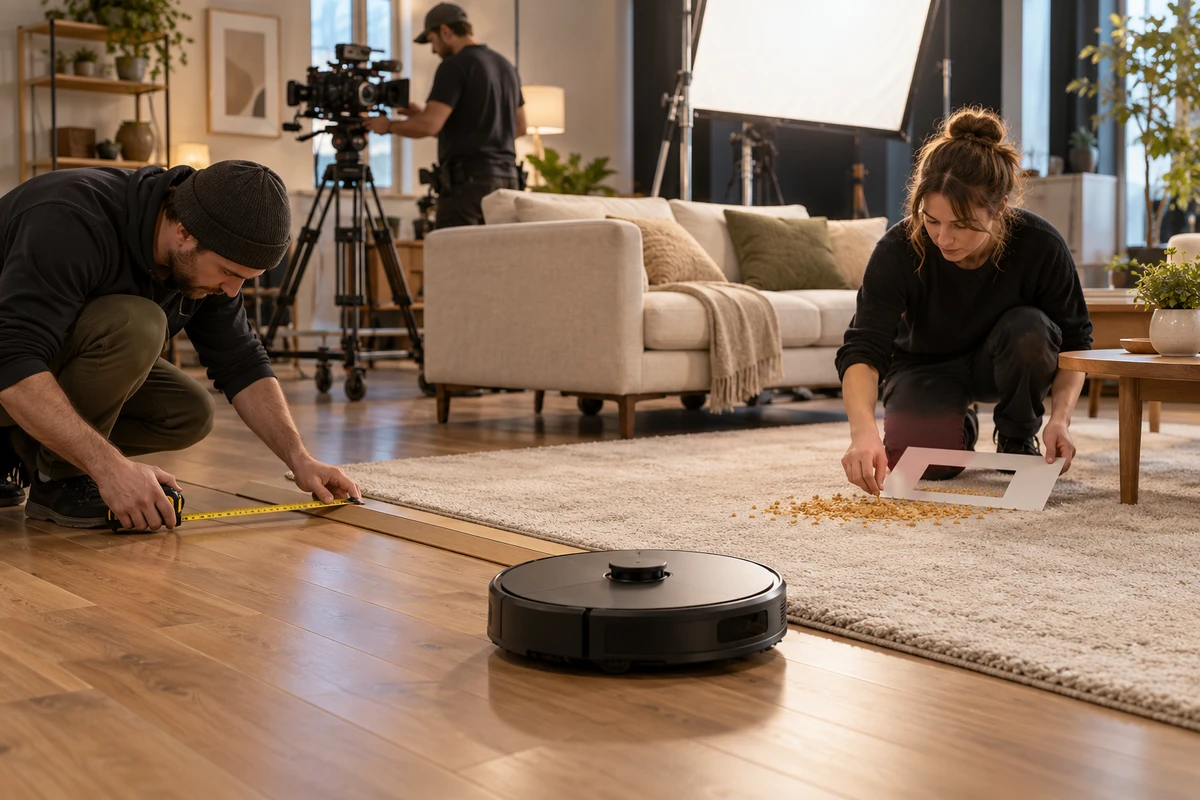
Suppose a robot vacuum needs four shots for an international product page: collecting dry crumbs, navigating around a cable, crossing a small threshold and returning to its dock. A shortlisted Shenzhen living-room set looks convincing, with timber flooring, a rug and a sofa in one frame. Is that enough to book it?
Do not decide from the set photographs. Put the actual unit on the intended floor, run one approved critical path without hiding interruptions, and restore the scene to the same starting state. A photogenic room becomes a workable functional set only when the product can complete the action, the camera can show it, the location permits it, and the crew can repeat it after a documented reset.
This recce is not a laboratory test or third-party product certification. It answers a production-buying question: can the location support the demonstration without making the full crew troubleshoot floors, debris, docking and resets on the shoot day?
Choose one critical path before testing the whole shot list
The first article in this series explained how to compare white studios, furnished sets and custom builds by shot task. A robot-vacuum project needs a narrower gate. Instead of testing every claim, select the path that would disqualify the location if it failed.
For example, the unit leaves its dock, enters a specified hard-floor area, collects brand-approved dry debris, navigates around one fixed obstacle and returns to the dock. That single path exposes six dependencies: a stable start, a suitable surface, permitted debris, a repeatable obstacle, continuous camera coverage and a reset that restores the next take.
“The robot moved through the living room” is not a completion standard. The path must correspond to approved product language, and the visible result must be defined. Suction power, noise, runtime or an obstacle-avoidance rate cannot be inferred from one polished shot. Where a number or measurement is required, the product owner supplies the applicable conditions and evidence; production presents only what has been approved.
Turn the room into a repeatable set with a floor-state card
Do not leave a recce with beauty shots alone. Give each candidate floor area a scene ID and record the variables that can change the product action or editorial continuity.
| State | What to record | Approver | Why it changes the shoot |
|---|---|---|---|
| Floor | Material, seams, texture, colour, reflections and permission for removable marks | Location and camera leads | It affects movement, sensor behaviour, reflections and camera tracking marks |
| Threshold and obstacles | Actual object, dimensions, fixing method, position and permission to move it | Product and art teams | A loosely placed object may create a different test on every take |
| Debris | Brand-approved material, method of measuring quantity, distribution area and cleanup | Product owner and location | Unsafe or unapproved material cannot be used to manufacture a result |
| Dock | Position, stable base, power, cable route, camera access and visible background | Product, location and production | Moving the dock can change the start and return conditions |
| Unit | ID, firmware or app build, accessories, charge, bin and consumable starting state | Product owner | Two visually identical units may not be in the same functional state |
| Light and sound | Window changes, fixture positions, ambient noise and whether operating sound matters | Camera, sound and location leads | Lighting cannot block the path, and multiple takes need compatible light and sound |
| Reset | Tools, owner, reference photographs, estimated and measured reset time | Floor crew and producer | Reset time determines repeatable output more than a single run time does |
The card is not a laboratory report. It gives every department the same definition of “the same set.” If take one uses timber and take two uses the rug; if debris is placed through a template once and scattered by eye next; or if the dock is moved forward to help a camera angle, the production is no longer repeating the same demonstration.
The exact product manual comes before the creative treatment
Before booking, the brand should provide the manual for the actual model, approved operating steps and prohibited actions. The official Roborock S5 Max user manual, for example, defines that model for indoor floor cleaning, instructs users to move wires and fragile objects, and says not to use it where liquids or tacky substances are present. It also gives model-specific conditions for dock placement.
The production lesson is not that every robot vacuum shares those restrictions. It is the opposite: debris, cables, thresholds, carpets and dock clearances must be checked against the unit being filmed. A restriction or capability from one manual is not an industry-wide standard. A competitor video showing sauce, pet hair or a particular threshold does not authorise the same action for another product.
If a treatment calls for liquid, tacky debris, height changes or another potentially damaging action and the manual, product owner or location has not cleared it, remove it from the shot list for now. A dressed studio is not a safety approval, and the production company is not a product-certification body.
The recce clip should be continuous, not cinematic
A phone or compact camera is sufficient for the test. The objective is to retain causality, not create a finished advertisement. One continuous record should show five points:
- the scene ID, unit ID and starting state;
- the wide relationship between debris, obstacle, threshold and dock;
- the trigger and the beginning of the task;
- the critical route and visible result; and
- the end state, exception, human intervention and reset for the next run.
Shoot additional close-ups if useful, but do not keep only the best fragments from different runs and present them internally as one continuous success. The recce clip is a booking tool. The producer needs to see waiting, stalled movement, reconnection, moved objects and manual correction. The finished film may use editorial pacing, while production retains a record that can be traced back to the original conditions.
ScreenSkills' description of continuity work explains that script supervisors keep detailed written and photographic records of action, props, camera and lens information so separate takes remain consistent in the edit. A robot-vacuum product film is not a drama, but the production principle transfers well: treat the floor, debris, obstacles and unit state as continuity elements instead of relying on someone to put them back “roughly where they were.”
Separate three responsibilities that are often called coordination
The product owner approves functional facts
The product lead supplies the model, build, approved claim, operating sequence, debris or obstacle conditions, backup unit and failure boundary. This team decides what may be said publicly and prevents engineering modes, test conditions or post-production simulations from being presented as normal consumer performance.
The location approves physical use
The location confirms whether the floor may be used, furniture and rugs may move, controlled debris may be placed, cleanup is acceptable, power and access are suitable, and the booking covers restoration, damage and hours. Public photographs are not project-specific permission.
Production approves visibility and repeatability
Production converts approved facts into camera positions, lighting, movement and resets, then records the state of every take. U-STUDIO in Shenzhen publicly describes multiple sets and a white cyclorama, making it one place to start a recce discussion. Floor use, docking, debris, cleanup, power and availability still need confirmation for the actual project. For the upstream comparison between different kinds of spaces, see the previous guide to choosing a Shenzhen studio for ecommerce product video.
The best lifestyle room and the best demonstration floor may differ
A common counterexample is a room with an excellent sofa, natural light and the right market feel, but a rug edge that lifts, a highly reflective hard floor, no workable dock position and a cleanup cycle that disrupts the next setup. It may still be an effective lifestyle set. It should not carry the full functional demonstration.
The decision is not simply to use or reject the location. Split the work by task:
- capture the critical cleaning route or docking action on a controlled floor;
- use the furnished set for the product's place in daily life, talent movement and storage; and
- use a white studio or tabletop for form, accessories and structural details.
ONCE's Shenzhen home-appliance video production page explains how complete actions and lived-in space can work together. Multiple settings may support one film, but atmosphere cannot replace a functional fact.
Use a clear booking gate
A candidate location is ready for a formal booking only when the project can show that:
- the actual model has completed one approved critical path in the target area;
- floor, obstacle, debris, dock, unit and lighting states are captured on one card;
- the continuous recce clip does not hide an intervention that changes the meaning;
- the location has approved the intended use, cleanup and restoration method;
- formal camera, lighting and crew positions do not occupy the product route;
- one complete reset has been timed and assigned to a named person; and
- failure leads to a known decision: retry, revise the shot, change location or wait for a product fix.
A replaceable side prop can be solved after booking if there is a named plan. A missing floor condition, dock position, permission or safety decision should not be left for the shoot day. Shenzhen proximity can make a small recce easier for a local product team, samples and engineering staff. Proximity creates an opportunity to verify; it is not proof that the conditions have passed.
If you are preparing a robot-vacuum or cleaning-appliance product film in Shenzhen, send ONCE the product and location information: target market and channels, Shenzhen or factory location, timing, model and sample state, approved claims, critical path, current location photographs and known failure records. We can first determine the required floor, whether a separate recce test is worthwhile, and how to divide functional and lifestyle shots before defining the production scope.
Source note: This guide checked the official Roborock S5 Max user manual and ScreenSkills' current explanation of continuity records on 8 October 2026. Manual restrictions apply only to the named model, and platforms, product builds and location conditions change. Confirm the real product documentation with the product owner, location provider and responsible on-site safety personnel before production. The project described here is a hypothetical buying scenario, not an ONCE client case or performance test.