Video Production Services in Shenzhen 05/10 · ONCE Guide to Video Production Services in Shenzhen
A Shenzhen hardware team is preparing a crowdfunding film for AI translation earbuds. The plan combines a founder message, an engineer-led two-way translation demo and two performers having a natural conversation at a café table. Putting all three into one studio and one shoot day appears efficient.
The real constraint is not the number of sets. It is whether the translation workflow can complete under a known build and known conditions. If an engineer must change settings after every connection, the cast, lighting crew, art department and location are simply waiting for product troubleshooting.
A safer sequence is to record one uninterrupted, engineer-witnessed evidence take before deciding which actions can move into the lifestyle set. The evidence take answers, “What can this prototype do now?” The lifestyle scene answers, “Why would someone need it, and how should the use feel?” They may be filmed on the same day, but one cannot impersonate the other.
Break one feature into input, processing and a visible result
Suppose the claim is that the earbuds help two people speaking different languages communicate face to face. A shot of two people smiling, followed by a polished app screen, does not establish that sequence. First write the demonstration as an observable task: who speaks which language, where the audio enters, which device or account processes it, where the other person hears or sees the output, and how the system returns to its starting state.
Kickstarter's guidance on sharing a prototype says a demo should cover the baseline functionality described by the project. It recommends documenting hardware-software interaction clearly, with single unedited shots working well, and says fundamental technologies should be demonstrated. The same guidance says computer-generated imagery should not be used to demonstrate product functionality. Kickstarter's later guidance on an honest and clearly presented project states that complex hardware projects require working prototypes and must not use misleading imagery. The current rules and project editor should still be checked at submission.
This does not mean the main film must look like a laboratory record. It means the production retains one master that can answer the factual question. For translation earbuds, the evidence take or a synchronised record should show:
- the trigger, such as wearing the product, selecting a mode or beginning to speak;
- the input source, language, phone and connected device;
- a visible or audible response, such as an indicator, app state, caption or output heard by the other person;
- the end of the task, not only its beginning; and
- current conditions, including any network, account, app-build or noise requirement.
Until those elements are clear, rehearsing the talent is premature. A repeatable performance does not make the product repeatable.
Give every prototype a demo-state sheet
Two units with the same enclosure may carry different firmware, accounts or connection states. Number every functional prototype and lock the demonstration conditions on one sheet. The table below is a procurement template, not the specification of a real product.
| Record | What the team fills in | Approver | Shots affected |
|---|---|---|---|
| Prototype identity | Unit ID, enclosure, firmware, app and operating-system build | Engineering lead | Every function and close-up |
| Input conditions | Language pair, speaking distance, level, phone and account | Product and engineering | Uninterrupted evidence take |
| Environment | Network, background noise, tabletop, power and connected devices | Production and engineering | Technical table and lifestyle set |
| Observable result | When and where the light, interface, audio or caption appears | Product owner | Evidence and inserts |
| Reset | Re-pairing, session clearing, restart, charging or unit swap | Engineering lead | Schedule and buffers |
| Failure branch | What happens after timeout, disconnect, recognition error or version fault | Engineering lead | Whether a technical window is separate |
| Public scope | Which interface, log, engineering detail and status may be shown | Brand owner | Edit, captions and campaign page |
Shenzhen proximity can make this handoff more practical. Samples can move between R&D, brand and production teams quickly, and an engineer can attend a defined verification window. Proximity reduces coordination time; it does not turn an unstable feature into a filmable one.
The Shenzhen Municipal Bureau of Industry and Information Technology's action plan dated 3 March 2025 identifies AI wearables, including smart earbuds, and real-time translation among the city's priority product areas and use cases. This is useful local industry context. It is not evidence that any particular prototype meets a performance claim, and it does not replace the project's own test material.
An engineer does not need to remain on set all day
The engineer's highest-value task is to confirm facts. It is not to block the talent or supervise every aesthetic adjustment. Give the engineering window four explicit outputs:
- confirm unit ID, builds, account, network and public scope before the camera rolls;
- complete the formal workflow in one uninterrupted evidence take;
- approve the actor operation card without removing necessary steps or changing conditions; and
- classify a failure as resettable, build-related or not currently supportable as a public claim.
After that, production can continue with appearance close-ups, wearing, handling, storage and verified repeatable actions. If a feature still requires an engineer to enter a test interface, change backend data or dismantle the unit, it should not be staged as a normal consumer action.
When the evidence and lifestyle scenes can share a day
“It worked yesterday” is not a scheduling gate. Before issuing the call sheet, answer five questions:
- Are the evidence and lifestyle shots using the same prototype or the same documented state class?
- Can the performer follow the approved operation card without live verbal correction from engineering?
- Can the result be captured clearly by the camera, an approved screen recording or synchronised sound?
- Is the worst-case reset path known, with real room for it in the schedule?
- Will the lifestyle set's noise, network, lighting or performance tempo change the conditions under which the demo works?
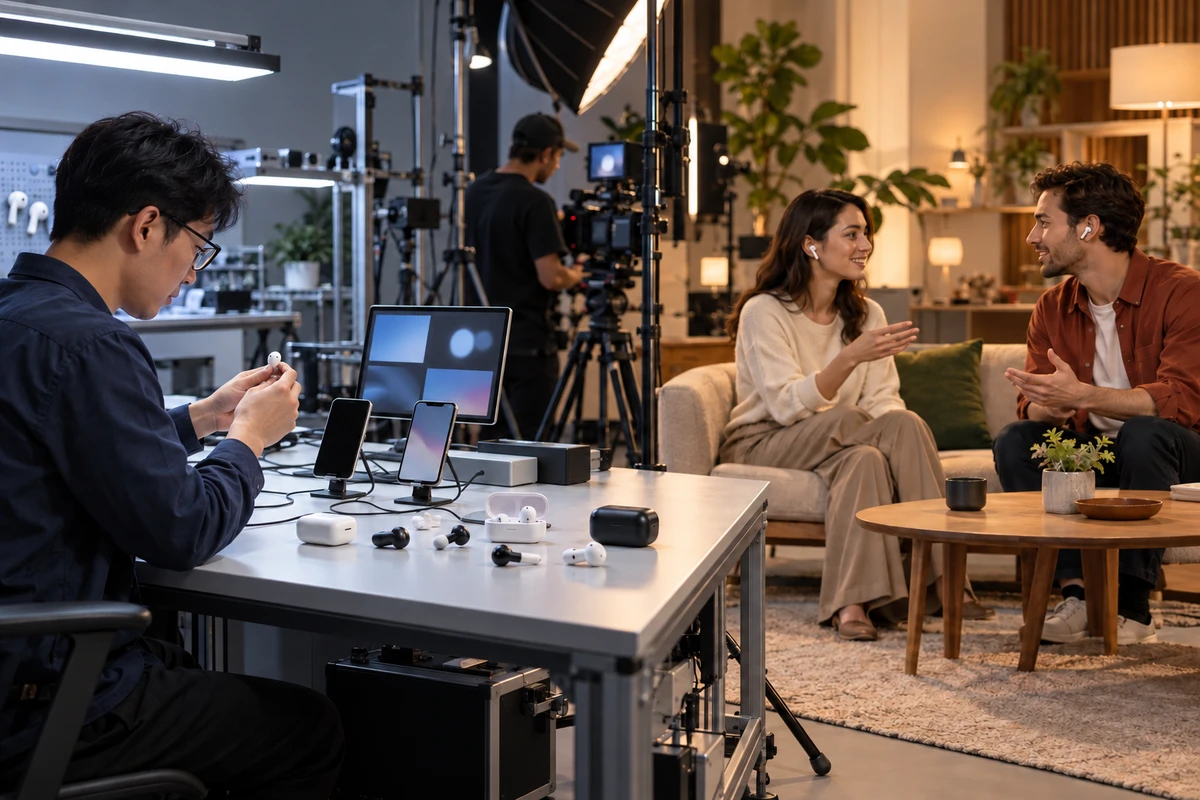
If every answer is settled, the work can share a day. Keep two independent work areas: a controlled technical table for build checks, uninterrupted demonstration and screen capture; and the lifestyle set for people, wearing and use value. Relighting and prop changes in the lifestyle area should not disturb the technical setup.
Use a separate technical window when engineering still has to judge success, reset time is unknown, a unit must be opened or reflashed, the location conflicts with the required network or noise conditions, or the result exists only after replacing the interface in post. Separate does not necessarily mean adding a full large-crew day. It may be a small pre-shoot verification and evidence capture. Scope should follow the actual prototype state and workload.
When a demo fails, do not let editing complete the product's task
A failed take does not automatically invalidate the product, but it must enter the record rather than disappear between close-ups.
Reset and retry under the same conditions
Use this path when the cause is known, reset steps are defined and the retry does not change the public claim. Record the failure time, cause, operator and reset. The successful take keeps the relevant conditions attached.
Reduce the claim to a smaller approved task
If a full two-way exchange remains unstable but one direction is approved for public demonstration, film that smaller capability. Captions and voiceover must reduce the claim as well; a smaller demonstration cannot continue carrying a larger promise.
Stop and return after a build fix
If the problem sits in firmware, the account, the backend or an unknown cause, stop. Preserve the camera position, lens, tabletop reference, screen-capture method and sound conditions, then pick up the same task after the build is fixed.
Use concept imagery only as labelled explanation
Boards, animation or generated imagery can explain a future experience, but they cannot pose as functioning hardware. Projects that use AI-generated content or develop AI technology should also check Kickstarter's current AI content and technology guidance for disclosure, data-source, consent and credit requirements. This is production management guidance, not platform approval or legal advice.
The highest-risk workaround is to film the actor completing an action, paste in audio from another run, replace the interface in post, and present the sequence as one real demonstration. Editing can clarify steps. It cannot make the prototype complete a step that did not occur.
Approve the evidence and lifestyle footage separately
The two groups of shots do not need the same visual language, but they must use the same product facts.
| Footage | Primary job | Acceptable editing | Approver | It should not carry alone |
|---|---|---|---|---|
| Engineering evidence | Establish what the current prototype completed under stated conditions | Keep a full master; a public cut may use explanatory excerpts | Engineering and product owners | Emotional performance or an exaggerated future experience |
| Lifestyle expression | Help viewers understand who needs the product and when | Pacing, coverage and reactions may be shaped | Director, brand and product owners | Proof of the underlying feature or a performance number |
| Founder section | Explain why the team is building it, current progress and the next step | Edit by message task | Founder and brand owner | Replacement for a functional demo or test record |
Kickstarter's 2025 lesson on creating an effective campaign video lists the introduction, core features and benefits, backstory, supporting information and call to action as common elements. They can live in one film without being produced by one kind of shot. ONCE's crowdfunding video production scope similarly separates a compelling vision, an honest prototype story and coordinated page assets.
For broader decisions about one day, two days or a separate test, read the existing guide to planning Kickstarter shoot days. That article works backward from people, locations, versions and resets. This guide is narrower: it defines when one AI-earbud demonstration has earned the right to leave the engineering table and enter a lifestyle scene.
Collect five deliverables before combining the booking
Require a versioned demo-state sheet, one engineer-approved uninterrupted evidence master, an actor operation card, a reset and failure log, and separate shot lists for the technical and lifestyle work. Also label which material may enter the hero film, a campaign-page clip or internal reference, so a test take is not mistaken for cleared public footage in post-production.
When all five exist, sharing a day becomes much more controllable. If the sheet still contains decisions that can only be made after the full crew arrives, a small technical verification is usually the better first booking. The previous guide to product-video equipment packages in Shenzhen can help close the monitoring, sound, power, media and technician chain. This guide decides when the function is ready to enter that production system.
If you are preparing a Shenzhen hardware crowdfunding film, send ONCE the product, target market, platform, Shenzhen or factory location, timing, prototype builds, core demonstration, known failure records and campaign-page materials. We can first determine whether the work needs a separate technical verification, two work areas on one day, or split engineering and lifestyle production, then define the actual scope.
Source note: This guide checked Kickstarter's public material on honest presentation, prototype demonstrations, campaign video and AI projects; the Shenzhen Municipal Bureau of Industry and Information Technology's action plan dated 3 March 2025; and ScreenSkills' current explanation of continuity records on 8 October 2026. Platform rules and project editors change. Recheck the applicable platform, account, product build and publication date before launch.