Video Production Services in Shenzhen 04/10 · ONCE Guide to Video Production Services in Shenzhen
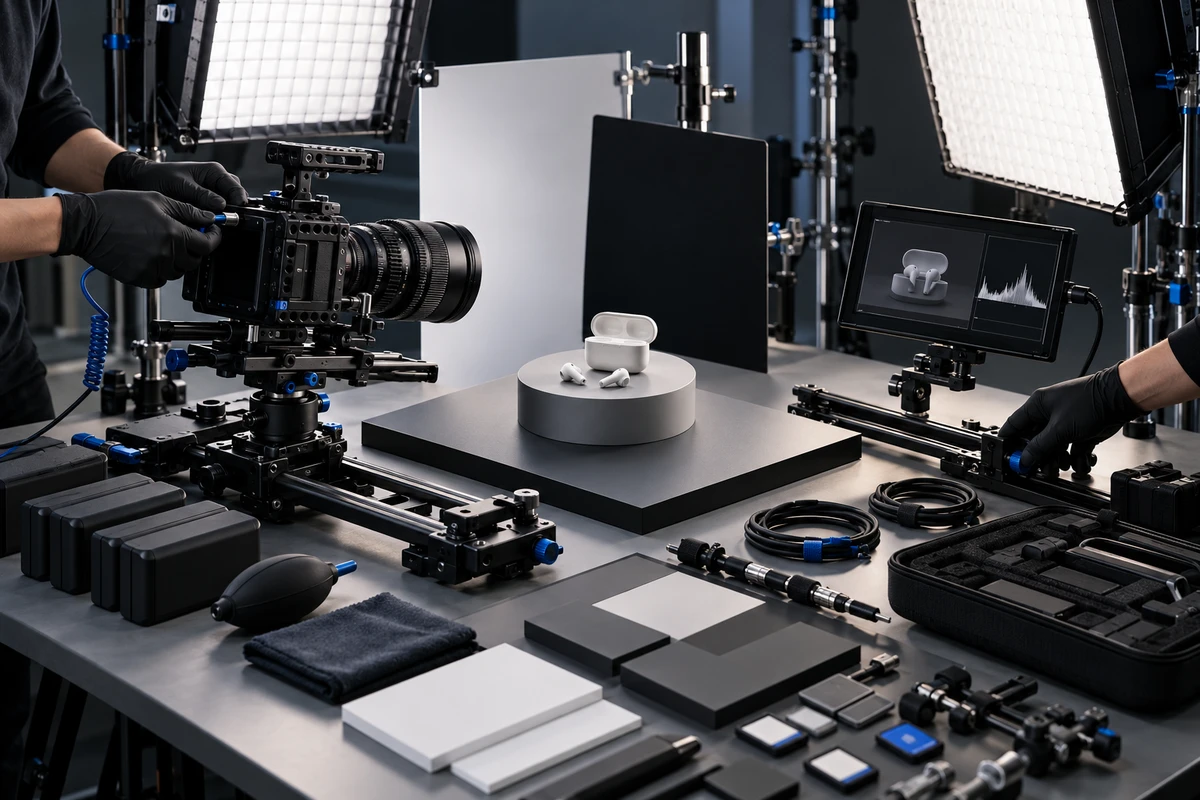
Imagine a Shenzhen hardware team preparing a launch film for wireless earbuds. The shot list includes a clean hero shot, a macro view of the charging case and status light, a hand pairing the product with a phone, and a desk-based lifestyle scene. A request for “one cinema camera, one macro lens, three lights and a gimbal” sounds specific. It can still arrive without a support system precise enough for macro work, a gimbal that balances the fully built camera, a client-monitoring path, or the diffusion, flags and safe rigging needed to control the light.
When renting equipment for a product video in Shenzhen, do not begin with the most impressive camera body. Start with the shots that must be completed. For each shot, close the chain of image capture, lighting, grip, movement, monitoring, power, media and operators. A model name becomes a shootable package only when it sits inside that chain.
Send a shot-task sheet before copying a rental catalogue
The same product puts different demands on the equipment in different shots. This matrix is a procurement template, not a fixed package for every project.
| Shot task | What the image must communicate | Configuration to consider first | What must be confirmed before booking |
|---|---|---|---|
| Clean hero shot | Shape, colour and the relationship between earbuds and case | Lockable camera position, normal or longer lens, stable tripod, continuous lights, diffusion and black or white flags | Aspect ratios, working distance, product-table size, minimum focus and room for horizontal and vertical versions |
| Case and indicator close-up | Hinge action, port and light feedback | Macro or close-focus option, precise support, follow focus, low-position monitor and separately controlled subject and background light | Repeatability, flicker, focus travel, replacement samples and cleaning tools |
| Pairing interaction | Sequence between hand, product, phone interface and feedback | Camera support that can work close to the action, wired or wireless monitoring, and sound where required | Phone and earbud versions, display behaviour, hand positions, pairing reset and interface approval |
| Desk lifestyle scene | Relationship between talent, product and work environment | Lens coverage for person and set, larger soft source, negative fill, stands and ballast, client monitor | Desk depth, power, reflections, talent blocking, window control and dialogue or product-sound requirements |
If a slow lateral move is added to one shot, do not simply add a slider at the bottom of the order. Recheck the total camera build, centre of gravity, travel length, start and end positions, focus method, floor level and operator. A movement system changes the whole package; it is not an isolated accessory.
A shootable package has at least nine interfaces
The current ONCE Shenzhen equipment rental catalogue groups resources into cameras and drones, lenses and filters, lighting, movement and stabilisation, focus and monitoring, sound and intercom, grip and light control, power and accessories, and crew and transport. The page identifies 372 equipment and support entries as availability-on-request, not live inventory. It also says the catalogue was compiled from a source list dated 22 August 2025; that is not a current price check, and a listing does not mean an item is available, reserved or owned by ONCE.
Those categories reveal the interfaces that a buyer needs to close.
1. Camera and recording
Lock the required aspect ratios, resolution, frame rates, colour workflow and expected take length. Then confirm the camera, recording media, reader, and any timecode or synchronisation needs. A body-only rate answers none of these questions. High-frame-rate or long recording adds requirements for media capacity, write performance, heat management and backup timing.
2. Lens, mount and close focus
Focal length is only the first layer. Confirm mount, adapter, filter diameter, minimum focus, whether focus breathing matters to the action, follow-focus gearing and matte-box compatibility. A macro lens reveals a connector beautifully, but it also magnifies dust, fingerprints, vibration and focus error. It requires more precise product preparation and support.
3. Continuous light and colour
Continuous light lets the team see reflections, indicator behaviour and talent movement as they happen. Output alone is not a lighting plan. Working distance, source size, colour control, high-speed capture, power and light-shaping accessories all matter. Flash may serve still photography during the same booking, but it cannot automatically replace video lighting.
4. Diffusion, control and safe grip
Softboxes, diffusion, black and white flags, reflectors, stands, booms, clamps and ballast are not miscellaneous extras. They determine where light falls, what appears in the product reflection, and whether a fixture can stand securely. The procurement task is to include the grip and accessories that make that control possible, instead of treating them as unnamed extras after choosing the lights.
5. Camera support and movement
A tripod must support the complete camera, lens, monitor and accessories. Sliders, turntables, gimbals and jibs also require load, balance, control, setup time and physical space to be checked. DJI's current RS 4 setup guidance tells users to keep the camera, lens and accessories within the stated payload and compatibility conditions and to complete mounting and balancing. That is a model-specific example, not proof that one stabiliser suits every product shot.
6. Focus and monitoring
A picture visible to the camera operator is not necessarily visible to the focus puller, director, client and product specialist. Draw the signal path: the camera output, any conversion or wireless link, who views a colour-referenced monitor, who only needs framing, how each display is powered, and what happens if the link drops. Low-angle and macro work make the question “who can judge focus?” especially important.
7. Power and cables
List the camera, monitors, transmission, focus, lights, movement system and charging area separately, with connectors, quantities and backup. The venue confirms the available supply and routing conditions; production plans the load and cable paths; appropriately competent personnel handle safety checks. A socket count is not a power plan.
8. Media, backup and files
Recording media must cover the actual shooting task. Readers and drives must match the interfaces, and the data owner, verification method, naming and handoff time should be clear before the call sheet. The current ScreenSkills second assistant camera checklist puts media, batteries, monitors, inventories, rental receipts and fault replacement inside one responsibility chain. A small product shoot may combine roles, but it cannot make the responsibilities disappear.
9. Technicians and transport
An established crew may collect, test and return familiar equipment itself. A specialised movement, focus, lighting or data system may need a technician who knows it. Ask whether support is included, the working hours and travel terms, loading and transport, replacement procedure, checkout, damage responsibility and return standard. Equipment that has arrived without anyone able to operate it safely and consistently is still not a shootable package.
Turn catalogue entries into a versioned configuration pack
The rental request should not be a string of brand names. Each line in the configuration pack should state:
- Purpose: the shot it serves and why it is required.
- Principal item: exact model, quantity and the conditions under which a substitute is acceptable.
- Accessories: mount, baseplate, quick-release plate, cage, cable, filter, matte box, focus part and remote control.
- Power and media: batteries, chargers, power cables, cards, readers and expected operating time.
- Interfaces: video, control, power, mounting threads and adapters.
- Support and safety: tripod, stand, clamp, ballast, cable protection and transport case.
- People: who installs, operates and checks it, and whether technical support is included.
- Handover: collection or delivery time, test window, fault replacement, return location and checker.
Public Shenzhen pages are useful for finding resources. Mairun currently separates cameras and lenses, movement, props, lighting accessories and locations and publishes a Bantian address. iRentals publishes a Shenzhen branch and its rental process. These observations do not establish a ranking, partnership, live stock or confirmed price. Send every shortlisted provider the same configuration pack if you want comparable responses.
Choose the service level by responsibility, not equipment count
Equipment-only rental
This fits a team that already has camera, lighting, production and data owners and can manage compatibility testing, transport, setup and faults. The client supplies a locked shot list and exact configuration and accepts responsibility for system gaps omitted from its order.
Equipment with technical support
This fits a project with a script and core creative team but a system outside the crew's everyday experience, such as more complex movement, wireless focus, multi-monitor distribution or high-output lighting. The technician operates the agreed system. The director, cinematographer and brand still own the shots, product facts and approvals. Technical support does not automatically become full production management.
Complete video production
If the available inputs are a product deck, reference films and a launch date, the immediate task is not choosing a camera. The scope still needs product priorities, script, boards, sets, people, prototype tests, filming, post-production and versions. The ONCE ecommerce product video production scope shows how these tasks can sit inside one project. Complete production does not mean every device or deliverable is automatically included; the confirmed project list remains authoritative.
AI boards can communicate intent, not replace a camera build
Generative boards can help a team discuss composition, pacing and a desired camera direction. Runway's August 2026 guide to AI previsualisation distinguishes creative previs from technical planning: a generated frame does not provide the measurable geometry of a real lens, rig or track. For a macro earbud shot, slider move or gimbal follow, the actual camera, lens, accessories and support still need a mounting, balance, signal, power and movement test.
A useful completion condition is to record a short test for each high-risk shot before the equipment leaves the rental facility. The system must record, display, focus, complete the move consistently, power safely and produce files that can be read. If it fails, revise the same configuration pack before talent, studio and the full crew are on the clock.
Leave pre-production with three sheets and a test clip
The first sheet is the shot-to-configuration matrix, showing which image each item serves. The second is the exact packing and interface list, covering principal items, accessories, labels, cables, batteries, media and substitutes. The third assigns setup, operation, data, transport, checkout and return. Keep the camera-build test clips and results with them.
Completion does not mean every item in the catalogue has been ordered. It means every required shot has an execution path, the complete equipment build works with its actual accessories and power, monitoring and data responsibilities are clear, transport and fault replacement are arranged, and the buyer knows which conditions still require written confirmation from the venue or rental provider.
For a Shenzhen product shoot, use the ONCE project brief to share the product, target market, use, Shenzhen or factory location, timing, prototype status, draft shot list and your existing crew. We can first determine whether the missing scope is individual equipment, a technically supported system or complete production, then narrow the request to the shots that actually need to be made.
Source note: This guide checked the current ONCE Shenzhen equipment catalogue, public pages from Mairun and iRentals, ScreenSkills camera-role checklists, DJI's RS 4 guidance, Google Merchant Center's current product-video requirements and Runway's AI previs guide on 8 October 2026. Third-party pages are market observations, not endorsements. Availability, accessories, rates, crew, dates and venue power must be confirmed in writing for the actual project.