Video Production Services in Shenzhen 03/10 · ONCE Guide to Video Production Services in Shenzhen
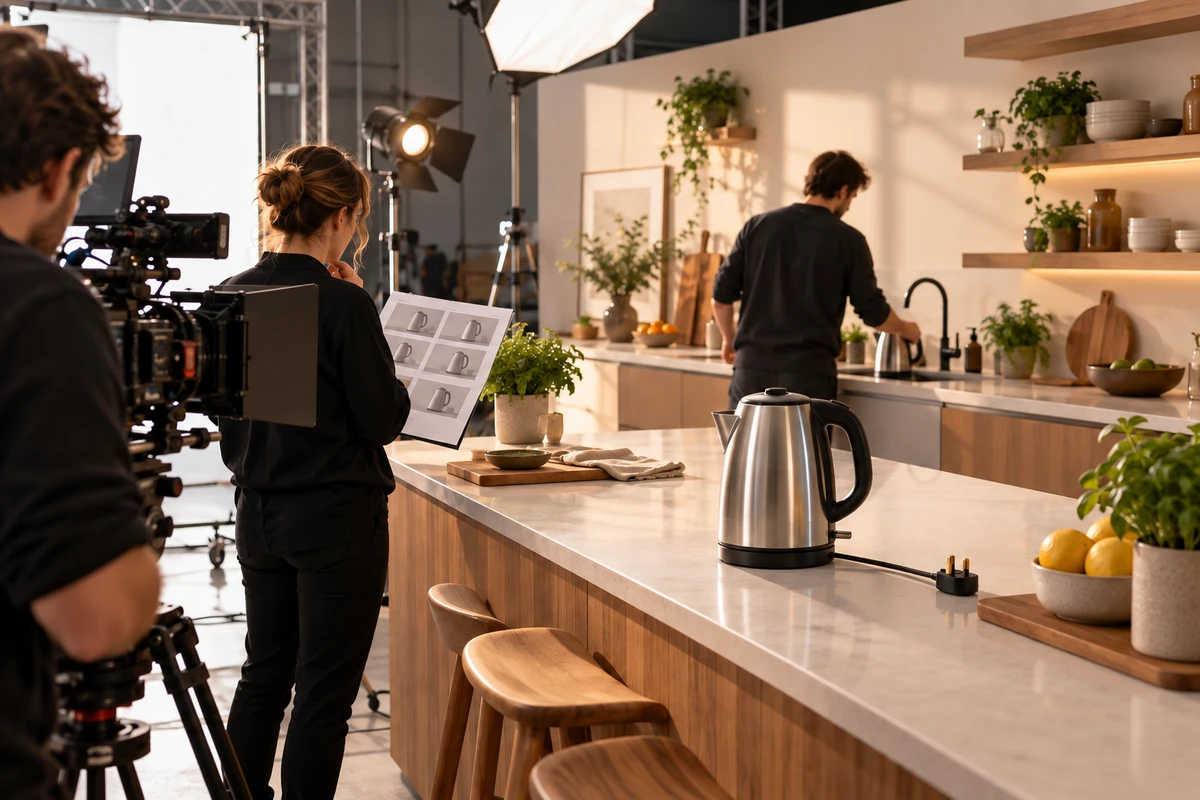
A pale-wood kitchen, a few English-language books and a coffee cup may look convincingly “international” in a location gallery. Put a UK-market electric kettle on the counter, however, and the practical gaps appear. The plug has no credible place in frame. The cable crosses the talent's path. The sink is too far away to film fill, return, switch-on and pour as one natural sequence. A reverse angle reveals the industrial building outside.
That set may still work for a polished product still. It may not work for a believable UK lifestyle product film.
When assessing an international-looking lifestyle studio in Shenzhen, do not start with whether the decor feels European. Start with one complete action the intended buyer must understand. Walk the product, talent, camera and location through that action. Style matters only after the action works.
Define the UK market before describing a Western look
This guide uses a hypothetical countertop kettle intended for Great Britain. The project needs product-page and advertising footage: a wide kitchen view for context, medium shots of filling and operating the kettle, and close-ups of the plug, switch, capacity marking and pour. It is not a client case, and the scene is not presented as a shoot in Britain.
The phrase “UK market” should be broken into at least four layers: the intended household and user, the correct product action, visible market-specific information, and facts the set must not imply. A solo breakfast routine has a different rhythm from a family kitchen. If the product has a UK plug, the production should not substitute a different plug simply because it fits the studio socket. A Shenzhen set can recreate a defined living context; it should not be described as a London location unless that is genuinely true.
Nor should a production company decide product compliance for the brand. The UK government's Electrical Equipment Safety Regulations 2016 guidance for Great Britain, updated in March 2025, distinguishes manufacturer, importer and distributor duties and addresses safety, technical documentation, marking and English-language instructions. The production task is narrower: use the market-version sample and approved information accurately. The brand and its qualified advisers remain responsible for determining what may be placed on a specific market.
Work backwards from a market-scene reference board
A useful reference board is not a collage of attractive kitchens. It gives the brand, studio, art department and camera team one shootable result to discuss. Include at least four groups of references.
Action references
Break the hero action into consecutive frames: where the person enters, where the kettle sits, how it is filled, where the hand reaches after returning it to the counter, and where the cup and kettle sit during the pour. Mark product orientation, hand position and intended camera position in each frame.
Adobe's June 2026 tutorial on storyboarding a commercial in Firefly Boards shows how style sources and starting frames can help maintain consistency across panels. Tools like this can align a visual direction early. Generated frames cannot verify the depth, power, windows or movement of a physical studio.
Spatial references
Do not collect soft furnishings alone. Show counter depth, upper cabinets, windows, walking space, talent scale and the reverse space the camera needs. Dimensions should come from the product, the planned action and approved target-market references—not from an unsupported claim about a “standard British kitchen”. Real homes vary; the studio needs to satisfy this film's spatial relationship.
Readable market information
Separate every detail the camera may read: plug and socket, packaging, capacity units, interface language, instructions and food props. Current UK guidance on units of measurement says metric measurements are required for most sales of packaged or loose goods in England, Scotland and Wales, with defined exceptions and conditions for supplementary imperial display. The production implication is not that every prop must show only metric units. It is that the brand must approve the correct product and packaging version before the crew fills the frame with guessed labels.
No-false-implication references
List what the set must not imply: actual shooting country, product performance, household size, installation conditions or certification status. The current CAP Code on misleading advertising says marketing communications must not materially mislead and that objective claims capable of substantiation need evidence. On set, the practical response is to separate elements that establish atmosphere from elements viewers may read as product facts.
Turn the recce into a physical-set difference table
Gallery images discover candidates; a difference table decides whether a studio can deliver the action. The current U-STUDIO Shenzhen page describes an 800 m² multi-set production base, a 64 m² white cyclorama and home and future-tech environments, with floor plans and multiple views for initial assessment. Those public details do not confirm availability, power, water, set changes or props for a particular date. The previous guide on choosing a Shenzhen studio by the shot task separates white-cyclorama, lifestyle and custom-set needs; this article goes deeper into target-market fit.
| What to inspect | Pass condition and decision |
|---|---|
| Counter and furniture scale | Product, two hands, cups and essential props look proportionate. If the shot only works with extreme wide-angle distortion or undersized props, record a material mismatch. |
| Product action path | Pick up, operate, show result and reset can happen continuously. If the performer leaves frame between every step, redress or change location. |
| Plug, socket and cable | The approved UK-market sample can appear truthfully. Before live power, the studio, product owner and appropriate technician confirm the supply and permitted setup. Do not fake compatibility with the wrong plug. |
| Units, model and interface | Packaging, capacity, language and model are brand-approved. Avoid readable close-ups of unresolved information. |
| Windows and reverse angles | Hero and reverse shots do not reveal a conflicting exterior. Decide whether to control the view, redress it or change angle—do not rely on “fix it in post”. |
| Prop meaning | Cups, food, books and furnishings support a specific household context rather than a pile of flags, landmarks or generic British stereotypes. |
| Talent interaction | Hand position, sightline, cabinet movement and carrying follow the approved use. Good composition does not override correct operation. |
| Location statement | Production notes describe a Shenzhen studio representing the target living context. Do not call it a UK shoot without a factual basis. |
A difference is not automatically a rejection. One cup, a distracting wall object or a window that needs dressing can enter the art list. A counter that cannot support the hero action, or a camera position that cannot show it, may change the location decision.
Test one action three times during the recce
The current ScreenSkills location manager skills checklist connects script breakdown, site photography and video, permissions, logistics, and director and designer recces. For a product film, that principle can become three bounded tests.
First, run a cold action test. Keep the sample unplugged and empty. Have the performer pick it up, move to the sink, return, operate and pour at a normal pace. The camera team checks wide and medium positions, the studio states what can be moved, and the product owner checks the action. A cold test that fails should not be left for the main shoot day.
Second, run a readability test. Record three short clips on a phone or test camera: one locked wide, one medium following the action, and one product close-up. Look for wrong plug details, capacity markings, interface language, window views and props. Crop a vertical frame and confirm that the hand, product and result still share a coherent relationship.
Third, run a conditions test only where the script truly needs live power, water, heat or steam. The brand provides prototype requirements and risk information. The venue confirms what is permitted and available. Production schedules the appropriate technical support, protection, cleaning and reset. Nobody should improvise electrical use or modify a sample for appearance. The crew records the test; it does not replace the responsible product or venue safety specialist.
Use three procurement outcomes, not a beauty verdict
Shoot as found
The hero action, camera positions, approved market sample and readable information pass. Changes are limited to reversible props and normal frame dressing. The team can move to a confirmed set list, call sheet and quotation.
Shoot after redressing
The space works, but furnishings, exterior views, visible sockets, props or colour differ from the approved reference. Art direction should provide a redress image, materials list, setup and strike time, restoration responsibility and approval photographs. “Make it feel more international” is not a defined line item.
Change location or split the shoot
The hero action does not work, or making it work would require changing the product, showing incorrect use, hiding a material limitation or promising uncontrolled post-production. Product close-ups can be filmed on a white cyc and lifestyle action elsewhere, or the script can change. Decor should never carry a product claim it cannot support.
The regional advantage of producing in Shenzhen is not a promise that every international interior is available at any moment. It is the chance to bring the sample, product or R&D contact, studio and production team into a short local verification loop. Proximity reduces coordination friction; it does not replace the correct sample, venue permission or a responsible decision-maker.
Leave the recce with two documents and one passing clip
The first document is the market-scene reference board: target household, hero action, spatial relationship, readable information and prohibited implications. The second is the physical-set difference table: pass, redress, confirm or reject, with an owner and deadline for each line. The final item is one complete action-test clip. A phone recording is enough if it lets the brand, producer, camera team and venue see the same facts.
Completion does not mean that the buyer likes the gallery. It means the hardest action has passed, the principal and reverse angles work, the market-version sample and readable information are correct, redressing and safety conditions have owners, and nobody will present a Shenzhen set as an overseas location. For broader product-page and advertising deliverables, see ONCE's ecommerce product video production service.
If you are planning an international-market product shoot in Shenzhen, use the ONCE project brief to share the product, target country or region, media use, Shenzhen or factory location, timing, sample status and existing scene references. We can first determine the space and production support the hero action requires, then scope the recce, redressing and shoot.
Source note: ONCE studio and service pages, UK product-safety and measurement guidance, the CAP Code, ScreenSkills location workflow and Adobe Firefly Boards materials were checked on 8 October 2026. Regulations and platform requirements should be rechecked for the actual territory, entity and publication date. This is a production-management guide, not legal, product-compliance or location-safety advice.