Video Production Services in Shenzhen 02/10 · ONCE Guide to Video Production Services in Shenzhen
“We shoot products every month. Would it be cheaper to build a studio inside the company?” The answer does not start with a fit-out quote, and it cannot be found by multiplying one rental quote by twelve. The useful question is how many annual assignments are stable enough to repeat in the same space, with the same lighting and the same team—and how many will keep forcing that space to change because the setting, talent, camera movement or brand idea is different.
The short answer: frequent, standardized SKU content with limited location requirements often belongs in-house. Less frequent campaigns that need multiple lifestyle settings, larger camera moves or a full production unit are usually better served by a rented Shenzhen studio or an external production partner. When a brand needs both, a hybrid model is often easier to operate and measure than an absolute choice.
Separate “we shoot every month” into two kinds of work
Imagine a Shenzhen consumer-electronics brand with two production streams.
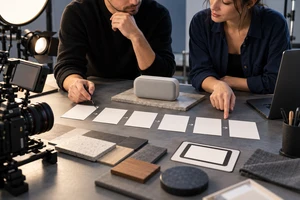
The first is weekly standardized content: new colors, packaging, ports, accessories, simple operating steps and a few vertical clips. Product dimensions are predictable, the background stays consistent, and the priority is clarity, continuity and a fast path to publication. This stream benefits from a tabletop, background, light positions, camera height, color reference and file workflow that can remain in place.
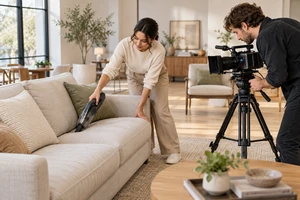
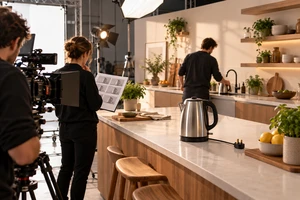
The second is a quarterly international campaign. Talent uses the product in a living room, kitchen or workspace. The production needs wardrobe, art direction, sound, horizontal and vertical framing, and room for camera movement. This is not the first stream with a larger budget; it is a different spatial task. Permanently occupying a meeting room or storage area for four projects a year may be a poor trade. Forcing a small fixed studio to imitate every lifestyle environment can also conceal recurring build, strike and restoration costs.
Shopify's current product photography guidance shows how basic a repeatable still-life station can be: a suitable room, camera, tripod, table, white background and reflector cards. That supports a modest starting point for standardized product photography. It does not mean the company has built a product-video operation. Video adds continuous action, stable lighting, monitoring, sound, data handling and people moving around the set.
An internal studio costs more than the lights you buy
Treat an in-house studio as an operating capability, not a one-time construction project. Start with an annual model:
Annual in-house cost = space + annualized fit-out + people + equipment and maintenance + set refreshes + software and storage + downtime and rework + management opportunity cost
“Annualized” here is only a planning convention for comparing choices. It is not accounting or tax advice; use your organization's approved financial treatment.
| Cost item | What to enter from your own records |
|---|---|
| Space | The real value of using that area instead of office, storage, display or rentable space, plus utilities and property costs |
| Fit-out | Blackout, acoustic treatment, walls and floor, backdrop systems, power, rigging, safety work and eventual restoration, spread over an approved period |
| People | Actual time from camera, lighting, production, props, post-production and studio operations; do not assume marketing staff can absorb the work at zero cost |
| Equipment and maintenance | Cameras, lenses, lights, grip, monitoring, sound, batteries, consumables, repair, firmware and calibration |
| Set refreshes | Furniture, styling, paper rolls, surfaces, paint, cleaning, storage and disposal |
| Software and storage | Tethering, editing, grading, review, backups and long-term asset management |
| Downtime and rework | Samples that are not ready, equipment faults, competing use of the room and approval delays |
| Management opportunity cost | Time invested by product, marketing and engineering teams to operate and schedule the facility |
Then calculate a more useful number than “average cost per video”:
Cost per usable in-house shoot day = annual in-house cost ÷ actual usable shoot days
The denominator is not 365 and it is not every day when the room theoretically exists. Count a day only when the product, people, space and equipment were ready and the session produced a usable delivery. Fixed costs continue while the room is idle. A studio temporarily functioning as a meeting room or warehouse is not also content capacity.
A rented lifestyle studio costs more than its hourly rate
Renting converts part of the fixed burden into project spending; it does not make every other cost disappear. Build the annual model from real quotations:
Annual external cost = project booking fees + access, strike and changeovers + equipment and technicians + transport and handling + art and props + cleaning and restoration + postponement or reshoot allowance + internal coordination time
Published Shenzhen venue and equipment pages may show environments or daily reference rates, but they are not live inventory or a final proposal for your shoot. ONCE's Shenzhen equipment reference catalogue, for example, explicitly separates reference rates from availability, quantities, accessories, deposits, transport, crew, tax and final configuration. Compare an internal and external option against the same shot requirements. Do not compare the room-only cost of the in-house option with the full-production cost of the external one.
Booking a multi-set location such as U-STUDIO in Shenzhen means purchasing access to the white cyclorama, home interiors or technology set needed for a particular project, with equipment and crew scoped separately. The current public page describes an 800 m² base, a 64 m² white cyclorama and several practical environments. Dates, exclusive areas, set changes, equipment and personnel still need project confirmation.
Four gates for deciding whether to build
1. Can the assignment be frozen?
If most annual content uses the same background, similar product dimensions, fixed camera positions and consistent output specifications, an internal station can create genuine repetition. Lighting diagrams, camera height, white balance, product marks and export presets can remain stable while only the SKU changes.
The counterexample is a company that shoots every month but asks for something different every month: earphones on a tabletop in January, a kitchen-appliance demonstration in February, and two actors with a tracking shot in March. High frequency is not the same as standardization. Repeatedly moving furniture, borrowing meeting rooms and rediscovering the light turns the internal studio into an endless set-build project.
2. Can the space stay dedicated?
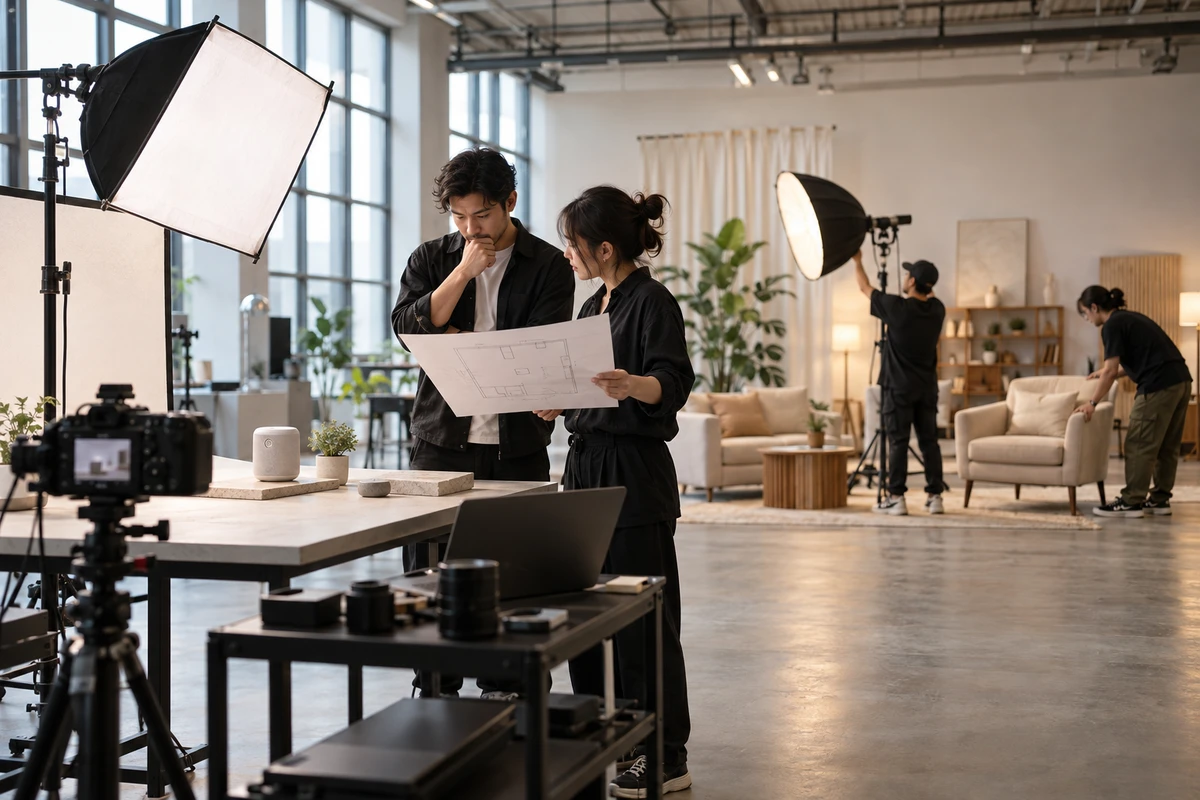
An operational studio needs a product area, camera area, lighting and control area, circulation, samples waiting to shoot, completed samples, packaging, props and a data station. Measuring only the width visible behind the product omits most of the room the production uses.
Draw an occupancy plan before approving construction: the furthest camera position, fully extended stands and flags, people and product access, temporary storage, charging, and data backup. Anything that must be removed every day creates a reset cost that belongs in the internal model.
3. Is somebody responsible for reproducibility?
Equipment left in a room does not become production capacity on its own. A named owner must maintain lighting records, color references, background condition, equipment status, sample flow, file naming and backups. Engineering confirms functions, marketing approves information, and a camera or content lead remains accountable for images and deliverables.
ARRI's current control and automation overview presents previs, equipment control, monitoring and recallable setups as one production-management problem. A brand does not need a sophisticated networked set, but the principle matters: an internal studio earns its value from recoverable configurations, not from an impressive equipment list. A lighting setup that nobody can restore three weeks later is not a standardized workflow.
4. Do variable assignments have a sensible exit?
An in-house studio does not need to cover every request. A mature internal plan states which jobs must go outside: large builds, multiple performers, complex sound, unusual lighting, long camera paths, several international lifestyle environments or overlapping projects that exceed the internal team's capacity.
Adobe currently positions Firefly in ideation workflows from mood boards to storyboards. That can help an internal team compare directions before committing to a set. It does not transform a limited office room into a shootable living room, kitchen and workspace. Once the concept is approved, the brand still has to choose a physical build, a practical rented location or a properly evaluated hybrid workflow.
Match each model to the right work
| Model | Best fit and prerequisites |
|---|---|
| Fixed in-house station | Frequent white-background images, packaging and accessory updates, simple operation, engineering records and basic vertical clips; stable product sizes, dedicated space and an accountable operator |
| Rented Shenzhen lifestyle studio | Less frequent brand campaigns, lifestyle scenes, performances, larger camera moves and rapid access to multiple environments; purchase the location around each shot list |
| Hybrid | Standard SKUs and quick pickups in-house; brand films, lifestyle sets, talent and complex technical shots externally; both sides share sample, naming, color and approval rules |
The common hybrid failure is operating two unrelated systems. If internal photography uses one color reference and file structure while each external video begins by rediscovering the product, firmware and deliverables, the savings from a small internal studio are lost in handovers.
Keep one shared product-asset card: sample version, color and surface standard, dimensions, accessories, firmware or interface version, correct operation, restricted information, brand color references, naming convention and approver. The card does not belong to either studio. It is the production knowledge that moves between them.
Run a 90-day pilot before building the full room
If the team favors an in-house studio, test a reversible internal area for 90 days. Give it only the two or three most stable assignments. Record preparation, shooting, resets, post-production and approval time for every session. Separately record the assignments sent outside because of space, people or technical limitations.
At the end of the pilot, answer six questions:
- How many usable shoot days were completed, rather than merely scheduled?
- Which camera and light positions were actually reused, and which had to be rebuilt?
- How much storage did samples, packaging, props and equipment consume?
- Who maintained equipment, backgrounds, files and color, and how many hours did that take?
- Which requests still needed talent, practical locations, art direction or external technicians?
- Which consumed more time: internal waiting and rework, or external access and coordination?
If the standardized stream is stable, utilization is real and ownership is clear, expand the facility deliberately. If variable work dominates, keep a lightweight internal station and place campaign production in external environments. Money already spent on a fit-out should not make the next content decision for you.
The final deliverable is a production allocation sheet
This decision is complete only when the next year's work has an owner:
- In-house work: fixed backgrounds, permitted product range, accountable operator, recoverable lighting and delivery specifications.
- External work: required settings, people, equipment, dates, set modifications and post-production scope.
- Shared inputs: sample condition, product facts, brand references, naming and one final approver.
- Review point: recalculate quarterly from actual shoot days, rework and changes in setting, not the original forecast.
The previous guide to choosing a Shenzhen studio explains how to match one project to its shots. This article addresses a different decision: how to distribute a year of content across space and fixed cost.
If you are evaluating an internal studio or external lifestyle production in Shenzhen, send ONCE your project pattern: product type, target market, monthly frequency, existing space, sample status, recurring environments, internal team and launch calendar. We can first identify which tasks fit a fixed station and which require a white cyclorama, practical interiors or a complete production, then scope a recce and quotation.
Source note: ONCE's studio and equipment information was checked against its current public pages on October 8, 2026; dates, inventory and quotes remain project-specific. Workflow references include Shopify Help Center, “Taking product photographs”; Adobe's Firefly business workflow page; and ARRI's “Control & Automation” page. The two brand scenarios are decision examples, not reported client projects. The cost model is a procurement tool, not financial, tax, property, fire-safety or on-set safety advice.