Video Production Services in Shenzhen 01/10 · ONCE Guide to Video Production Services in Shenzhen
Suppose your brand needs a product-page video for a handheld cleaning device. Buyers should see the body and attachments, watch it clean a sofa crevice, and understand how someone picks it up and puts it away. Should you book a white studio or a furnished living-room set? You may need both environments, but that does not necessarily mean booking two locations.
When choosing a Shenzhen studio, start by testing the hardest product action on your shot list. Can the sample perform it, can the camera show it clearly, and can the crew repeat it? Those questions should come before deciding whether the decor looks like an overseas home. This guide concerns the main product video on a listing or product page. It does not equate video with a static main image or assume that every platform accepts the same content and specifications.
Where can you start looking in Shenzhen?
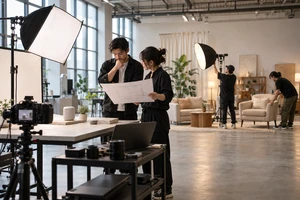
One place with publicly available set information is U-STUDIO, ONCE's Shenzhen studio. Its page, checked on October 8, 2026, describes an 800 m² base at 1/F, Building 17, Longbi Industrial Park, Bantian, Shenzhen. It includes a 64 m² white cyclorama, a future-tech set, a contemporary living room and a sunlit home interior. Views from several directions help you assess product scale, talent movement and camera positions. You can discuss rental for your own crew or a complete ONCE production.
That information narrows the shortlist; it does not confirm conditions for a particular shoot. A kitchen photograph does not establish permission to use water, heat, controlled dirt or animals. Cameras and lights shown on the page are not automatically included in a space-only booking.
For a broader search, Gingyan's “Shenzhen location” directory lists names including Tiancang's Guangming branch, Pengxing and Weihe's Longhua branch. This is a third-party resource directory, not live booking evidence. Confirm the operating business, branch, address and available sets with the actual location provider. Shenzhen Mairun's public rental catalogue separates equipment, lighting and locations, which is also a useful reminder: a room is only one part of the production package.
This is not a ranking of Shenzhen's best studios. A tabletop suitable for earphones may not accommodate a complete appliance demonstration. A photogenic corner may work for a still image but leave no room for a continuous performance. Compare whether each location can support the same shot requirements.
Give each environment a specific job
Asking a studio to quote for “a one-minute video” tells it little about the space you need. Product rotation, a presenter and a practical cleaning demonstration place different demands on a set. Define what the buyer must see first.
| Shot requirement | Space to consider first | Question to settle during the recce |
|---|---|---|
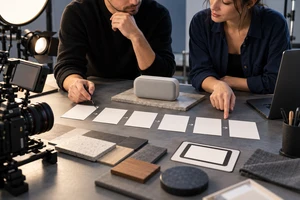
| Product shape, attachments, connections and scale | White studio or controlled tabletop | Can product, camera and lighting fit, with room for each required framing? |
| How and where the product is used | A relevant furnished set | Do furniture scale, working surfaces and movement paths support the complete action? |
| A specific brand look or unusual use environment | Adapt an existing set, or build a custom one if necessary | What can change, who builds and restores it, and when can it be tested? |
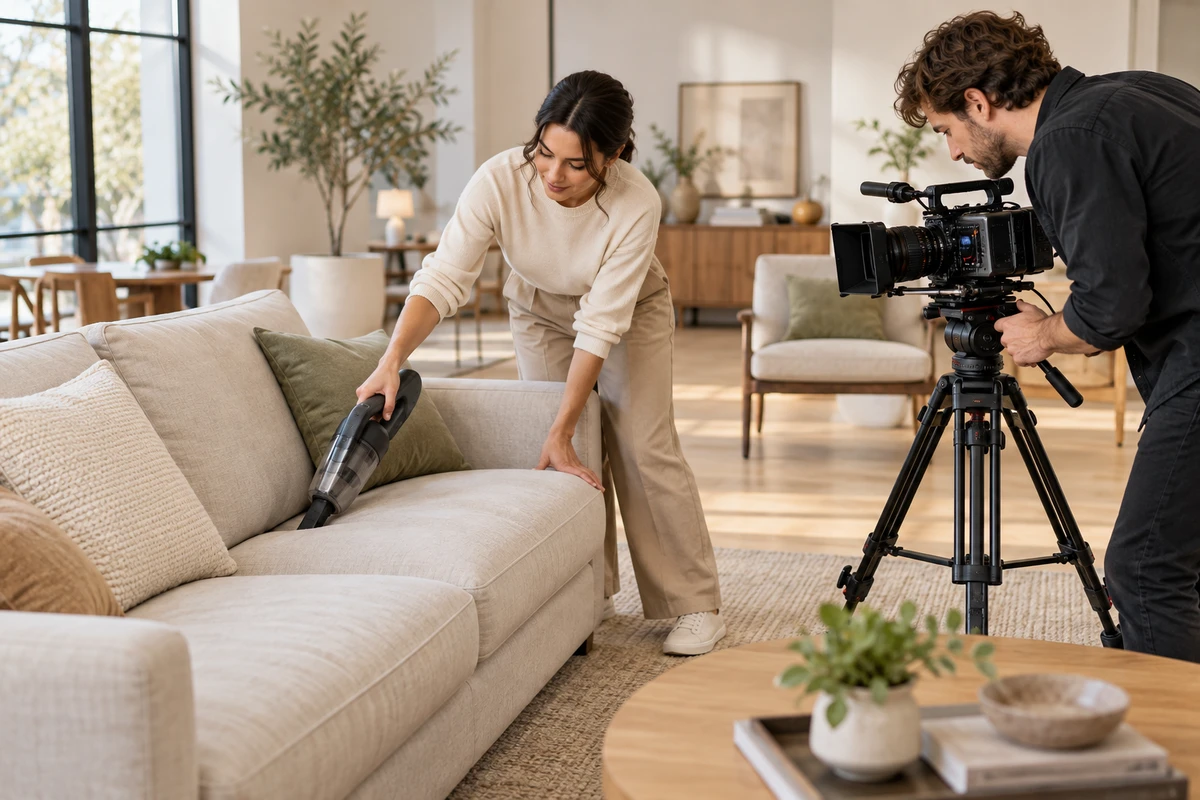
In our hypothetical cleaning-device project, attachment close-ups could be filmed on a tabletop. Cleaning a sofa crevice requires a suitable sofa and a camera position that reveals the action. The storage shot needs a cabinet the actual product fits into. A studio that supports all three may reduce transport and repeated setup across locations. It still takes time to move lights, dress the next set, rehearse and reset. One address does not mean zero changeover time.
If the film only needs appearance shots and simple assembly, a whole lifestyle set may be unnecessary. Controlled tabletop work, considered art direction and testing the critical shots may be a better use of the budget.
Test the difficult action with the location provider and cinematographer
Bring the actual sample where possible. If it is not available, provide dimensions, weight, accessories and a recording of the real operation. Your product lead confirms the action and sample state. The cinematographer checks whether it can be filmed clearly. The location provider confirms the space, facilities and permitted use. These responsibilities are different.
Put the camera in position before judging the decor
Have someone stand where the talent will be and perform the action with the product. Test the camera's starting and ending positions. Does it back into a wall? Would the available space force a wide-angle view that misrepresents the product's proportions? Does an arm obscure the operation? Does the reverse angle reveal objects outside the dressed set?
Ask to see reverse views, entrances and the connections between sets. A promotional photograph often shows one carefully selected angle; video lets people, products and cameras move. Identify where lighting and light-control equipment can stand without assuming that a circulation route is available for a permanent setup. Total floor area cannot settle these questions. A workable shot can.
Check daylight and sound for the intended time
A sunlit set may suit a changing daylight look or make consistent coverage harder. Establish window direction, blackout options, the intended hours and places for supplemental light. Where practical, visit at a similar time to the planned shoot. One attractive daylight photograph is not an all-day lighting plan.
If the film needs speech or genuine operating sounds, record quiet room tone, air conditioning and normal movement separately, then listen through headphones. Music cannot be assumed to cover every disturbance. If the edit does not need location dialogue, make that choice deliberately before filming.
Confirm demonstration conditions with named people
Can controlled dirt be placed on the furniture? Can an appliance use water, drainage or heat? How will power be supplied? Who cleans the set, and how long does it take to restore the same starting state? “Lifestyle studio” does not answer any of these project-specific questions.
The provider confirms permitted activities and facilities. Your product team supplies operating requirements and risk information. The producer incorporates those conditions into the shoot plan. Responsible on-site personnel must assess power, loads, heat and equipment access; counting sockets is not a safety assessment. Remove an unconfirmed high-risk action from the plan until the relevant conditions are resolved.
An international-looking set must fit the actual use
Replacing Chinese books with English ones does not define a target market. Start with the audience and the way the product will be used. Check furniture dimensions, surface heights, storage, plugs, accessories and visible props. A familiar setting should help buyers understand the device. It should not imply that the production took place overseas.
A cleaning device needs a credible relationship between sofa, floor and storage. A decorative fireplace does not establish a usable cleaning path. A small webcam may instead need a meaningful arrangement of desk, screens and the person on camera. The published Logitech MX Brio project page describes that creator-workspace relationship. It can help you think about why a setting belongs in the story; it does not establish that your project can reproduce its location, budget or delivery arrangements.
AI-generated references can help discuss a visual direction, but they cannot validate a physical studio's depth, windows, noise or facilities. For merchants using Google Merchant Center, its “Misrepresentation” policy requires accurate, realistic and truthful representations of products and businesses. This is not a shared rulebook for Amazon or other platforms. The policy was checked on October 8, 2026. The production implication here is to avoid using sets or post-production to change what the product can actually do, while checking the requirements of each intended platform, market and account separately.
Compare booked time and scope before comparing hourly rates
A studio may quote four hours while a production team plans a full day. That does not necessarily make either estimate wrong. The first may cover filming time; the second may allow for unloading, setup, lighting, rehearsal, changeovers and striking the set. Establish when charged time begins and ends.
Ask every shortlisted location to respond to the same scope: sets and exclusive-use areas; access, setup, filming, reset and departure times; permission to move furniture; included lights, accessories and personnel; sample storage and unloading; and how overtime, cleaning, damage, postponement and set changes are handled. The parties should confirm those terms in the booking. This guide does not provide a contractual determination.
Space-only rental fits a client with an established camera, lighting and production team. A brand with product information but no shot list first needs to define the script, sets, art direction, people and post-production. Explore ONCE's ecommerce product video production scope to see how those tasks can enter a project. Still photography, talent and language versions should be agreed separately; sharing a studio does not automatically include them.
Leave the recce with an executable decision
| Confirmation | Responsible party | Completion standard |
|---|---|---|
| Sample state and critical actions | Brand product lead | Identified version, approved operation recording and information cleared for publication |
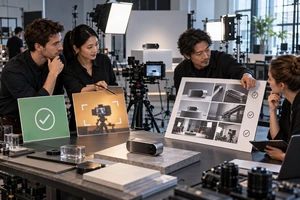
| Framing, camera positions and lighting | Camera and lighting leads | Critical shots tested; remaining gaps have a solution and owner |
| Set and facility use | Location provider | Clear response on sets, permitted activities, limits and hours |
| Time and cost scope | Producer and buyer | Access, changeovers, people, equipment and extras appear in one scope |
| Decision to proceed | Named project approver | No unresolved condition prevents the essential shots |
A missing item does not always disqualify a studio. A replaceable side table may be solved with a prop. A location that cannot accommodate the essential product action may require another set, a revised shot or another space. Judge whether the gap affects what buyers need to understand before deciding how much to spend on it.
This is the practical opportunity of a local Shenzhen recce: sample, product specialist and production team can discuss the same shot in the same space. Proximity does not guarantee that a sample is ready, a person is available or the shoot can finish in one day.
To scope a Shenzhen product shoot, send ONCE your product and location requirements: product link, target markets and placements, intended use, sample location and condition, filming and launch dates, and any script or visual references. Start by deciding which spaces and production support the film needs, then confirm a recce and quotation scope.
Source note: Studio and service information comes from ONCE's U-STUDIO and ecommerce solution pages. Local resource observations come from Gingyan's Shenzhen directory and Shenzhen Mairun's equipment-rental catalogue. Platform context comes from Google Merchant Center Help, “Misrepresentation.” Sources were checked on October 8, 2026. Third-party directories are not live availability records. The cleaning-device example is hypothetical, not a reported client production.