Establish Manual Review Standards for AIGC Commercial Projects
Before launching an AIGC commercial or AI product video project, the brand and production team must jointly confirm the feasibility of manual review for generative shots. The core focus during the initiation phase is to define which visuals require human intervention and the cost boundaries for corrections. If the project’s key selling points rely on absolutely precise product structures, specific physical interaction logic, or strict compliance text, and current generative models cannot stably output these via prompts, the project proposal must explicitly reserve budget for traditional CGI modeling or live-action reshoots. Lacking this preliminary judgment leads to endless regeneration loops later, causing scheduleshi kong and budget overruns.
Marketing heads must review the 'AI Controllability Test Report' submitted by the production team. This report should not only showcase the best generation results but must also include failure samples and defect statistics under the same prompts. Only when the usability rate of key shots reaches the agreed threshold through small-sample validation, and the time required for manual repair is lower than pure CGI production, should AIGC production terms be formally signed. For content involving brand asset security, the project documentation must also list a separate copyright screening process to ensure generated materials do not infringe on third-party intellectual property, avoiding takedowns due to legal risks.
Structured Visual Benchmark Materials Required from Brands
AIGC video production has far higher normative requirements for input materials than traditional filming. Brands cannot merely provide flat logo vector graphics or simple product photos on white backgrounds; they must provide structured assets containing three-dimensional spatial information. Specific actions include organizing multi-angle orthographic views of the product, engineering drawings with dimension annotations, material sphere parameter tables, and CMYK and RGB reference values for brand standard colors. These materials serve as physical anchors for later manual review, used to correct common perspective distortions, proportion imbalances, and material errors in AI-generated visuals.
In addition to static assets, brands must prepare a dynamic reference library. This includes high-quality video clips from competitors or cross-industry sources, footage of products used in real environments, and mood boards for lighting atmosphere. Reference materials should be archived by four dimensions—'composition,' 'camera movement,' 'lighting effects,' and 'texture'—rather than mixed in a single folder. Production teams can significantly improve the stability of generated visuals by establishing ControlNet or IP-Adapter control weights based on these categorized materials. If the brand cannot provide the above materials, the production team should pause generation and arrange for product scanning or real-world sampling first; otherwise, all subsequent manual reviews will lose objective comparison standards and devolve into purely subjective aesthetic negotiations.
Manual Intervention Points and Execution Standards for Generated Shots
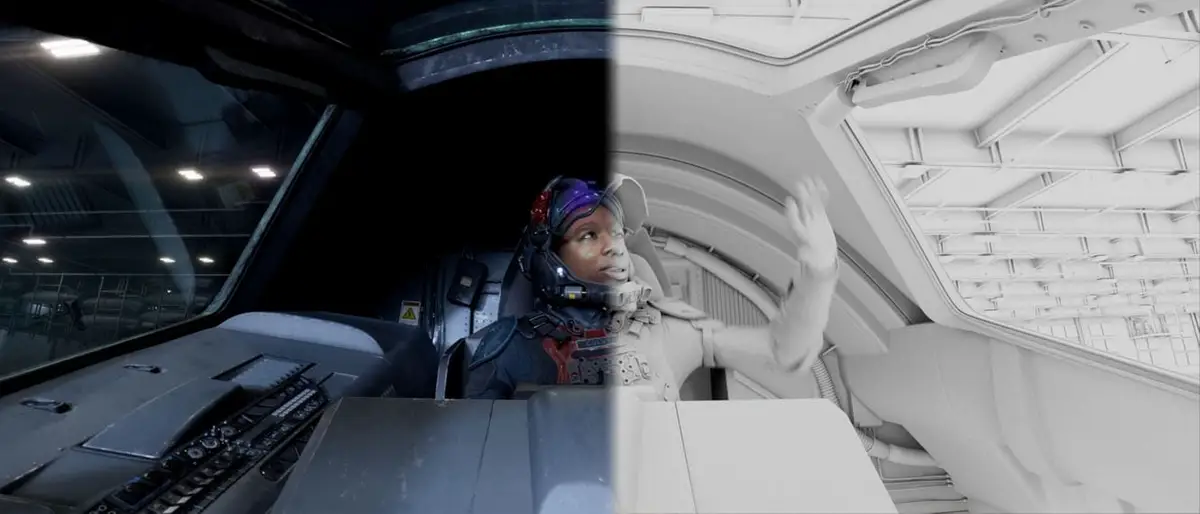
In the AIGC commercial production flow, manual review focuses on a correction mechanism that runs through the entire process. At the execution level, the generation process should be broken down into three independent acceptance nodes: 'rough generation,' 'refinement,' and 'compositing.' During the rough generation phase, AI operators select basic materials that align with the script intent; here, manual review focuses on narrative coherence and character consistency, ignoring minor details. In the refinement phase, digital matte painters or 3D artists intervene, using inpainting tools to fix high-error areas such as fingers, text, and logos, and unifying lighting logic across multiple shots. Deliverables for this stage must be layered files, not merged video frames, to facilitate subsequent adjustments.
The compositing phase involves matching AI-generated layers with live-action footage and traditional CGI elements. Cinematographers and colorists must check at this node whether the noise structure, dynamic range, and color science of the AI visuals are compatible with the live-action footage. If the lighting direction in the AI-generated visuals contradicts the live-action scene, or if motion blur does not conform to physical laws, the work must return to the previous stage for redoing; forcibly masking issues with post-production effects is strictly prohibited. The execution team should establish version naming conventions, recording parameters and reasons for each manual modification to prevent breaks in repair logic due to personnel changes. Any AI shot that has not undergone layered verification must not enter the editing timeline; this is the baseline principle for ensuring the security of commercial deliveries.
Multi-Dimensional Acceptance Checklist and Delivery Verification Points
Acceptance of AIGC video projects cannot rely solely on subjective descriptions like 'does it feel similar' or 'does it look good'; it must verify items against preset technical indicators. The acceptance checklist should include the following core items: whether the deviation between product appearance and official drawings is within allowable limits; whether brand identifiers and packaging text are clearly legible and free of spelling errors; whether human limb structures and facial expressions conform to anatomical common sense; whether subject features remain consistent across consecutive shots; whether resolution and frame rate meet the latest specifications of publishing platforms; whether audio waveforms synchronize with lip movements; and whether authorization documentation for generated materials is complete.
In addition to the final video, the delivery phase must include a package of source process files. The source file package should contain uncompressed image sequences, layered project files, model version numbers used, seed numbers, and prompt documents. These materials are necessary credentials for future version iterations, partial replacements, or copyright audits. If the producer refuses or fails to provide editable source files, the brand should consider the delivery incomplete. Meanwhile, both parties must sign the acceptance form to confirm copyright ownership and usage scope of the AI-generated content, clarifying whether the video is limited to the current marketing campaign or can be used for long-term omnichannel distribution, to avoid subsequent legal disputes.
Applicable Boundaries and Risk Warnings for AIGC Video Production
Although AIGC technology offers advantages in visual expressiveness, not all commercial video projects are suitable for this workflow. When the core project requirement is to display the internal structure of precision machinery, medical surgical operation standards, or food safety inspection processes, AI-generated 'plausible but inaccurate' visuals actually constitute a risk of false advertising. Such content must adhere to live-action shooting or high-precision industrial simulation. Similarly, for narrative commercials requiring extensive synchronous human dialogue, complex multi-person interactions, or specific actor performances, the current cost of AI technology for lip-syncing and micro-expression control often exceeds that of directly hiring actors for filming; forcing the use of AIGC not only fails to reduce costs but also sacrifices performance quality.
Brands must also remain vigilant against compliance risks brought by changing platform policies. Major social media and ad delivery platforms frequently update labeling requirements for AI-generated content; a posting method compliant yesterday may face throttling or bans today. During the project planning phase, assign dedicated personnel to review the latest creator guidelines of target delivery platforms and reserve space for AI labels in the final video. If the project cycle is long, develop a backup plan to quickly switch to traditional production modes if the AI route is blocked. Ignoring applicable boundaries and the external regulatory environment is the primary cause of failed AIGC commercial projects.
Shifting Mindset from Single Cases to Universal Methods
Excellent AIGC cases in the industry often showcase a perfect blend of technology and art, but brands must strip away the specific creative context when drawing lessons. The visual style, narrative pace, or technical combinations in studied cases were born to solve unique communication problems for those specific cases; directly applying them to your own products easily leads to incompatibility. The correct approach is to analyze the decision-making logic behind the cases: why did they choose AI for this shot but live-action for that one? How did they handle conflicts between generated visuals and brand tonality? What fault-tolerance mechanisms did they set up to cope with technical uncertainty?
Treat cases as an 'index of problem-solving solutions' rather than 'templates for visual style.' In internal workshops, prohibit using case screenshots directly as acceptance standards; instead, translate them into specific technical parameters and execution actions. For example, seeing smooth object morphing transitions in a case should not lead to demanding the production team 'make one just like it,' but rather asking about the ControlNet types, frame interpolation algorithms, and number of keyframes requiring manual repair needed to achieve that effect. This mindset shift helps teams move from mimicking appearances to mastering essentials, building their own AIGC video production knowledge system for the brand, rather than forever relying on external cases for inspiration.
Prudent Next Steps Based on Business Status
If your company is evaluating the feasibility of AIGC commercials or AI product videos, we recommend starting with small-scale pilots in non-core business scenarios. You can choose social media short videos, internal training materials, or concept preview reels as test objects to accumulate the team's mastery of generation tools and experience in manual review. In pilot projects, focus on running through the complete collaboration workflow from 'material preparation - generation - review - delivery,' identifying shortcomings in your company's existing asset library and work habits. Once stable quality standards and acceptance norms are established internally, gradually apply AIGC to high-sensitivity projects such as brand promotional videos or TVCs.
ONCE’s publicly listed services cover corporate promotional videos, brand promotional videos, TVC commercials, product videos, overseas marketing videos, social media short videos, and AIGC video production. We recommend that brands organize their needs and asset status according to the checklist described in this article before contacting the production team. Clear input is the prerequisite for efficient output; regardless of the final technical solution chosen, solid preliminary preparation is the cornerstone of successful commercial video project delivery. Please rationally assess the applicability of AIGC technology based on actual business goals, letting technology serve brand growth rather than creating new communication barriers for the sake of using technology.
If you are preparing an AIGC commercial project, you can first organize the brief, reference images, product or corporate materials, delivery platforms, and copyright scope, then view theAIGC Video Services Page, to ground communication from abstract preferences into executable production boundaries.