The focus of the interview is gathering business evidence.
Interview segments in corporate videos often fall into two extremes. One is the person standing in front of the camera reciting the company profile; the other is improvising with zero information value. A truly valuable interview should have the interviewee state verifiable business facts, such as specific processes, client scenarios, delivery standards, and internal collaboration methods. The key to this content is that they are promises the audience can verify in subsequent cooperation.
Distinguish the interview's purpose at the project initiation stage. If the video is for brand building, the interview focuses on vision and values. If it is for sales support or investor roadshows, the interview must include verifiable business details. The same interviewee will express themselves completely differently depending on the purpose. Only when the brand clearly states its communication goals in the brief can the production team design the interview outline.
To judge whether an interview plan is qualified, look at three points. First, do the interview questions point to specific events or data, rather than abstract adjectives. Second, does the interviewee have the authority to discuss these contents, to avoid unauthorized commitments. Third, can the interview content complement other visuals in the final cut, rather than repeating information already stated in the voiceover.
Confirm business boundaries before determining interviewees
For corporate promotional video interviews, the key is to see who holds verifiable business information. A technical lead can discuss testing standards in product R&D, a delivery manager can discuss project scheduling and acceptance processes, and frontline employees can discuss details in daily operations. This content is more persuasive than executives saying "we pursue excellence."
The brand should prepare a list of interviewees, with each person's business scope, discussable topics, and off-limit content attached. For example, a finance lead can discuss cost control, but cannot disclose unpublished financial data. The production team designs a question list based on the roster and communicates with each interviewee in advance to confirm which questions they can answer and which they cannot.
The risk is that interviewees change their statements on the spot or refuse to answer. The countermeasure is to prepare backup interviewees or conduct a pre-interview before filming. The pre-interview does not require filming, only audio recording or notes, with the aim of familiarizing the interviewee with the questions and allowing the production team to judge whether their expression is clear. If the pre-interview reveals empty content, promptly replace the candidate or adjust the direction of the questions.
An exception is when the interviewee is subject to NDAs or competitor information; even if the content is highly valuable, they cannot be forced to answer. The production team should specify in the contract who holds the final review rights for the interview content, to avoid rework later due to sensitive content.
Interview outlines should be designed to elicit verifiable answers
The interview outline focuses on a script that guides the interviewee to state specific facts. Good questions should prompt the interviewee to recall a project, describe a procedure, or explain a standard. For example, do not ask "how is your quality," but rather "during the last client acceptance, which test items did you pass?"
When designing questions, use guiding phrases such as "please give an example," "specifically," and "how was it handled at the time." When the interviewee responds, the production team should follow up on details, such as "how long did this process take," "what was the client feedback," and "what decision did you make at the time." These follow-ups can draw out verifiable business content.
The brand should provide business materials as question sources, such as product spec sheets, service process documents, desensitized client cases, and internal training materials. The production team extracts key points from these and designs them into questions. If materials are insufficient, the production team can request the brand to arrange a business interview to understand the real workflow.
The standard for judging an outline is that each question allows the interviewee to state at least one fact, not an adjective. If the interviewee can only answer "we are very professional," it means the question design failed. The way to revise is to narrow the question to a specific scenario, such as "How did you handle a customer complaint the last time?"
Control variables on set to ensure usable footage.
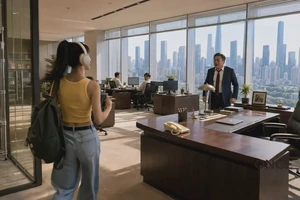
On-site conditions during the interview shoot directly affect footage quality. Lighting, sound, background, and composition must be confirmed in advance. Choose a background related to the business, such as a production line, laboratory, or office, but make sure the background is not too cluttered, otherwise the audience's attention will be distracted.
Audio recording is the lifeline of the interview. Use a professional lavalier or shotgun microphone, and prepare backup equipment. Test all audio channels before shooting, and check for electrical noise or ambient noise. If there is air conditioning or traffic noise on site, deal with it in advance or change locations. Post-production cannot fix completely damaged audio; it can only be re-recorded.
Use a dual-camera setup or a single camera plus a recorder during the shoot to ensure at least one clear audio track. The interviewee should look at the interviewer, not the lens, so it feels more like a conversation than a speech. The interviewer sits next to the camera and maintains natural communication with the interviewee, avoiding a scripted feel.
The risk is that the interviewee is nervous or forgets their lines. The countermeasure is to do relaxation exercises before shooting, chatting about daily topics for a few minutes first. During the interview, if an answer deviates from the topic, the interviewer should gently bring it back to the question rather than interrupting. Keep each answer as complete as possible to facilitate post-editing.
Post-production editing must preserve the integrity of business evidence.
When editing interview footage, you cannot only keep the most brilliant clips; you must also ensure the integrity of business evidence. For example, if the interviewee mentions "we pass through three inspections," the footage should be able to show the inspection process, or use subtitles to label the inspection items. If only a slogan is left, the audience cannot verify it.
The editor should build a footage index, tagging the business topic corresponding to each interview segment. This allows you to quickly find the needed clips later, avoiding the omission of key information. At the same time, when editing, preserve the interviewee's tone and pauses; do not over-compress, or it will seem unnatural.
Subtitles and graphic labels are important means to enhance verifiability. When the interviewee mentions specific numbers, processes, or standards, label them with subtitles or animations. For example, "48-hour response," "ISO 9001 certification," "customer repurchase rate." These labels allow the audience to intuitively see the business facts.
Color grading and sound processing must be unified. The color tones of the interview footage, B-roll, and actual footage must be coordinated to avoid abrupt interview segments. Sound clarity must be ensured, and background music volume must not overpower the voiceover. Subtitle fonts and sizes must meet platform requirements, and all subtitles must be error-free.
During acceptance, verify the authenticity of the interview content item by item.
Before delivering the corporate promotional video, the brand must verify the authenticity of the interview content. Check whether the business facts stated by each interviewee are accurate, exaggerated, or misleading. For example, if an interviewee says, "We have served 500 clients," the brand must confirm whether this number can be made public and whether there is supporting documentation.
The acceptance checklist includes the following items. Whether the interview footage is clear and the audio is clean. Whether subtitles match the speech and labels are accurate. Whether interviewees agree with the content in the final cut and if there are segments to be removed. Whether all business evidence has been internally reviewed to avoid leaking sensitive information.
The brand must designate a business lead to review the video alongside the production team. This person is familiar with the business and can judge whether the interview content is factual. If errors are found, they must be corrected before final delivery, not after going live.
Upon delivery, the production team must provide the raw interview footage, editing project files, subtitle files, master, and all versions. These files are for subsequent edits or re-editing. The brand must confirm the scope of copyright, including the rights to use, modify, and publish the interview footage across platforms.
Identify situations where interviews are not applicable in advance.
Not all corporate promotional videos are suitable for interviews. If the communication goal is simply to showcase the product appearance or brand vibe, interviews may seem redundant. For example, product commercials or social media short videos are fast-paced and information-dense; interviews would slow down the pace.
If the company lacks suitable interviewees, or the interviewees have poor communication skills, forcing an interview will lower the final video's quality. In this case, voiceovers or subtitles can be used as alternatives, or animations can be used to demonstrate business logic. The brand must honestly assess its team's communication skills and not sacrifice content for form.
If the business content involves highly classified information that cannot be discussed in a public video, the interview content will be limited. In this case, only process footage can be shot and explained with a voiceover, without featuring specific individuals. Alternatively, anonymous interviews can be used, but audience trust must be considered.
Budget and timeline are also determining factors. Interview shoots require extra time and equipment. If the project timeline is extremely short, pre-interviews and multiple shoots may not be possible. In this case, adjust the plan by reducing interview segments or using existing footage.
Next, we recommend starting with a business review.
When preparing a corporate promotional video interview project, don't rush to contact the production team. First, sort out what content in your business can be made public and what must remain confidential. Then list potential interviewees and prepare a business information package. This package includes product descriptions, service processes, client cases, internal standards, etc.
When communicating with the production team, clarify the proportion of interviews in the final video and the level of verification the interview content needs to achieve. Both parties should co-design the interview outline and arrange a pre-interview. Pre-interviews can reveal many issues, such as unclear expression from interviewees, inaccurate content, or insufficient permissions. Solving these in advance can avoid rework later.
During shooting and post-production, maintain close communication with the production team. At each review, focus on the accuracy of the business evidence, not just the visual aesthetics. Upon final delivery, ensure all footage and files are complete and retain the right to make revisions.
Interviews are not the only format for promotional videos, but used well, they can make the content more persuasive. The key is to have interviewees speak about verifiable business practices, not empty words. Achieve this, and your corporate promotional video will stand out among similar content.
If you are preparing a corporate promotional video project, you can first organize the Brief, reference visuals, product or company materials, delivery platforms, and copyright scope, then check thecorporate promotional video service pageto move the conversation from abstract preferences to executable production boundaries.