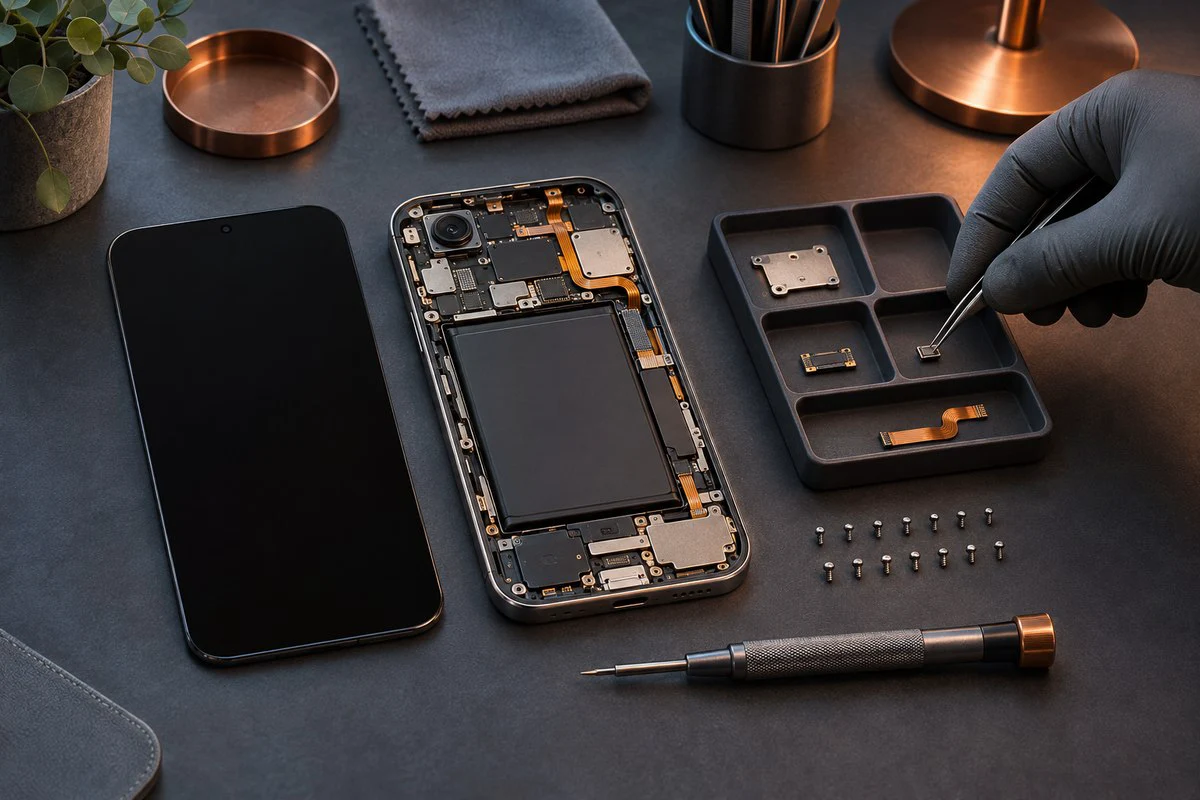
Your supplier in China has offered to film a full teardown before the next shipment. Your European support lead would rather have a way to tell two nearly identical units apart before a technician opens one. That difference should shape the purchase order. A teardown can look complete and still be useless if it follows the wrong hardware revision.
Start with access and audience
The European Commission’s guide to the Directive on repair of goods says Directive (EU) 2024/1799 was adopted on June 13, 2024, with national rules to apply from July 31, 2026. The repair obligation concerns products listed in Annex II that are subject to EU reparability requirements. For smartphones, Commission Regulation (EU) 2023/1670 also sets conditions for professional repairers’ access to repair and maintenance information for specified parts, starting June 20, 2025 or one month after placement on the market, whichever is later. These provisions do not establish a general requirement to film repairs. Confirm the rules for the model and destination before deciding which materials are public and which belong in a professional repair channel.
Write the brief around the point of failure
The ONCE service brief starts with three fields: who performs the task, what they might get wrong, and what they need to see to avoid it. If customers order the wrong accessory, give them a searchable compatibility table. If they already have the right accessory and struggle to orient it, commission a short view that shows the orientation and the finished state. Publish only procedures cleared for that audience, with an obvious route to support when they should stop.
For technicians, ask the factory to demonstrate the decision the technician cannot infer from a wide teardown shot. Imagine two hardware revisions with similar housings and different connector assemblies. Film the approved cues for identifying each revision, then capture the relevant step separately on each verified production unit. Keep the approved service procedure, tool requirements and safety conditions alongside the footage. Put part numbers and compatibility lists in editable text so a sourcing change does not force you to re-edit otherwise usable footage.
Make the clip replaceable before you buy the library
Commission one job from the support queue. Ask for the clip, its model and hardware revision, its intended audience, the procedure revision and an engineering approver. Pay for capture and verification as distinct deliverables, with a price for replacing one affected clip. Have a technician who was not on set find the correct instructions and carry out the task on the matching unit. Treat that as an acceptance test, then use support and rework records to decide what deserves a second shoot. For related planning, see ONCE’s guide to separating a video purchase from a page fix.