A loop ending is often treated as a short-video editing trick: hide the seam between the last frame and the first so viewers do not immediately notice the replay. For brand content, however, the useful goal is larger. A strong loop lets a product action, a use moment, or a sound gain new meaning on the second viewing. The ending explains the opening, and the opening pulls the viewer back into the idea. A weak loop simply cuts off brand information, product causality, and the next action.
Loops suit repeatable experiences, not every ending
The most natural loop subjects already contain a cycle: liquid entering a glass, a dial returning to its starting point, a light moving from dark to bright and back again, a person crossing the same position, or a product state that visually echoes its beginning. A viewer who enters during the second pass can still understand the action quickly.
A video carrying full pricing, a legal qualification, installation steps, or a strong call to action may need a definite endpoint. The viewer has to know that the information is complete and decide what to do next. The first question in brand short-video production is therefore not “How do we make this seamless?” It is “Does the meaning of this video allow it to return to the beginning?”
Design the seam before writing outward
A conventional script moves from shot one to the final shot. A loop script works better when the seam is chosen first. The seam is not an effect. It is a state shared by both ends: the same product position, a related hand pose, motion traveling in one direction, continuous room tone, or a sentence that only becomes complete across two plays.
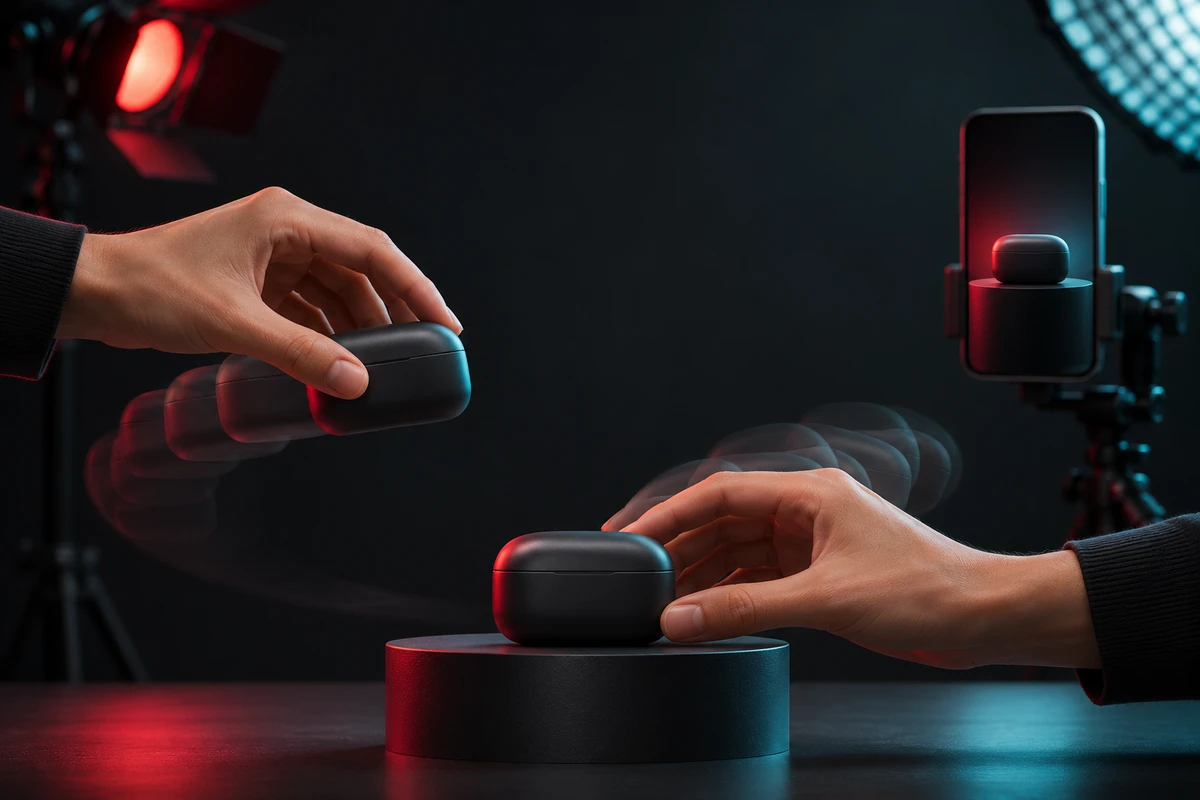
For example, the opening might show an empty glass pushed into frame. The ending can send a used glass out along the same path. If the product action itself is irreversible, do not force a reverse shot. A second prop with the same composition can close the structure without falsifying the product behavior. Once the seam is believable, the middle can answer why the story returns there.
Three loop structures solve different problems
Continuous action: make the ending the first half-beat of the opening
Continuous action works with rotation, sliding, camera passes, opening and closing, and fluid movement. Record more than the standard start and finish. Extra motion before and after the planned action gives the editor room to match direction, speed, and frame position. Adobe's explanation of match-on-action editing makes the same continuity point: the second shot needs to continue the movement of the first so the viewer remains grounded in time and space.
Graphic matching: replace the subject while preserving the visual skeleton
When physical action cannot continue, the ending and opening can share a composition. A circular dial can cut to the mouth of a glass. A block of package color can cut to an object with the same color in the next environment. The product landing in one frame can occupy the position where a hand enters in the first. This approach does not pretend there was no edit; it keeps the viewer's eye searching in the same region. The more complex the frame, the more useful one stable visual anchor becomes.
Audio seams: let the ear believe the loop first
A perfect visual match still feels broken when the sound stops abruptly. Room tone, a musical beat, or a product sound can carry through the seam. The final button click can become the cause of the opening movement. A voice-over can ask a question at the end and deliver its first word at the beginning. These choices belong in the script and sound plan. Adding a long reverb later usually masks detail rather than repairing the structure.
Product logic must remain true inside the loop
Seamless does not mean facts can run backward. A seal is torn once, consumables decrease, ingredients are cut, and dirt is removed. Reversing these actions only to restore the opening state may make the product appear to regenerate itself or turn cleaning, absorption, charging, or preparation into an instantaneous result.
A better solution changes samples, changes viewpoint, or brings in another matching object while preserving cause and effect. If the video refers to time, durability, capacity, or performance, repeated playback must not imply unlimited operation. The media can loop; the product claim still has to remain within real conditions.
Brand recognition does not have to wait for an end card
A static logo inserted at the last moment will expose the seam when the video jumps back into motion. Removing branding entirely creates the opposite problem: the viewer remembers an attractive action but not who made it. A loop can place brand recognition inside the action. Show the package face before and after the key movement, use a brand color as the shared visual anchor, or synchronize a short sonic identity with the seam.
This is a different job from a conventional end card. An end card supports dwell time and a call to action; a loop supports re-entry into the content. A conversion-led version can keep a dedicated ending, while an organic social version distributes brand cues through the movement. The shoot should capture both options instead of forcing every channel to use one master ending.
Capture more material around the seam
Many loops feel one beat short because the set recorded only the middle of the action. Give the product, performer, and camera repeatable references: mark product position, log action direction and speed, hold focus, exposure, and white balance, and avoid changing perspective between the two ends without a narrative reason.
For every candidate seam, record the full action plus lead-in and follow-through. Capture a clean plate and continuous room tone. If vertical delivery will be cropped from a landscape master, keep the visual anchor inside the 9:16 safe area. An object near the edge of a 16:9 frame may disappear in the vertical crop, taking the loop relationship with it.
Edit the opening after the ending on the timeline
Scrubbing backward and forward over one cut does not reproduce the viewing experience. Duplicate the first two or three seconds after the ending and play the sequence for three to five cycles. Watch for a speed change, a lighting jump, or a sound discontinuity that repeats in the same place. The viewer experiences “ending plus the next opening,” so the review timeline should contain exactly that relationship.
Align direction, subject position, and speed before reaching for a dissolve. Many seams are cleaner with a hard cut; a dissolve can create double edges that expose the edit. A short audio crossfade can preserve room tone, but the product's feedback sound should remain distinct rather than being smoothed away.
Do not treat replay count as proof of creative success
TikTok once highlighted the “Perfect Loop” as a creator trend, showing that the loop itself can become a visible creative form. YouTube changed Shorts view counting on March 31, 2025: a view is counted when a Short starts to play or replay, with no minimum watch time, while the previous metric remains available as Engaged views. The distinction matters for brands. Replay volume and deliberate attention are not the same signal.
Test at least three separate outcomes. Can viewers understand the product value on the first pass? Does the second pass add information or emotion? Can viewers recognize the brand without a conventional end card? If replay count rises while product understanding and brand recognition fall, the loop has produced an attractive metric rather than useful communication.
Make the second viewing reveal something new
The strongest loop has a reason to be watched again. A strange sound at the opening receives its cause at the ending. An empty space in the first frame is filled at the last. A hand entering the frame appears to start the demonstration, but on the second pass it also completes the previous cycle. The loop becomes a narrative structure instead of a hidden edit.
If you are planning content for TikTok, Instagram Reels, YouTube Shorts, or owned social channels, ONCE can connect short-form content planning, product video production, and creative consultation in one opening-and-ending capture plan. Send the product action, target channels, and brand information that must remain visible. We will first decide whether looping actually serves the idea, then design the seam and two interchangeable ending options.
Sources: TikTok Newsroom, Loops, pets, and DJ sets: Trending on TikTok; YouTube Help and YouTube Blog guidance on Shorts replay counting and the 2026 Shorts experience; Adobe, What is continuity editing in film. Platform behavior and measurement definitions can change; this article reflects public information available in November 2026.