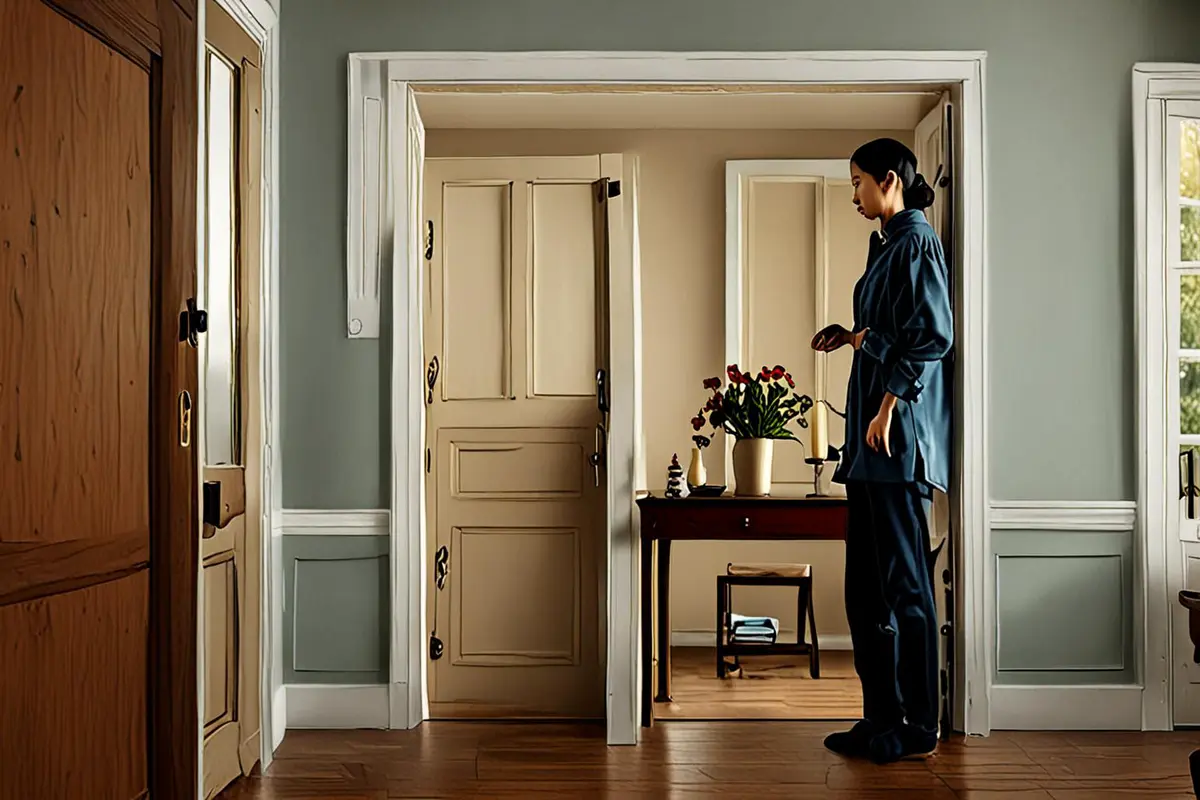
An elevator chime, footsteps in a corridor, or rain striking an awning comes from outside the room. The camera never follows it. If the character stops, reconsiders, and acts, the audience builds the unseen space for itself. In a brand film, offscreen sound becomes useful when an invisible cause changes the person we can see.
That also gives the product a natural role. The character may pause a device, pick up a bag, switch something off, or take the object they had just decided to leave behind. The product does not need a line of explanation. Its value enters the story when it becomes part of what happens after the sound.
Offscreen sound becomes story when it changes the task
Separate two kinds of sound. One is environmental texture: distant traffic can place the room in a city without changing anything. The other is an event: keys outside the door, a short brake sound below the window, or rain that suddenly stops. When the character notices it, the old task is interrupted and a new one begins.
In the script, replace “the character hears something outside” with two actions. What are they doing before the sound, and what do they choose after it? A character may set a product down, recognize familiar footsteps, then pick it up again. The sound is no longer atmospheric decoration. It is the reason a decision happens.
Write the state before the sound, then the state after it
Offscreen sound often fails because the script only says, “the character turns.” Turning proves that the ears received information. It does not show how the person understood it. The useful design work lies in the change of state: does a hand stop, does the breath shift, does the gaze find the door before the product, and does the body approach the source or retreat?
Beat one: attention
The character first leaves the original task. The movement can be small: a finger stops scrolling, a cup never reaches the table, or a zipper pauses halfway. This confirms that the character heard the event too.
Beat two: judgment
The character interprets the sound through lived experience. The same footsteps can mean anticipation to someone expecting a friend and pressure to someone trying to stay quiet. Performance should point the judgment in a direction without explaining the answer immediately.
Beat three: action
The character changes what they are doing. Only then do the person, the product, and the unseen space connect. The action may be to wear, pack, open, or offer something. It can also be a visible choice to do nothing.
Do not let the camera explain the source too quickly
Many storyboards cut to a handle, corridor, or person outside as soon as a sound arrives. The source becomes clear, but the character's judgment is compressed. If the story cares about what the listener will do, hold first on the face, hands, or product and let the audience guess alongside the character.
A wide shot preserves the distance among the character, the door, and the product. A close shot catches the instant an action stops. Cut outside only when that image adds new story information. If it merely proves that someone walked past, an exact reaction can do more. More production thinking about space and coverage is available in ONCE's video production insights, while this article stays focused on character causality.
Distance is more than reduced volume
A closed door, an empty corridor, a carpeted hallway, and a wet courtyard give the same action different character. Do not take one clean footstep and turn it down to imitate “outside.” Decide where the source moves, what surface it crosses, and what separates it from the listener before choosing how much detail remains.
On set, record the room at rest, the door open and closed, a clean version of the outside action, and a reference that actors can use for timing. If postproduction needs to rebuild the moment, the sense of distance can remain continuous. Product foley has another job: it describes contact, material, and use. ONCE's production library covers that wider craft context; the offscreen cue here carries an unseen event into a decision.
Put the product in the cause and effect, not in a forced insert
Cutting to a product close-up immediately after the sound can feel like a reminder from the brand. A more natural approach changes how the character responds. They pause a device when someone knocks. They check what they will carry when the rain grows heavier. They hear a familiar vehicle stop and put the object on the table into a bag.
The product action should fit the character's task and clarify what the product does in life. If removing the product leaves the action entirely unchanged, the placement may only be compositional. ONCE's article on product-triggered character decisions examines a visible trigger; offscreen sound lets that trigger begin beyond the frame.
A repeated cue must change meaning
One sound can return three times, but it should not perform the same function each time. The first occurrence attracts attention, the second reveals a pattern, and the third lets the character act early. Distance, speed, and the state of the space can also change, so the event feels as if it is approaching, leaving, or being understood differently.
If every appearance uses the same file and the actor repeats the same turn, repetition only spends attention. Write the progression into the storyboard and sound notes: when does the audience know more than the character, when does the character recognize the cue first, and when can a product action replace facial explanation?
Keep the shortest causal chain in every aspect ratio
Short edits often remove the outside cue or reaction to reach the product faster. The remaining action then has no reason. The minimum chain contains three elements: sound cue, character response, product result. Each can be brief, but the edit cannot keep only the last step.
A landscape frame can use the distance between a door and a person. A vertical edit relies more on a relay among hands, face, and product. Compress waiting before deleting causality. If a version also has to work without sound, make the action readable on its own and use restrained captioning for an essential cue. Captions should not replace performance or reveal the answer before the character does.
When offscreen sound is the wrong tool
If the central message must register immediately without audio, or if the action already has a clear visual cause, an extra cue may only add explanation. When a film needs to demonstrate the product's real operating sound, a dramatic environment should not cover it for long. Every offscreen cue should serve a specific choice instead of using mystery to hide the absence of an event.
Try two simple removals. Mute the offscreen cue and ask whether the action remains equally logical. Then remove the reaction and ask whether the sound still changes any result. If neither test changes the scene, the cue is still decoration.
If you are developing a brand film with a character, a product, and an interior location, send ONCE the character's task, product action, floor plan, and target versions. Through our brand video and commercial production work, we can test the script, sound rehearsal, coverage, and landscape and vertical edits together, deciding which spaces need to be seen and which become more compelling outside the door.