At the head of the timeline sits a polished two-second animation: the logo arrives, a sound plays, and a tagline resolves. It clearly belongs to the brand. Yet when the same sequence is copied onto every fifteen-second video, viewers must watch the same event before the actual episode begins.
The useful question is not whether two seconds is objectively too long. It is whether those two seconds have already started this episode. If the entire intro can be removed without changing the action, question, or story that follows, it is mostly front-loaded packaging. If the brand cue triggers the first action, establishes the situation, or creates a turn that only makes sense in this particular episode, it is part of the opening.
Branding early does not mean branding alone first
A short-form opening has two jobs that can pull against each other. The viewer needs an immediate reason to stay, while the brand wants to be identifiable before the video is over. The simplest compromise is to play a standard intro and then begin the episode. But that turns two simultaneous needs into a queue: recognize the brand first, receive value second.
Google's official YouTube ABCD playbook recommends branding early, often, and richly through products, in-scene elements, graphics, voice, and sound—not only through a logo card. TikTok's Creative Codes treat the first seconds as the hook and advise that early brand cues should not compromise it. The production implication is straightforward: the brand can arrive early, but it should arrive with the content.
The goal of a fixed video intro should therefore be more ambitious than a beautiful animation that can be pasted onto every edit. A stronger system makes each video recognizable while allowing the episode to begin immediately.
Use the deletion test: what disappears with the intro
Temporarily mute and remove the fixed sequence, then watch from the first remaining frame.
If the video loses a distinctive rhythm, a camera move, or a gesture that brings the product into the action, the intro may contain a brand cue worth preserving. If it only loses the ceremony of “the brand animation is now playing” and the content becomes clearer, the complete sequence does not need to return unchanged.
Then run the inverse test. Watch the intro without the rest of the video. Can you tell what this episode is about? If the only answer is “this is a video from Brand X,” the intro identifies the source but makes no episode-level promise. It can be compressed into a signature or distributed across image, sound, and action.
This differs from a visual motif inside a brand film. A motif gains meaning as a recurring action or composition changes across the story. A short-form opener faces an earlier decision: before the viewer has entered the story, how can brand recognition and the episode's specific problem begin together?
Build a two-layer opener: variable action, limited constants
A durable series does not need a fixed block of timeline. It needs a two-layer opener card for every episode.
The first layer is the content action, and it should change. A product demonstration might open on a jam, a completed result, or an unexpected outcome. A character-led video might begin with an unfinished sentence, a specific choice, or a conflict already in progress. An educational video can show the visible consequence of the problem before announcing the series name.
The second layer is the brand constant. Keep only one or two: perhaps the camera always approaches the workbench at the same speed, the product enters through one recurring gesture, captions share a particular entrance rhythm, or a brief sound is synchronized to an action. The cue matters because it participates in the episode, not because the brand guide lists it.
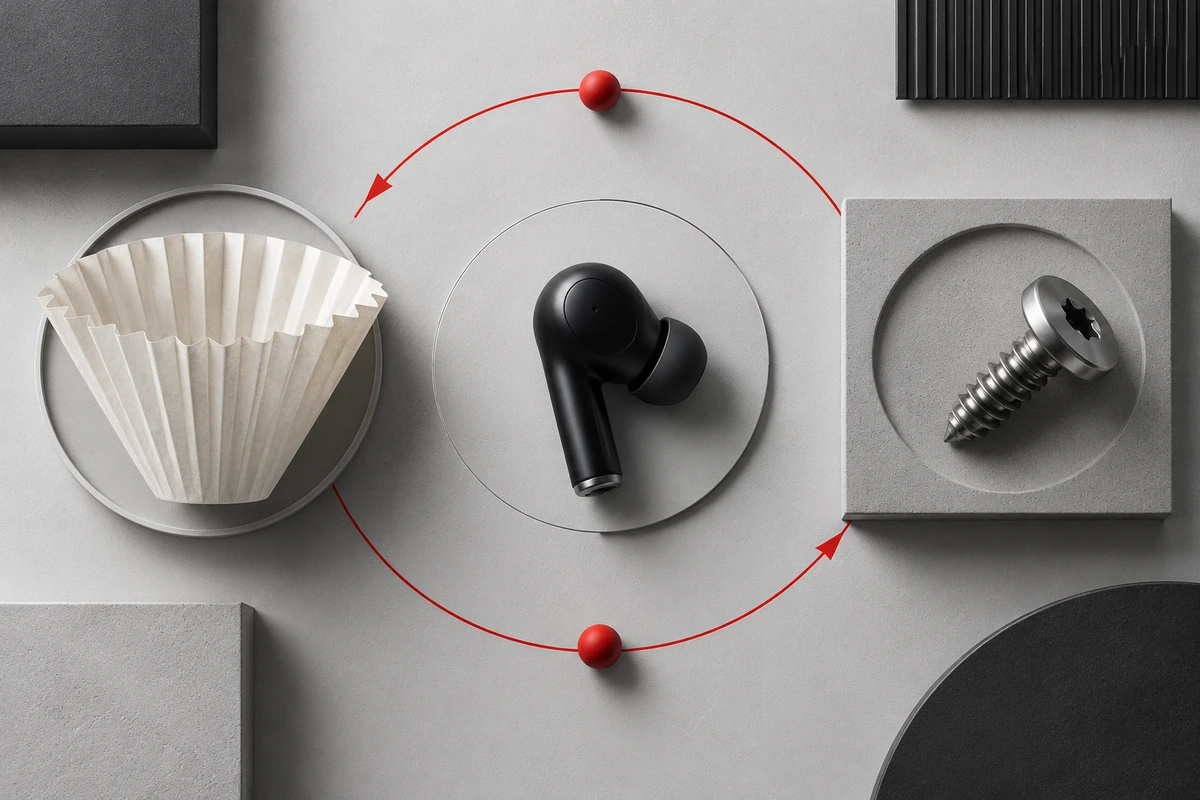
Imagine a series in which every video begins with an object landing on a table. In the coffee-machine episode, it is a scaled filter. In the earbud episode, it is a rain-soaked earbud. In the tool episode, it is a stripped screw. Camera position, action rhythm, and a short sound create recognition; the object and its condition create the episode's problem. Something is already happening when the viewer starts to recognize the brand's way of speaking.
If different products merely land on the same table without producing a new question, state, or consequence, the device becomes another template. A good invariant helps the audience read the change faster; it does not imprison every change inside identical packaging.
Deliver opening rules, not just one intro file
Many series look consistent in their first batch and drift by episode ten. The editors are not necessarily careless. Often they received one rendered intro file, but no motion rules.
A more durable kit specifies where a logo or episode title may appear, how type enters and exits, how the sound signature may be shortened or split, how camera movement accelerates and stops, how the system adapts to vertical safe areas, and what remains when the video is viewed without sound. These are phrases in a visual language, not one recording that must play in full every time.
At script stage, write the first scene in two lines: what the viewer sees first, and how the brand becomes recognizable. During production, leave enough time before and after the opening action and capture both branded and clean versions when practical. In the edit, compare at least three structures: the complete fixed intro, content first followed by a short sting, and brand cues embedded directly in the action.
Do not judge the animation only on a loop. Place it inside the finished short. That is where you can see whether it advances the video or makes the video wait.
Sound can accelerate recognition, but it cannot be the only door
A short mechanical hit, breath, pulse, or melodic fragment can establish familiarity faster than a full-screen logo. Sound can sign the work while the product action continues. But when the video is watched muted, the brand should not disappear with the audio.
Give the same recognition moment a visual counterpart: the rhythm of the product action, the entrance of captions, or a recurring composition. At the same time, avoid loading the first second with a logo, brand color, tagline, sound mark, and catchphrase. When every cue competes, the audience often experiences a busy opening rather than a clear identity.
Generative tools can help teams explore backgrounds, palettes, and compositions quickly. Adobe's current Firefly Custom Models page positions brand consistency and production of variations as core uses. Yet ten openings in the same style do not automatically serve ten different content tasks. A reference system can protect appearance; the script and edit must still decide why the first action happens and how it enters the episode's problem.
A complete title sequence still works when it is part of the show
Some formats earn a fuller intro: long interviews, video podcasts, recurring shows, event replays, or entertainment series whose audience treats the title sequence as part of the ritual. There, the opener can establish the host, guest relationship, chapter structure, tone, or anticipation. Remove it and the viewing experience may genuinely lose an entrance.
Fast product demonstrations, search-led tutorials, urgent updates, ad cutdowns, and very short vertical videos usually have less room for a separate animation. The standard is not “professional brands need intros.” It is whether this sequence supplies recognition, structure, or emotion that the current video actually needs.
A full sequence can also live only in a pilot, quarterly release, or long-form episode. Short cutdowns can preserve one movement, one sound, or one title behavior. The brand system remains coherent without forcing every placement to carry the same opening length.
Read the opening curve, not a universal stopwatch
YouTube's official audience-retention guidance asks creators to inspect video-level retention, dips, and skipped moments, compare similar-length videos, and experiment with different opening styles. Its content-performance guidance also says the initial seconds should deliver on the promise made by the title and thumbnail. Neither document gives every brand one ideal intro duration.
A more useful comparison holds topic, length, and distribution conditions as steady as practical while changing the opening structure. One group uses the current fixed intro. One compresses it into a signature inside the action. One lets the content begin before a brief identifier appears. Study where viewers leave, but also check whether the brand is still identified correctly.
If the same skip or dip repeatedly appears during the branded sequence and retention stabilizes when the content begins, the packaging may be delaying value. If content-first versions hold attention but viewers misidentify the source, strengthen embedded cues rather than simply enlarging the logo.
One upload cannot establish a universal rule. Topic appeal, title and thumbnail, audience source, and paid distribution all affect the opening. Testing is valuable because it reveals which cue the series truly needs and which one persists only from habit.
The best series opener does not make viewers feel that the intro has ended and the video is finally starting. The first frame is already answering this episode's question, and the brand is already there.
If you are planning an ongoing short-form series, product-content program, or mixed live-action and AIGC system, share your current intro, recent edits, and next set of topics with ONCE VISUAL. We can identify the brand constants worth keeping and write them into the first action that genuinely belongs to each new video.