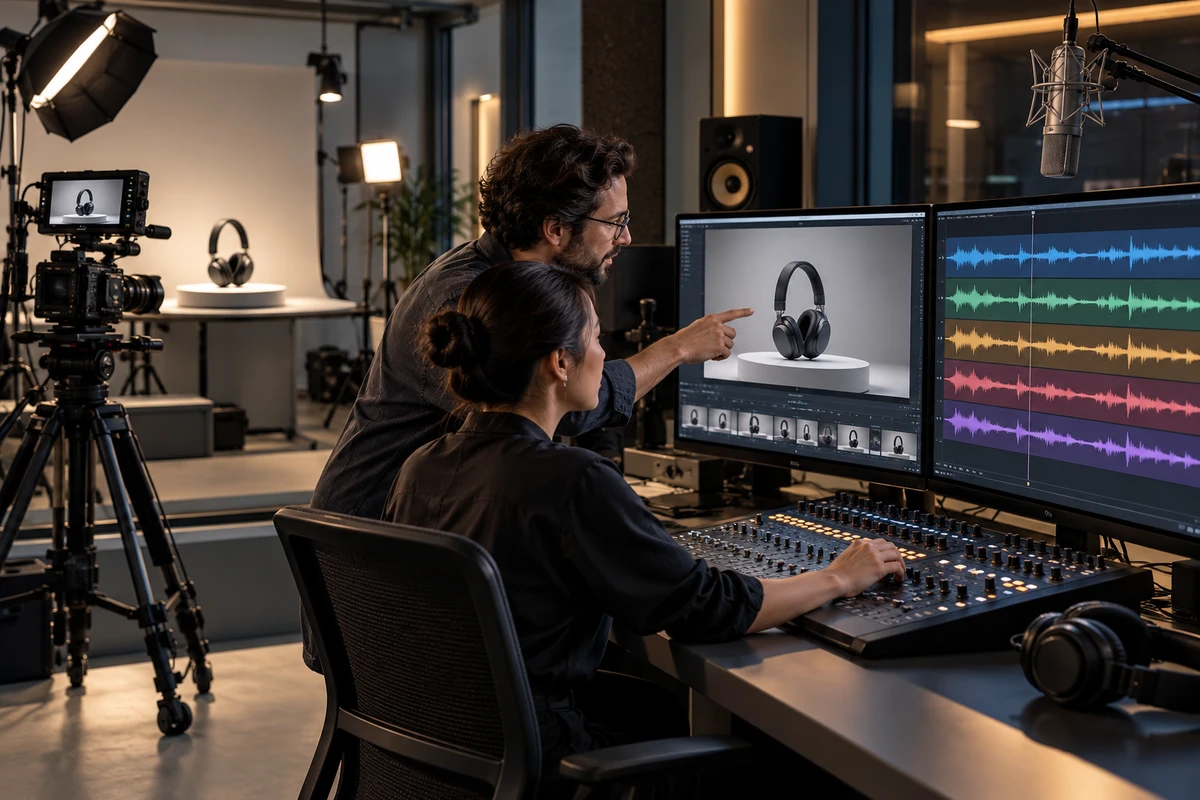
A brand has one English product film and a launch calendar for Spanish, Japanese and Portuguese markets. The old procurement pattern was simple: finish the master, then commission three near-duplicate localized edits. YouTube’s current language stack changes that sequence.
In February 2026, YouTube said auto dubbing was available in 27 languages. The same video can also carry brand-supplied audio tracks, translated titles and descriptions, captions, and—on long-form videos—localized thumbnails. This does not remove localization work. It changes what a brand should buy first: a picture master that can safely accept new languages.
The platform can generate a dub; it cannot approve a brand promise
YouTube’s multi-language feature documentation says creators can attach additional audio tracks to new or existing videos. Viewers can switch tracks, and translated titles and descriptions can help the video surface for searches in those languages. A creator can upload a custom dub, but an existing automatic dub for the same language must be removed first.
That is distribution infrastructure, not a substitute for brand review. YouTube also warns that automatic dubs cannot be edited directly, may vary in quality between languages, and can struggle with proper nouns, jargon, accents, dialects and background noise. A pronunciation error in a casual tutorial may be tolerable. The same error in a model number, warranty statement, dosage instruction or regulated claim may change the meaning of the offer.
The useful procurement question is therefore not “Can AI dub this?” It is “Which parts of this film may be automated without transferring unacceptable risk to the brand?”
ONCE’s three-layer model: master, language, release
Layer 1: commission a separable picture master
A global master should survive a language change without forcing the editor to rebuild the film. The production brief should specify four practical deliverables:
- Separated sound elements: clean dialogue, music, ambience and effects, rather than a single flattened mix.
- Replaceable on-screen copy: product names, prices and calls to action kept as editable layers wherever possible.
- Timing tolerance: a few natural breaths around critical lines, because translations rarely occupy exactly the same duration.
- A clean picture master: no burned-in subtitles, stickers or platform interface elements.
For brands sourcing physical products from China, this layer matters because reshooting a prototype, factory process or product demonstration is usually a different operational problem from replacing an audio track. A modular brief lets the production partner protect the expensive visual evidence while language assets keep changing.
Layer 2: make every language auditable
A localized deliverable should be more than a finished MP4. Ask for a time-coded source transcript, an approved translation, a terminology sheet, pronunciation notes for names and model numbers, subtitle files, isolated voice tracks, and a named approver for each language. When a dub fails, the team can correct one line instead of reopening the entire production.
The source script also affects machine output. Clear sentence boundaries, controlled overlap and explicit subject references are easier to recognize and translate. Brand-critical claims should be marked as locked terminology. The aim is not to drain personality from the script; it is to separate the lines that may be adapted from the lines that must remain exact.
Layer 3: localize the release package
Audio is only one part of the release. The package also includes the correct source-language setting, translated metadata, captions, thumbnail variants, review settings and language-level analytics. YouTube allows localized thumbnails for long-form videos, while translated titles and descriptions can be searched in the viewer’s language.
This is why a multilingual plan cannot stop at voice-over. The viewing promise begins with packaging. A useful extension is to treat each market’s thumbnail as a testable asset, following the same logic as a product-video thumbnail system, rather than burning English copy into one universal image.
Choose auto dub, human dub or reshoot with four variables
Before releasing each market version, score four things: claim risk, performance value, lip dependence and market value.
- Start with auto dubbing for educational content, basic how-to videos, support libraries and lower-risk market tests—provided a person listens before publication.
- Use human review and a professional dub when the script carries product specifications, brand promises, dense terminology, a founder’s voice or a performance that needs consistent character.
- Reshoot locally when direct-to-camera speech dominates, lip movement is central to trust, cultural behavior changes the scene, or local rules require a different spokesperson or wording.
A practical cost model does not need invented industry averages:
Total multilingual cost = master modularity + per-language translation and voice + localized release assets + review cycles + correction exposure.
Auto dubbing can reduce part of the per-language voice cost. It does not eliminate metadata, approval or correction work. If the original production omits stems, clean picture and terminology, every additional language inherits that debt.
Put this delivery list into the production agreement
- Clean picture master plus the final graphic version;
- Separate dialogue, music, ambience and sound-effects stems;
- Time-coded source transcript and approved language scripts;
- Brand terminology, model-number and pronunciation sheet;
- SRT or VTT captions and isolated dubbed audio files;
- Localized titles, descriptions and thumbnails;
- A named reviewer and approval date for every language;
- Channel policy for automatic publishing, manual review or disabling auto dubs;
- A post-release review using watch time, retention and correction logs by audio language.
This turns video production from a collection of finished files into an expandable content system. The better commercial comparison is no longer just price per film. It is the amount of work the brand must repeat when it adds one more language.
What the current evidence does—and does not—prove
YouTube’s official 4 February 2026 announcement reported 27 supported languages and said that, in December 2025, more than six million viewers per day watched at least ten minutes of auto-dubbed content. YouTube’s current auto-dubbing help page describes the quality limits and manual-review controls used in this article.
Those figures establish that the distribution mechanism is operating at scale; they do not prove a revenue lift for every brand or language. The decision still depends on the content’s risk, the target market and the quality of the master. For a global launch, the durable move is to design the master, language assets and release package together—then use automation selectively, where the brand can still review what goes live.