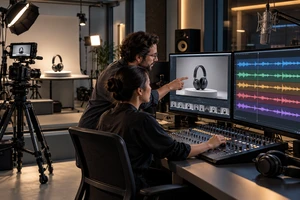
A good product ad can create interest in fifteen seconds. It can also create five unanswered questions just as quickly: Will this fit my device? What is included? How hard is setup? Which model should I choose? What happens if it does not work for me?
On 24 September 2026, Google announced Business Agent for YouTube Ads. Viewers can engage with conversational AI alongside video ads with product feeds and ask questions without leaving the viewing context. The announcement invited advertisers to sign up; it did not establish universal availability, nor did it publish a conversion lift attributable to the feature.
The strategic signal is still clear. A video ad is becoming an entry point to a product conversation. Brands now need to commission not only a persuasive film, but also the product data and visual proof required to answer what the film makes people ask.
One announcement, part of a larger commerce shift
Google had already launched Business Agent on Search for eligible US retailers in January 2026. The company described it as a branded virtual sales associate that retailers could activate and customise in Merchant Center. Google also introduced product-data attributes aimed at conversational shopping, including common product questions, compatible accessories and substitutes.
The official question and answer attribute accepts questions and answers authored by merchants, manufacturers and users. The related product attribute can describe accessories and substitutes. These fields sit alongside the core feed information needed to identify the right item and offer.
For YouTube Ads, however, the September announcement is narrower: conversational AI appears alongside video ads with product feeds. Google has not yet published a complete public description of every source the YouTube experience uses, its market coverage or all eligibility rules. Brands should prepare reliable inputs, then validate the actual behaviour in their own account rather than assuming the Search implementation is identical.
Give the film, feed and answer source different jobs
The wrong response is to force every specification into the edit. The equally risky response is to make a mood film and assume the agent will invent the practical explanation. A useful division of labour is:
- The film creates a reason to care. It shows the problem, the product in use and the value of learning more.
- The product feed identifies the item. It connects the correct model, offer, variant, image and destination to the ad experience.
- The answer source resolves doubt. It supplies current facts about compatibility, dimensions, setup, included parts, policies and model differences.
These inputs should agree without repeating one another. A film can show a folding action. The feed identifies the exact model. A verified answer gives the folded dimensions and the conditions under which the claim is true.
The ONCE Question–Proof–Handoff framework
Before storyboarding an agent-ready product campaign, ONCE recommends a Question–Proof–Handoff sheet. It turns buyer uncertainty into a production plan without turning the hero film into a manual.
Question: what could change the buying decision?
List the questions viewers are most likely to ask after the ad. Prioritise them by decision impact, not by how easy they are to answer. Most fall into five groups: suitability, use, model comparison, what is included, and what happens after purchase.
Bind every question to a SKU and market. A plug, accessory kit, warranty or return answer that is correct in the United States may be wrong in Europe. Similar wording does not make an answer globally reusable.
Proof: what makes the answer trustworthy?
Choose the right proof for each question. Use video when an action, scale or physical relationship needs to be seen. Use structured product data for exact identifiers and changing offer information. Use approved product or service documentation for policies and technical limits. If a claim has no current source, the agent should not be expected to fill the gap.
For example, “works in a small apartment” may need a real spatial reference, a storage sequence and exact dimensions. “Compatible with Model X” requires an authoritative compatibility record; visual resemblance is not enough.
Handoff: what should happen after the answer?
Every answer needs a destination: choose a variant, open installation guidance, add to cart, submit a qualified lead or reach a person. Conversation without a handoff can increase engagement while leaving the purchase decision exactly where it started.
For customised products, high-ticket equipment or B2B sales, the agent should not be forced to close the deal. It can confirm use case, location and key constraints, then pass a better-qualified question to sales.
Shoot an answer library, not a longer commercial
Conversational advertising does not require every answer in the main edit. It does make a broader capture plan more valuable. Add footage for:
- Scale and dimensions: show the product beside a hand, desk, suitcase, room or familiar object.
- Compatibility: record interfaces, installation, required adapters and known exclusions—not only the successful end state.
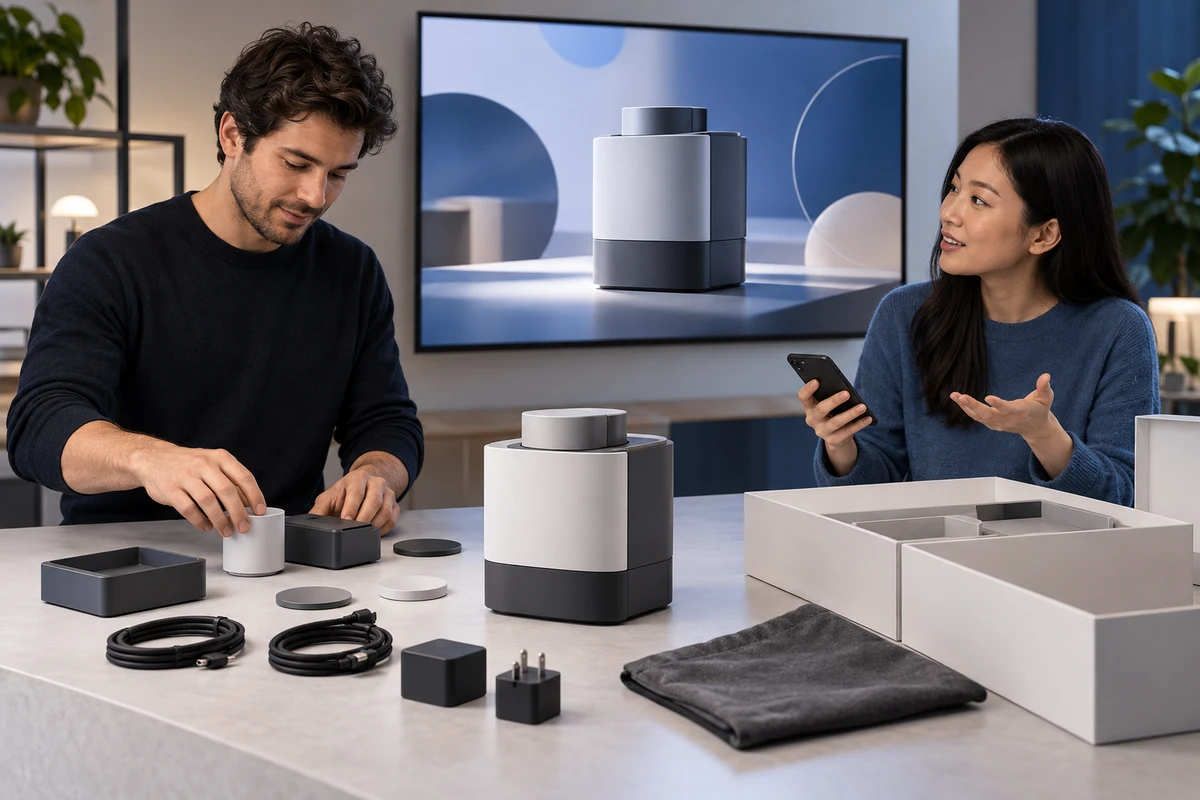
- In-box contents: capture the main unit, cables, accessories and package variations in a clear sequence.
- First use: preserve the continuous steps from opening the box to completing the core task.
- Model comparison: shoot major differences under the same camera, light and action so the comparison is meaningful.
- Limits and exceptions: document conditions that are easy to misunderstand, such as load range, surface compatibility, consumables or protection ratings.
The clips may become short answers, product-page modules, support instructions, sales demonstrations or a later ad version. The production asset is no longer only a finished film. It is a visual evidence library linked to current products.
Change the production deliverables
An agent-ready product-video brief should request five things:
- a hero film plus the required landscape, vertical and square adaptations;
- proof clips organised by priority buyer question;
- SKU, market, capture date and product revision attached to each useful asset;
- an approved Q&A sheet with an owner and source for every answer;
- a handoff map connecting the ad, feed, product page and human support.
This does not make the production company responsible for live price, inventory or return-policy maintenance. Production owns the footage and asset mapping; ecommerce owns the feed; product, legal and service teams own facts; media teams own account configuration and the test.
Budget against answer coverage, not asset count
Do not reshoot the whole catalogue because a platform announced a new feature. Start with one high-value product and rank ten to twenty real buyer questions. Then calculate:
Answer coverage = priority questions with a current, verifiable answer ÷ total priority questions reviewed
A covered question must meet three conditions: it maps to the correct SKU and market, has a source or visual proof, and leads somewhere useful. If coverage is low because data is missing, fix the feed and answer sheet first. If the missing element is visual proof, add it to the shoot. More videos are not the same as more answers.
A wider cost comparison is:
Total readiness cost = hero production + answer-library capture + product-data upkeep + wrong-answer correction
Brands with few variants and stable questions may need only a focused proof shoot. Brands with dense catalogues and frequently changing bundles may gain more from product-data operations than from another cinematic master.
Run a narrow pilot before changing the whole system
Because Business Agent for YouTube Ads is not yet documented as universally available, the first step is to confirm account eligibility. Then use one SKU, an approved product feed, twenty priority questions, one hero film and a small proof library. Track what viewers ask, where answers lack support, and which conversations proceed to a product page, checkout or human handoff.
Chat volume alone is not success. The useful outcome is faster, accurate resolution of purchase questions—and a clearer list of what the brand must reshoot, rewrite or repair in its product data. As video advertising becomes conversational, a production partner creates more value by anticipating the next question, not merely polishing the previous statement.
Sources and limits
This analysis uses Google’s 24 September 2026 Demand Gen announcement; its 11 January 2026 article, New tech and tools for retailers to succeed in an agentic shopping era; official Merchant Center documentation for question_and_answer, related_product and product-data specifications; and official Demand Gen guidance for creative assets with product feeds.
Those sources show Google connecting conversational product questions with ads, Search and structured merchant data. They do not prove universal advertiser access or a fixed conversion improvement. The Question–Proof–Handoff sheet, answer-library deliverables, coverage metric and cost equation are ONCE’s production and procurement framework, not Google requirements.