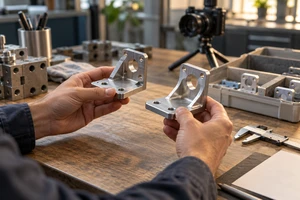
When an action appears three times in a brand film, repetition alone is not the point. The first appearance teaches the audience how to read it. The second changes its circumstances. The third lets it arrive at a new meaning. A strong action motif works like a line of dialogue that keeps returning in revised form: the physical skeleton stays recognizable, while the relationship, resistance, and outcome continue to change.
This is not simply a request for more action coverage. It is a narrative structure. The brand does not have to sit in the center of every frame, but it must be the reason the action can continue, evolve, or reach completion.
Find the Action Skeleton Before the Beautiful Pose
Repeatable actions are usually short and easy to name: hand over, pull open, press, close, turn, catch, lift. The most useful ones share three qualities.
First, the action has a clear direction. A hand moves from left to right, a door opens outward, or an object rises from low to high. The audience can read its start and finish quickly. Second, another person can inherit it. Change the performer or location and the action is still recognizable. Third, the action has a causal relationship with the brand value rather than merely looking elegant.
Imagine a brand film built around “handing something over.” The first time, an employee passes a product to a customer. The second time, the customer passes it to a family member in a different setting. The third time does not need to repeat the product exchange literally. The family member can pass forward the time, ease, or feeling created by the product. What remains in memory is not three extended hands; it is the idea of something moving through a relationship.
A pose that only looks attractive in slow motion and collapses outside one specific camera angle is harder to use as a motif. It may produce a good poster frame without being able to organize the film.
The Second Repetition Must Introduce a Difference
Repetition becomes meaningful because the viewer sees sameness and change at once. If the setting, performance, and outcome remain identical, the second appearance is usually redundant. Keep the action skeleton, then deliberately change one variable.
Change the Person to Rewrite the Relationship
The same handover can mean service between strangers, collaboration between colleagues, or care within a family. The action remains stable while the relationship changes. Casting and performance therefore matter. Where the hand pauses, whether the other person accepts immediately, and whether eye contact comes first can turn a courteous exchange into trust, hesitation, or concession.
Add Resistance to Create Progress
If the first action is effortless, the second can encounter distance, crowding, time pressure, or emotional hesitation. The viewer moves from understanding what the action is to wondering whether it can still be completed. Resistance need not become melodrama. It can be as small as the recipient being occupied, the space narrowing, or a character needing to put something else down first.
Change the Outcome to Land the Brand Meaning
The third repetition can alter the result. Instead of handing over another product, let the action complete a value: returning time to someone, transferring creative control to the user, or passing a helpful act forward. That meaning must grow from what the product or service actually does. A sudden layer of generic emotion at the end will not repair a weak causal link.
Match Cuts Turn Separate Scenes Into One Sentence
Action motifs often connect scenes through match cuts. Adobe describes graphic, action, and audio matches, while a 2022 Netflix Research paper defines match cuts through similar framing, composition, or action. The practical lesson is simple: the transition needs to be designed before the shoot.
If one shot cuts as an arm reaches two-thirds of the way across the frame, the next should enter at a compatible pose and speed. Direction, subject scale, hand and product position, camera height, and motion blur all belong in the storyboard or previsualization. Post-production can adjust timing and framing, but it cannot fully repair a left-to-right movement that suddenly reverses without narrative purpose.
Not every recurrence needs to be seamless. A brief, deliberate pause can signal that the character or situation has changed. What matters is the job of the transition. Is it hiding the cut, crossing time, or comparing two relationships? If the answer is only “to look premium,” the transition is decoration and can be replaced without damaging the idea.
Put the Brand Inside the Causal Chain
A memorable action can still produce a memory with no owner. One common failure is to let the story and motif reach a complete ending, then introduce the product or logo only in the final card. The audience has just finished one act of interpretation and is suddenly asked to begin identifying the advertiser.
Research on event boundaries and commercial communication offers a useful but limited warning. In one published study, strong conceptual closure around the moment of branding was associated with weaker brand linkage, and a re-edit that moved branding earlier performed better in that specific case. The authors also note methodological and commercial-data limitations, so this should not become a universal timing rule. It does support a practical principle: do not reduce the brand to a signature after the story has ended. The full study explains the conditions and limitations.
The brand can enter the action chain earlier. The product can determine why the character hands something over, make the exchange easier, or cause what happens afterward. Packaging geometry can participate in the visual match. Interface feedback can confirm that the handover is complete. A service flow can move the same action from one role to the next. When removing the brand breaks the motif, attribution is stronger than anything a larger end-card logo can provide.
If the film also uses narration, let the voice explain how the meaning is changing instead of describing each shot. Several narrators can carry one proposition, but when action and voice both repeat, at least one of them must move the story forward.
What Live Action, CG, and AIGC Each Control
Live action is strongest at preserving small differences in physical behavior: the pause before acceptance, the moment weight settles into a palm, or the eye moving before the hand. When continuity matters, rehearsal should come before adding camera setups. Recording the complete rhythm in a wide shot before collecting close-ups is usually more reliable than assembling a pile of attractive hand inserts.
CG offers precise control over product geometry, paths, and transitions. If packaging must hold the same angle across locations, or an action travels from a real space into an abstract one, define the anchor point, rotation axis, and speed curve before animation begins.
AIGC is useful for exploring settings and action variations, but repeating the same prompt does not guarantee continuous movement. A September 2026 multi-shot video generation preprint frames consistency as a problem of preserving character, spatial, and prior-shot state, not merely repeating text. Hands, product orientation, contact points, and end positions can still drift. A more controlled approach divides the motif into short action units, fixes starting and ending frames, preserves character and product references, and generates shot by shot. When a final handover must be exact, live action or controlled CG may still be the most reliable anchor.
Test the Idea With a Four-Frame Board
Before expanding the script, draw four frames: the first appearance, the second variation, the third completion, and the brand’s role. Under each frame, write only four things: who acts, the direction of movement, what changes, and why the brand cannot be replaced.
If the second frame says only “a new location,” the variation is too weak. If the fourth still works after removing the brand, the brand is not yet part of the causal chain. If every appearance requires an entirely different action and camera setup, you may have three related shots rather than one motif.
The value of an action motif is not that it makes a commercial look more cinematic. It compresses several scenes into one thread the audience can recognize, understand, and carry away. The action starts simple, but it should say more every time it returns. If you are developing that kind of visual thread for a brand film or content series, ONCE can test it from concept and storyboard through previs, production, and post. Start with our brand video production solution .