Wind in a product film is rarely visible as wind. The audience sees one corner of a curtain swell, a sheet of paper slide across a table, or a coat hem rise half a beat late, then reconstructs the invisible force in their mind. That is why airflow is not a universal switch for adding energy to a frame. It is a cause-and-effect relationship. If everything is moving from the first frame, the image may feel busy, but it says little about where the wind came from, why it arrived now, or what it has to do with the product.
The real question in product ad wind design is not which fan setting to use. It is what the audience should infer from the movement.
Give the Wind One Job First
Wind generally has three possible jobs in a story. It can establish the environment: the weather outside has changed, a closed space has opened, or the chill of morning is approaching. It can answer a character: someone opens a door, turns, or leaves, and the airflow becomes a consequence of that action. Or it can demonstrate a product: a fan moves air, a hair dryer shapes hair, or a jacket faces a gust, inviting the audience to judge performance.
All three jobs can exist in one film, but they should not compete ambiguously in the same moment. Environmental wind only needs to make the space believable. Character-driven wind must connect action and consequence. Product wind may create a verifiable performance implication. Each asks for a different approach to production design, performance, shooting, and review.
The UK Met Office's explanation of the Beaufort scale offers a useful creative analogy: wind intensity can be described through observable consequences. This does not make a weather scale a studio calibration tool. It simply reminds filmmakers that, because the camera cannot photograph air itself, they must decide which consequence deserves to be seen.
An Original Scene: Let the Gust Follow the Decision
Imagine a fictional short film for a suitcase. This is not a client case and does not represent a product test.
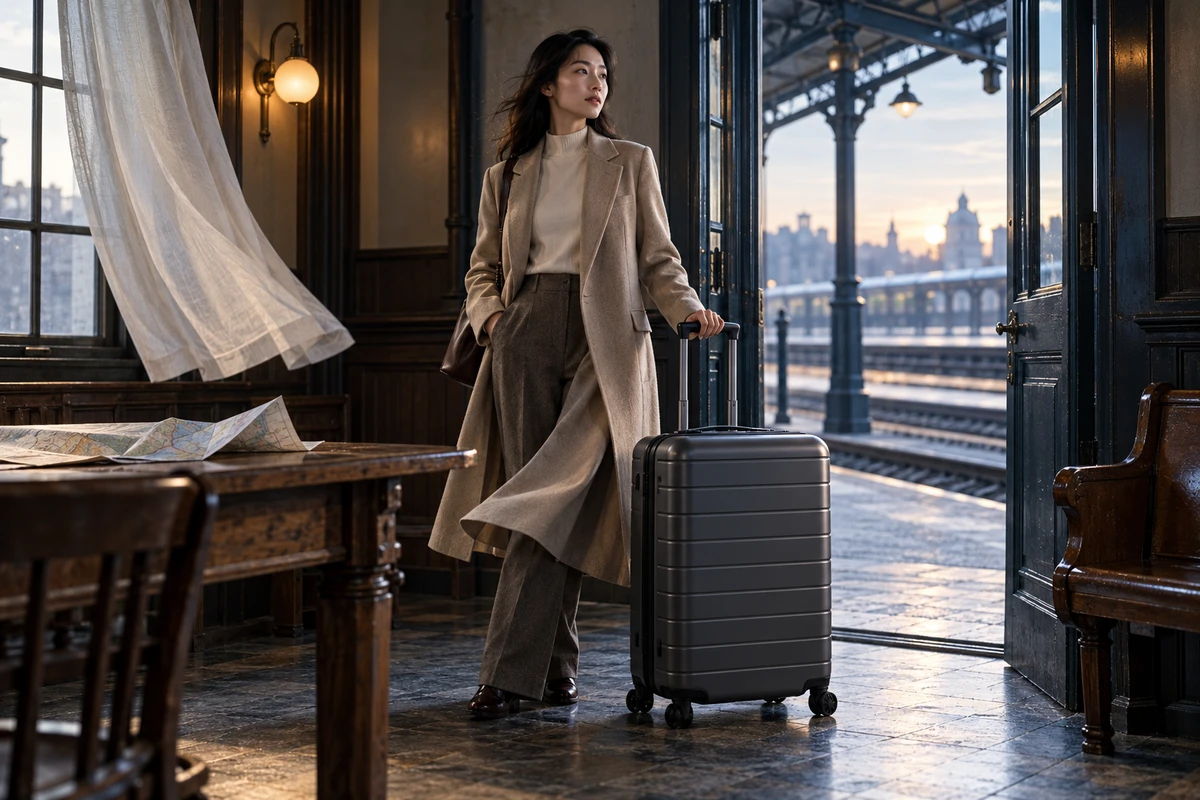
At dawn, a traveller sits in an old station waiting room with the suitcase beside her. A curtain barely breathes; the route map on the table remains still. She reads a change of departure on her phone, folds the map, stands, and pushes open the door to the platform. Only then does the outside air enter. It lifts one corner of the map first, catches the hem of her coat next, and finally pulls the distant curtain in the same direction. The suitcase itself does not move. She grips the handle and walks onto the platform.
Here, the wind does not decorate every shot. It separates waiting from departure and arrives after the character has made a decision. If the curtain, hair, paper, and clothing were all flying from the opening frame, the wind would become continuous background noise. It would no longer have narrative timing.
The point is not to shoot slower or blow harder. It is to treat the onset of wind as an edit point. Before the decision, movement is restrained. After the decision, the environment responds. A change in the air can then replace an explanatory line of voice-over.
Give Moving Objects a Hierarchy
The same gust will not move every object at the same speed or amplitude. Thin paper responds quickly. A heavy curtain is slower. A coat hem may be shielded by the body and only open fully after the character turns. Realism comes from these differences, and from the willingness to let some things remain quiet.
The primary movement should carry story information. In the station scene, the route map reacts first because it relates to the character's choice of journey. The coat brings the force into contact with the person. The distant curtain confirms that the airflow crosses the whole space. The suitcase stays still, preserving the visual centre of gravity and avoiding an accidental suggestion that the case is light enough to be pushed by the wind.
Direction must also remain consistent across shots. If a wide shot sends air from the doorway into the room, close-ups of paper, hair, and fabric should not reverse merely because that composition looks convenient. Viewers may not name the mistake, but the space will feel incoherent. Instead of drawing only an arrow on the storyboard, write down what moves first, how much later the second object responds, and when each movement stops.
Sound Can Arrive First, but It Should Not Over-Explain
A low sound through a door gap or the light rattle of a distant metal sign can appear a few frames before the fabric moves. That gives the audience advance notice that the space is about to change. But the soundtrack does not need to turn a breeze into a disaster film. A heavy roar paired with subtle visual movement suggests a different force level; obvious fabric tension with no environmental sound at all can feel equally unmotivated.
Sound and image should answer the same question together: how far away is the force, and is it approaching, passing through, or leaving?
When Wind Becomes a Product Claim
Once a product appears to create, resist, or alter airflow, the image may stop being mere atmosphere. A hair dryer that visibly smooths hair, a fan that moves a distant object, or outerwear that appears stable in strong wind naturally encourages viewers to attribute the result to the product.
The US Federal Trade Commission says advertising must be truthful and non-deceptive, considers words and pictures in context, and expects objective express and implied claims to have support. The UK's ASA and CAP also warned on September 11, 2025 that before-and-after imagery and production techniques should not exaggerate a product's capability or performance. These are public principles for the US and UK markets, not Chinese legal advice. For teams making cross-border advertising, however, they expose the same creative risk: when wind becomes evidence, attractive movement cannot replace a real product, real conditions, and traceable support.
For a functional product, the repeatable result should therefore be established with an actual sample before deciding whether CG will clean an edge, extend particles, or make a subtle effect easier to read. If the outcome works only at a specific distance, setting, environment, or material, the camera should not quietly erase those conditions.
Divide the Work Between Live Action, CG, and AIGC
Live action is strongest at contact. Fabric wrapping around a body, paper held down by a fingertip, or hair touching a cheek involves small resistances that affect performance, light, and sound at once. It is often easier to establish a coherent physical cause on set than to rebuild all those interactions later.
CG is useful when it extends logic that live action has already established: lengthening a trail of distant particles, removing the fan from a reflection, or making an underpowered background response more legible. It should not make wind direction, object weight, and stopping behaviour contradict one another from shot to shot.
AIGC is better suited to early exploration of atmosphere, framing, and movement relationships, or to transitional environments that do not bear the burden of proof. If an image is meant to show how a specific product truly affects airflow, smooth generated motion is not a validation result. Product appearance, operating conditions, and functional outcomes still require separate checks.
The division of work is not about which technology is more advanced. It is about which method best protects one causal chain: where the force comes from, what it touches first, how the character responds, and whether the product really does what the image implies.
Write Visible Consequences into the Storyboard
A useful airflow discussion can begin with one precise sentence: "After the door opens, the map lifts first, the coat hem follows half a beat later, the curtain confirms the direction, and the suitcase remains still." That is closer to something a crew can shoot, an editor can cut, and a brand team can review than "add some atmospheric wind."
The less visible the wind, the more exact the creative decision must be. A small movement can reshape a space and propel a character, but it can also turn atmosphere into an unintended performance claim. Mature product ad wind design is not about making more things move. It is about making every movement answer the same story question.
If your product film needs to coordinate airflow, materials, and performance across live action, CG, and AIGC, ONCE can start with the script and test shots, then translate the invisible force into executable images. Explore our brand film production approach.
Source Note
The Beaufort-scale discussion refers to the UK Met Office's public explanation. The section on visual and implied claims refers to the US Federal Trade Commission's advertising FAQ and the UK ASA/CAP guidance published on September 11, 2025. The station-and-suitcase scene is an original hypothesis, not a client case or product test.