An older person can appear throughout an ad without the story truly belonging to them. There may be smiles and close-ups, while someone else initiates everything: taking them out, choosing a product, and waiting for an approving nod. Care and assistance can belong in the scene. The question is what the character wants beyond accepting the arrangement.
That is useful writing work to do before ad casting. Establish a specific desire and a decision, then find someone who can perform them. Age may shape a person's experiences, relationships, and circumstances; it should not stand in for them.
One Camera, Two Positions in the Story
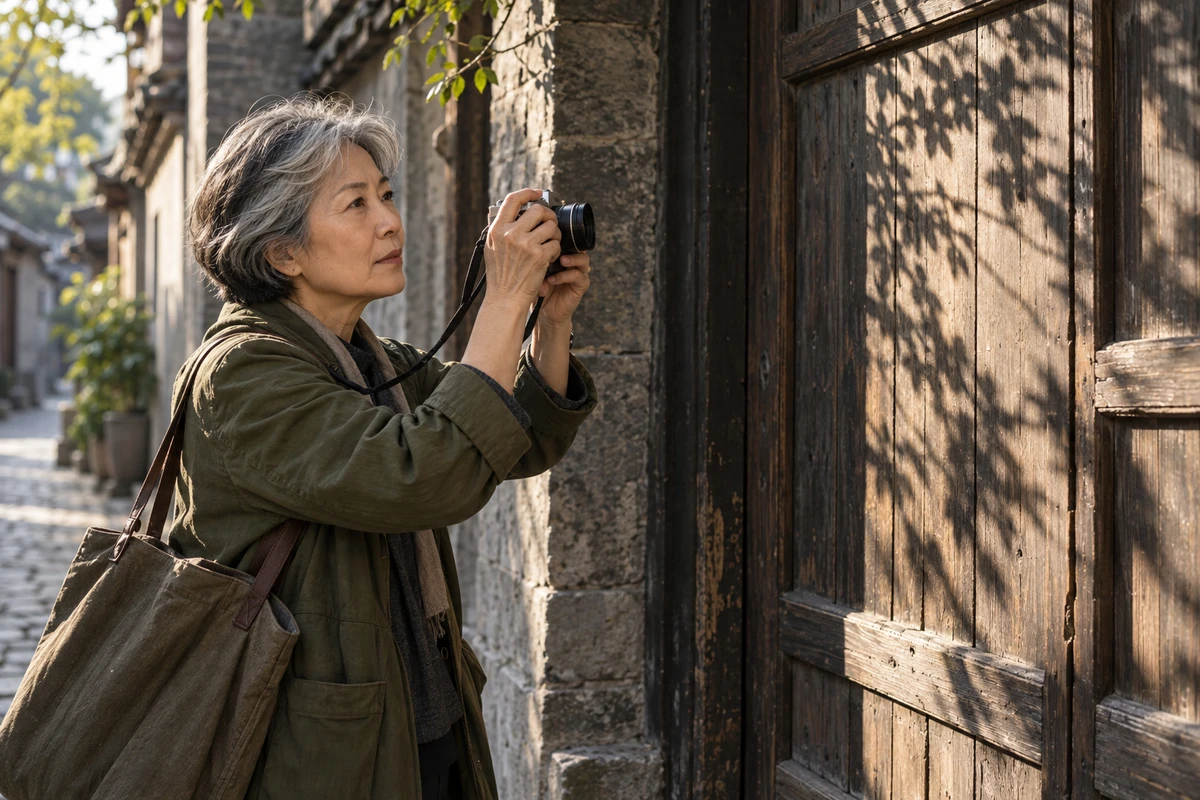
Imagine a wholly fictional compact-camera ad. A woman in her sixties explores an old neighborhood with a friend. This is not an ONCE client project, and no filming or product test has taken place.
In one version, the friend hands her the camera, points out what to photograph, and she follows the suggestion before smiling happily. The scene can be warm, but her main task is to respond. That can serve a story about patient companionship. It offers less of her own discovery if the brand wants to express personal exploration.
In a second version, she stops first. Her friend assumes she wants a portrait and starts moving into position. She gestures for them to wait: she wants to photograph a tree's shadow on a doorway. She changes her position, waits for the wind to move the shadow, then raises the camera. Seeing her composition, the friend begins looking for an angle of their own.
Her attention and decision create the turn. The product helps her preserve a moment she cares about. It need not promise youth, an end to loneliness, or a new life. Real operation and any result shown must still be confirmed against the specific product; an ideal image in the concept cannot automatically become a performance demonstration.
Neither version is always right. Decide whether the film is about companionship, learning, or self-directed exploration, then give the character a position that fits.
A Positive Image Can Still Become a Narrow Template
The UK's Centre for Ageing Better published its Age-positive images guide on January 7, 2021, encouraging realistic, varied portrayals rather than reducing a person to wrinkled hands. Its Age Without Limits article The power of age-positive images cautions against both bleak stereotypes and polished images of exceptional “super-agers.”
These are approaches to representation, not evidence of Chinese audience preferences or an individual ad's effectiveness. An older character may be energetic or tired, independent or in need of help. Requiring everyone to climb mountains, dance, or live like a twenty-year-old to qualify for a positive role still leaves little room for ordinary lives.
SixTwentySix's production account of Hera's Age Your Way offers another creative reference. The team describes casting real older participants in deliberately stylized settings and treating them as fully realized protagonists. This article uses the production text, not a viewing of the complete film, and does not treat the company's impact statements as independent evidence.
Respectful portrayal need not mean an unadorned interview. Art direction, wardrobe, cinematography, and editing can be expressive. Let those choices express the person rather than placing an older performer in a generic picture of peaceful later life.
Leave the Decision in the Shot
A face close-up and a shutter press may not reveal who is leading the camera scene. Preserve the sequence in which she notices the shadow, asks her friend to stay out of frame, and changes position. Give viewers a chance to understand the choice.
Product coverage can follow: how she holds the camera, checks the frame, and decides whether to take another shot. The close-up serves someone's purpose in looking. Its job is more than showing that an older hand can operate a device. Skin texture can remain visible without becoming the only thing worth seeing about the character.
Performance directions should be specific. “Act younger” is hard to play and may frame age as a problem to correct. “You've noticed light your friend hasn't seen, and you want them to stop blocking it” supplies an action to explore. She might gesture directly or make a small joke; either choice develops a different personality.
Wardrobe and setting need individual reasons too. Why this bag? Does the coat suit today's outing? What is her relationship to the neighborhood? A standard outfit for an older relative and a few old props cannot explain a life. Details should come from conversation or an explicit fictional character brief, rather than assumptions that age implies retirement, living alone, or difficulty with technology.
Support Can Remain Without Taking Over the Choice
Giving an older person agency does not require writing friends and family out. A friend can carry belongings, point out the ground conditions, or help with a setting. Ask whether that assistance supports the picture she wants to make or decides everything for her: the subject, the timing, and whether the result is good enough.
A character who needs more support can still have definite preferences. With a companion assisting the action, they can choose where to go, reject a composition, or ask to wait. Production should also discuss comfortable working methods, pacing, and communication with participants. A natural performance still requires preparation.
Give the product an accurate role. If the task is to explain ease of use, show the actual operating conditions. An older performer completing an action does not establish that anyone can use the device. Age is neither a difficulty rating nor proof of a product benefit.
In a Concept Image, Ask Who Decides
When using AI for casting or storyboard concepts, begin with what the character wants to accomplish, then add age, clothing, and setting. Review who holds the product, who gives directions, and who waits for approval, alongside the quality of faces and hands. Replacing a face with a younger or smoother one does not resolve the relationships in the scene.
These are proposed creative review questions, not findings from a model experiment conducted for this article. Generated images should not be presented as real consumers, production locations, or actual product experiences. Formal production still needs the performer, product, and setting to support the specific action together.
For your next brand film, bring a character's intention to ONCE's brand film production team and develop the role, casting, and shots together. An older protagonist need not be justified by an end line declaring that age is just a number. Sometimes she only needs to notice the shadow first and decide when to press the shutter.
Sources checked on October 21, 2026: the public texts named above from Centre for Ageing Better, Age Without Limits, and SixTwentySix. The first two belong to the same organization's related work. No audience or sales study was conducted. The original AI cover is a fictional scene, not the Hera campaign, a real client project, or a record of a consumer.