Before commissioning the next B2B brand film, decide when a buyer should think of the company. Then choose the factory, engineering and product footage. A capabilities deck tells production what is available to film; it does not, by itself, explain why someone would need that supplier now.
For an overseas team working with Chinese manufacturers, the distinction is practical. The same sourcing manager may seek a partner because a new product is entering pilot production, or because additional orders exceed the current supply arrangement. The audience profile is unchanged. The situation starting the purchase is not.
Add the missing situation to the audience brief
“Procurement and engineering teams at mid-sized manufacturers” identifies people. “Precision machining and responsive service” describes claims that need support. Neither says what happened before those people started considering the category.
The Ehrenberg-Bass Institute’s Identifying and Prioritising Category Entry Points describes category entry points as thoughts and cues associated with entering a category purchase. LinkedIn’s B2B Institute similarly connects brands with buying situations in Category Entry Points In A B2B World. Both public pages were checked on October 21, 2026. This is an evergreen application of existing material, not a newly released study.
No universal percentage of out-of-market buyers is needed for the production decision. The useful implication is that one audience can start buying for different reasons. A film can address a credible situation instead of repeatedly compressing the same company overview.
Is the gap in research or in expression?
If the team cannot explain why buyers previously began searching for suppliers, do not start by choosing a cinematic treatment. Review permitted enquiry records, won/lost business discussions and buyer interviews. Ask what changed before the search, what stopped working and what the buyer wanted to achieve next.
“Customers care about quality” may be a standing requirement. “The design is changing during pilot production” describes a situation. Avoid turning an internally favored feature into an invented customer trigger.
A few conversations can reveal candidate situations, not establish their prevalence across a market. The Ehrenberg-Bass page separates eliciting situations from quantifying their relevance and brand/competitor associations. Match the research to the scale of the budget decision; an internal workshop sheet is not a representative category study.
Once the situation has support, the creative question becomes clearer: can viewers understand what happened and what the brand does in response? Authentic factory footage still needs that organizing idea.
The ONCE buying-situation selection sheet
Use a short page for each candidate theme. This is our proposed planning method, not a research institution’s measurement instrument or a numerical effectiveness score.
| Element | What to establish |
|---|---|
| Buyer evidence | The record or interview behind the idea; distinguish actual wording, a team summary and an untested hypothesis |
| Trigger | What changed so the existing arrangement became insufficient—not just a job title or generic pain point |
| Desired progress | What the buyer needs to advance at that moment, rather than every message the brand wants to include |
| Visible brand role | The real action, process or product behavior that supports the response, and the material still missing |
Prioritize through three questions: is the situation supported, can the business credibly address it, and can this production show that response? Missing evidence calls for research. Missing capability calls for a different theme or operational improvement. Missing filmable material calls for preparation and permission—not a fabricated scene.
Ease of filming is not enough. An available aerial shot does not automatically deserve the center of the film. A relevant buying situation might be better expressed through one engineering interaction than a larger production setup.
One supplier, two different films
Consider a hypothetical precision-metal-parts supplier developing content for overseas brands. This is an illustrative brief, not an ONCE case, market study or claim of delivery performance.
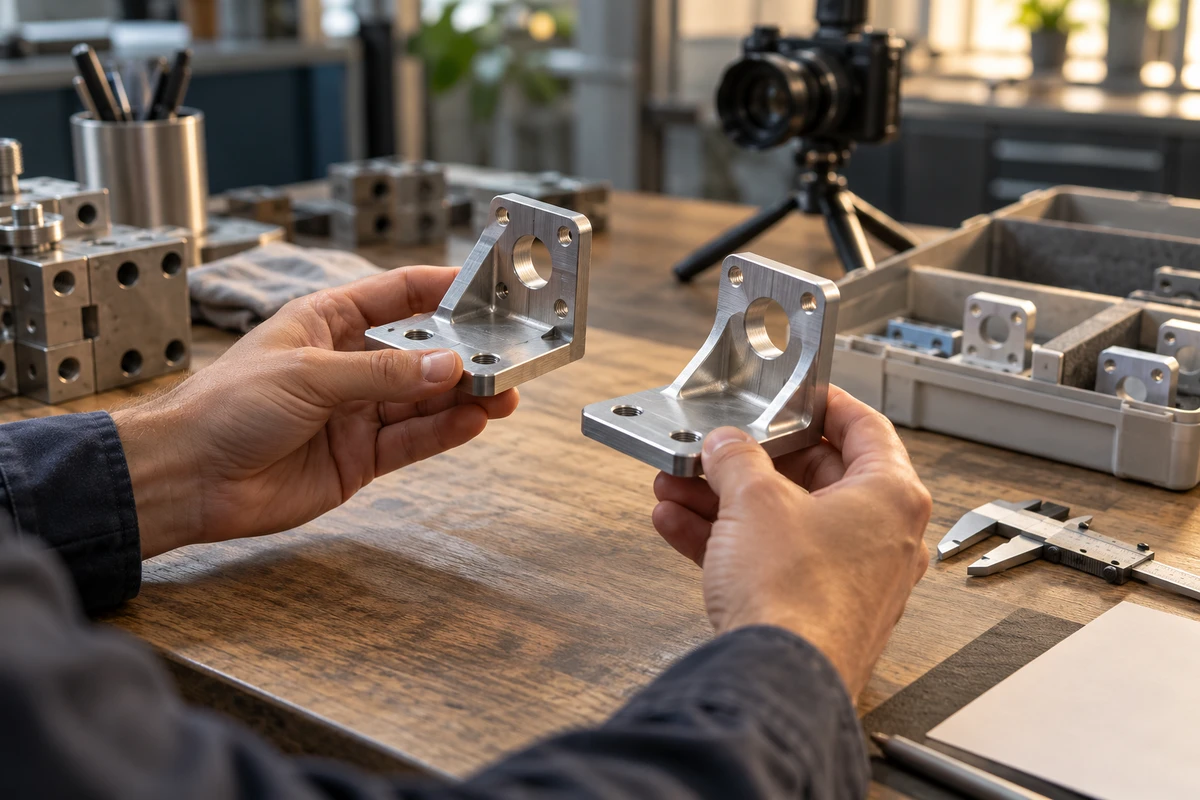
In the first candidate situation, a buyer’s new product enters pilot production while the design is still changing. Start with differences between two samples, then explore the engineering discussion, revision confirmation and sample checks. The point is how the supplier helps move the pilot forward, not merely that it owns impressive machinery. Confirm which steps and versions may be shown and who approves the technical explanation.
In the second, the current supply arrangement cannot cover an unexpected increase in orders. The sample-revision story may no longer be the main question. Order-condition clarification, production planning, quality and dispatch coordination may be more relevant. Without evidence for a delivery promise, rapid editing and packed cartons must not imply that any urgent order can be fulfilled.
Some workshop footage can serve both films. Their preparation cannot be assumed identical: one needs a visible change and collaboration; the other needs approved planning and execution material. Choosing the situation first determines participants, records, props and what can be omitted.
These are not recommended themes for every manufacturer. They illustrate the reasoning: start with a supported buying situation, then choose a brand action worth showing. Do not retrofit a customer problem to footage already on hand.
Keep four questions separate
Theme research asks whether a situation exists and deserves priority. A rough-cut review asks whether viewers understand the situation and the brand’s role. Subsequent work can investigate brand association and business outcomes. They are related questions, not interchangeable results.
Ask suitable buyers to describe, in their own words, when they would consider the company after seeing a rough cut. That checks expression; it does not establish market demand. Testing whether the situation later brings the brand to mind requires a separate design. Evaluating qualified enquiries and sales requires actual reach, timing and customer feedback—not simply view counts.
An absence of immediate enquiries does not automatically disprove a film intended for future buyers. Equally, “long-term brand building” is not a reason to avoid review. State the task and what remains unknowable before production, rather than selecting a flattering metric afterward.
Buy a defined theme before comparing production packages
Give prospective teams the same buying situation. Ask what research is needed, what authentic material the brand must provide and what the film should make understandable. Only then compare treatments and production scope. Otherwise, suppliers may quote for different business questions under the same request for a two-minute video.
For an ongoing content program, retain the evidence behind each theme, its unresolved assumptions and later feedback as well as the footage. Those records can inform the next commission without being misrepresented as a complete market database.
When discussing a B2B brand video with ONCE, bring one situation in which you want the company to be considered, the material supporting it and a response the business can genuinely show. That gives the shot list a purpose beyond representing every department.
The selection sheet and hypothetical supplier examples are ONCE’s analysis, not customer research results or a growth guarantee. The original AI cover is conceptual, not a photograph of a client production. Publication dates were not established from the two research pages; October 21, 2026 is the access date.