A product video can leave a China production studio with an approved edit, three attractive thumbnails and no useful explanation of what those alternatives are meant to test. The overseas marketing team inherits the final choice. If the result disappoints, nobody knows whether to redesign the image, change the opening or book another shoot.
ONCE proposes a different procurement unit: a viewing promise backed by a specific moment in the video. Buy alternatives that can teach the team something, with production and measurement responsibilities defined separately. This matters especially when the people filming the product, approving the claims and operating the channel work in different countries.
The distribution surface comes before the artwork
YouTube's current official guidance makes an important distinction. Its desktop title and thumbnail A/B testing supports up to three alternatives for eligible accounts but excludes Shorts. Separate guidance currently allows custom Shorts thumbnails to be uploaded on desktop. Upload capability is not experimental capability. These pages were checked on October 20, 2026; teams should confirm their own account access before scoping work.
A long-form video page, a vertical feed, a website embed and an ad placement are not interchangeable entrances. Specify the actual placement and inspect its rendering on the target device. A finding about a thumbnail cannot automatically be transferred to an autoplay opening frame.
Where no usable test exists, a clear, faithful default image and well-organized source assets may be the sensible first purchase. Where the channel team can run an experiment, commission distinct hypotheses and the operational work needed to evaluate them. Do not price a large variant library as a learning program unless someone can actually use it that way.
Use an ONCE Thumbnail Promise Card
This is an editorial and production framework proposed by ONCE, not a platform requirement or a proven performance claim. Complete one card for each candidate.
| Card field | What the production and channel teams agree |
|---|---|
| Surface | Placement, format, device, language and version |
| Viewer question | The specific reason someone would choose this video |
| Visible evidence | The product, action or outcome the image depicts |
| Payoff | Script reference, followed by the delivered edit's timecode |
| Test boundary | Thumbnail alone, or an explicitly defined title-image package |
| Decision | What would justify changing the entrance, filming more evidence or stopping |
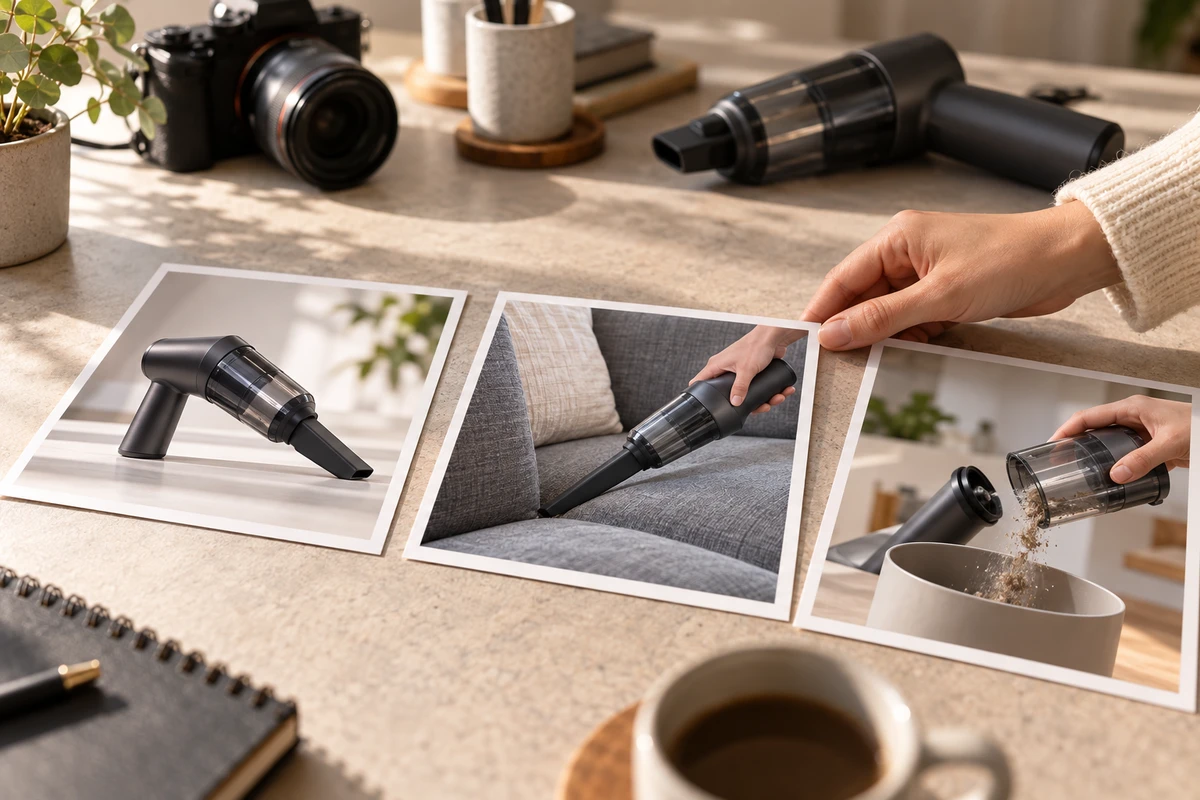
Consider a hypothetical handheld vacuum demo. One candidate could emphasize product recognition, another access to a narrow gap, and a third the emptying procedure. Each is a different viewing promise, not just a background-color variation. All three require genuine support in the edit. An image centered on easy emptying is a poor match for a video that only shows the unboxing and exterior.
Alternatively, a narrowly defined design test might change only the background treatment. That is valid too. The crucial distinction is between testing a complete package and isolating a variable. Record which question you are asking before making the alternatives.
Capture the evidence without turning every shot into a still-photo shoot
Before filming, give each promise a practical shot requirement. Access to a tight space needs a readable relationship between the nozzle and the gap. A maintenance promise needs a credible action sequence. Product identification may need a cleaner silhouette. This connects thumbnail planning to the storyboard rather than leaving it entirely to the final export.
Where appropriate, allow a brief hold, a clean composition and room for the intended crop. If the video frame cannot meet the display requirement, scope a dedicated still. Do not compromise the motion treatment of the whole film simply to make every frame extractable. A separately photographed thumbnail is possible, but the product state and message must remain truthful to the content.
The handoff should identify each image's intended crop, matching edit version, source location and payoff timecode. Print campaigns, exhibition graphics and demanding still-image work need their own photographic scope; they should not be quietly bundled into a thumbnail request.
For an overseas brand buying ecommerce product video production in China, this is also a coordination mechanism. The local production team can deliver traceable evidence; the channel owner can confirm placement and access. Neither side has to infer the other's requirements from a folder of exports.
Read a test as bounded evidence
YouTube describes its native outcome in terms of watch-time share, with a winner, comparable performance or an inconclusive result. A clear winner is not guaranteed. Agree on the evaluation window and how the result will be used before launch, rather than declaring success from an early click movement.
Three response rules make the result useful:
- A clear native-test winner supports using that package for the tested video and context. It does not establish a universal design rule or incremental sales.
- More clicks alongside weaker subsequent viewing is a reason to investigate a promise-payoff mismatch. Check the content and audience context; that pattern alone does not prove the cause.
- Similar or inconclusive results can justify keeping the most accurate, readable option. They do not automatically justify another shoot or permanently disqualify a creative idea.
Keep the denominator intact, too. YouTube's impression reporting does not include every viewing route, including impressions on externally embedded videos. Combining website traffic and platform thumbnail reports into a single supposed conversion rate can mix incompatible populations.
If sales impact is the question, it requires a separate measurement design tied to that business outcome. A watch-time result is useful packaging evidence, not a substitute for sales incrementality. Parallel movements in channel metrics and orders do not by themselves establish attribution.
Buy production and learning as separate deliverables
Ask for a scope with three named responsibilities: produce the candidates, configure and operate the experiment, and document the finding with the next action. One supplier may cover all three, or several teams may share them. Ownership still has to be explicit.
A studio without account access or channel cooperation should not promise a completed platform experiment. Equally, a marketing team should not treat delivery of three images as validation of three hypotheses.
The durable asset is not a supposedly magical winning composition. It is a record linking a version, a promise, its evidence and the limits of the finding. ONCE sees that record as a potentially reusable production asset; this is an analytical proposition, not a claim about measured client savings.
For the next brief, bring the intended placement, viewer questions, approved product evidence, available test access and a named decision owner. Those five inputs will do more to define the right thumbnail scope than an instruction to make the video “more clickable.”
Sources and boundaries
Official YouTube Help pages checked October 20, 2026; no fixed publication date is shown. Availability and eligibility can change.
- A/B test titles & thumbnails: native testing eligibility and outcome definitions.
- Add custom thumbnails on YouTube: custom thumbnail and Shorts upload guidance.
- Check your YouTube thumbnail impressions and watch time: reporting coverage.
The Thumbnail Promise Card, procurement split and response rules are ONCE's original analysis. The vacuum example is hypothetical, not a client case or a reported experiment.