Cross-Border Product Video Market Research 09/10 · ONCE Cross-Border Product Video Market Research
When a client says that a UAE version should “feel more Middle Eastern,” the production team should not begin by filling a mood board with gold, skylines, robes and desert imagery. The first questions are more practical: Who is this video for, what buying task are they trying to complete, and which language will they use to check the risk?
This article deliberately narrows the problem to a hypothetical project: a multi-port travel charger sold through UAE online retail, with a product-page film, an English short ad and an Arabic short ad. The audience is not “all UAE consumers.” It may include English-speaking professionals living in Dubai, Emirati or other Arabic-speaking buyers who want to compare in Arabic, and visitors making a time-sensitive purchase around an airport, hotel or travel-retail context. This is not an ONCE client case, and people inside any of these groups do not share one fixed preference.
Our central judgment is that the charger’s appearance, ports, connection steps, packing action, device setup and box contents can form a shared product-fact layer across languages. Who appears, what is explained first, how Arabic reads, how English is spoken, how a commercial relationship is disclosed, and where viewers confirm price and after-sales terms must be rebuilt around the audience and publishing account. One shoot can support both languages, but the Arabic and English outputs should not be treated as the same film with different subtitles.
A Counterexample First: English Can Work Without Representing Every Buyer
Many transactions in Dubai can be completed in English. That easily leads an overseas team to an economical conclusion: produce an English master and treat Arabic as an optional subtitle track. The flaw is that “able to complete a transaction” and “willing to use this language to understand a promise” are different questions.
In 2024, Ahmad Al-Issa and Hana Sulieman of the American University of Sharjah published “Arabic or English? Multilingual users’ preferences in Dubai ATM transactions” in Frontiers in Communication (DOI: 10.3389/fcomm.2024.1355632). The researchers conducted an eight-week, in-person survey near ATMs in three Dubai shopping malls. The 566 participants included UAE nationals, other Arabs and non-Arabs. Almost all non-Arab participants selected English, while the choices among Arab participants were not uniform; residence, age, occupation and comfort with technology were associated with different choices.
This was an ATM study, not a product-video study. It did not measure advertising comprehension, trust, clicks or purchases. It cannot show that an English video sells better, and it cannot decide an Arabic production budget for a brand. Its useful contribution is more limited: it challenges the assumption that one city has one effective language. The same person may use different languages at work, in banking, in a family discussion and while comparing a product. A production brief therefore needs more than nationality. It needs the task, channel, product risk and desired depth of understanding.
A separate peer-reviewed study, “Translating headlines in print business advertisements from English into Arabic in UAE”, appeared in Across Languages and Cultures in 2020 (DOI: 10.1556/084.2020.00006). It examined print-advertising headlines. The abstract reports that respondents found function-oriented Arabic translations more acceptable than form-oriented translations. This is not a product-video effectiveness experiment either, but it supplies a testable production direction: an Arabic version should preserve the job of the sentence before it preserves English word order and rhythm.
Segment the Buyer Before Assigning Jobs to Arabic and English
For this travel charger, the team can begin with three task cards rather than one “UAE persona.”
An English-using Dubai resident may be comparing whether one device can replace multiple adapters at a desk, during a commute and on a business trip. The video should quickly show size, port positions, simultaneous connection actions, space in a bag and the specifications that can be checked on the product page. English is not decoration for an “international” mood. It is the working language that connects visible operation with page information.
A buyer who prefers to compare in Arabic may face the same product questions but need a different order and reading rhythm. Brand names, model numbers and familiar interface terms may retain their established forms. “What is in the box,” “which device combinations are supported” and “who provides the warranty” should not become vague in the pursuit of brevity. When Arabic narration, captions, numerals, units, model names and a Latin-script URL share a frame, the team must test bidirectional text rather than mirror an English graphic layer.
A short-term visitor may encounter the product around an airport, hotel or journey. Travel timing, carried devices, destination plug requirements, returns and timely availability matter more than adding a landmark. If the product is delivered only to residents, a tourist scene may attract attention while misrepresenting the transaction. If visitors are genuinely served, inventory location, collection method and after-sales contact are the local facts worth placing in the call to action.
These three groups are not three fixed ethnic, income or aesthetic categories. Age, familiarity with the brand, device mix, sensitivity to risk and viewing entry point may change the script more directly than nationality. “Choose the audience first” does not mean choosing a face first. It means deciding which uncertainty this film will remove for a defined person.
What One Shoot Can Share: Film Actions That Do Not Change With Language
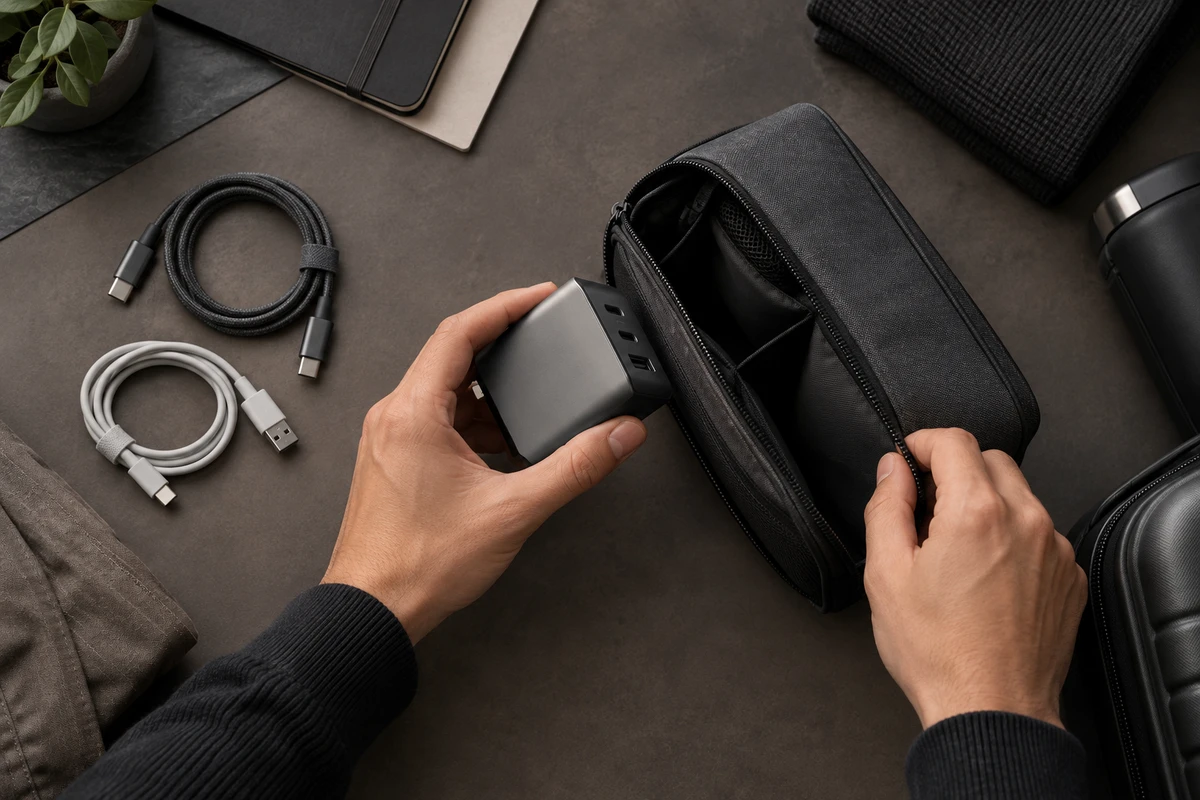
Reusable footage should begin with observable product facts. For a multi-port charger, one controlled shoot can cover the surfaces of the product, port labels, plug or connection method, size against a hand and travel bag, package contents, cable connection, the sequence of attaching multiple devices, and the action of packing it away. Every shot must correspond to the actual sales SKU and its instructions. Performance cannot substitute for model verification.
The shoot should leave text-free clean plates, safe space for both landscape and vertical crops, and enough time for different voiceovers. A product rotation may be shared, but footage containing an English-only interface, packaging for the wrong model or a composition designed only for left-to-right copy turns “reuse” into rework. Product action can stay central while information space is protected on either side; captions, price, disclosures and calls to action belong to later language layers rather than being burned into the master.
One shoot also does not make every performance reusable. If a person places the charger in a laptop bag, connects devices and clears a desk, they are completing an operation that can remain intelligible across versions. If they speak to camera about personal experience, endorse the product as a creator, or place it inside a specific occupational, family or identity context, the performance enters the language, identity and commercial-relationship layer. Changing subtitles cannot turn an English performance into natural Arabic delivery, and it cannot turn a brand actor into a genuine customer.
ONCE’s cross-border ecommerce video approach plans product-page material, short ads and multilingual versions inside the same production list. The public FO12B air-fryer product demonstration case illustrates a more basic principle: hands and continuous operation are useful when they explain structure and steps. The case demonstrates an expression method; it is not evidence of UAE preference or sales performance.
Arabic Is Not a Mirrored English Version
An English script may open with “one charger, three devices” and then reveal the ports. The Arabic version does not have to preserve the same order word for word. If the defined audience needs to confirm what travels in the bag, who is selling the item or how a port is used, the script can state the task first and then identify the model. The two versions need shared facts, not shared grammar.
Post-production needs at least five real-device checks. First, review Arabic captions at phone size rather than only on an editing monitor. Second, test Arabic text mixed with model names, numerals, units and URLs for broken or reversed ordering. Third, let natural Arabic pauses determine shot duration rather than compressing a translation into an English rhythm. Fourth, confirm that the packaging, interface and landing page actually support the language shown. Fifth, test silent viewing separately: without sound, can the viewer still identify the connection sequence, relevant conditions and the next place to verify information?
Voice cannot be reduced to a generic “Middle Eastern accent.” The choice between Modern Standard Arabic, a regional spoken variety, or English-led delivery with selected Arabic interface elements must return to the paid audience, brand voice, speaker identity and real review capacity. If the team lacks an appropriate native-language review, it should not guess tone from subtitle software. A responsible deliverable is not merely “one Arabic version.” It names the language, audience, publishing channel, speaker, caption direction and reviewer.
Permits Follow the Publisher and Channel, Not a “Middle Eastern Asset”
As of October 2026, the name of the UAE’s federal media regulator requires an important update. On 18 December 2025, the UAE government announced Federal Decree-Law No. 11 of 2025 establishing the National Media Authority. The new body replaced the UAE Media Council, National Media Office and Emirates News Agency in their functions, rights and obligations. Existing regulations continue where they do not conflict with the new decree-law. A production team relying only on older UAE Media Council news may therefore name the current authority incorrectly.
The National Media Authority’s current individual advertising permit service concerns individuals publishing paid or unpaid advertising and media content through social accounts, websites or other digital platforms. Its wider Advertiser Permit page also lists exemptions, including a natural person advertising their own product, service or company through their personal account. A UAE-based compliance owner should check the actual person, account and activity rather than turning a short summary into a universal exception.
Visiting creators follow another route. The current service for visiting individuals providing advertising or media content on social media says the application must be submitted through a licensed UAE advertising agency. The temporary permit lasts three months and may be extended, with the total temporary period not exceeding six months. Its subject is a visiting individual who enters the UAE and provides advertising through their social account, website or another digital platform. It does not mean that every brand video filmed in China and later targeted to the UAE needs a visitor permit.
This distinction changes how production manages people. If a brand buys a model performance and publishes the finished film on its own account, the team must check performer rights, production location, brand publication and local content duties. If a visiting creator endorses the charger through their own account, the team must additionally check the person, account, agency, permit, disclosure and contract. The footage may look similar, but the publishing responsibility is not.
The National Media Authority’s current Media Content Standards require advertising to respect UAE culture, identity and values and also address privacy, false or misleading information and children’s rights. The media executive rules identify categories such as medical, financial, education, food and real estate advertising that may require approval from relevant authorities. This article uses general consumer electronics precisely to avoid extending category-specific approval to every product. A real project involving health, finance or another regulated claim needs a separate check with the responsible authority.
Cultural Expression, Product Claims and Market Access Need Separate Checklists
“Does the image respect local culture?” cannot replace “Is the performance claim true?” If a charger video says “fastest,” “works with every device” or “never gets hot,” or uses animation to imply compatibility that has not been verified, the problem lies in the claim rather than the color palette. The UAE Ministry of Economy and Tourism’s current consumer-protection legislation page says Federal Law No. 15 of 2020 covers goods and services in the UAE and related operations by suppliers, advertisers and trade agents. Its description of misleading advertising includes deceptive information or omission of essential information that affects a consumer’s decision to contract.
For a production team, the practical method is to divide copy into three groups. The first is directly observable: port count, box contents and connection action. The second contains performance claims requiring conditions and documents: power allocation, compatibility range and temperature behavior. The third contains information that must be confirmed through market-access, certification or local sales records. Product video can explain facts that the documents support; it cannot use “local feeling” to complete certification or legal conclusions on behalf of the brand.
The preceding article on people, Arabic and real use in Saudi product video examined when a local person truly helps viewers understand a product. The UAE question requires one further separation: inside the same city, Arabic and English may perform different buying jobs. A “local person” must therefore answer who they are addressing, through which account, and what their appearance or action actually proves.
A Minimum Test: Measure Understanding Before Liking
Before scaling media, prepare two short edits with the same price, sales page, SKU and comparable media opportunity. Aim the English version at a defined English-using group and the Arabic version at a defined Arabic-using group. Retain the same port, connection, size and package-content shots while allowing each version to reorder the opening, narration, captions and call to action. If the purpose is to learn about language, do not change the performer, setting, offer and editing intensity at the same time.
Begin with questions that have checkable answers: Can viewers say what is in the box, which connection actions they saw, which performance conditions still need to be checked on the page, who published the advertisement, and where to find price and warranty? Then record language naturalness, relevance, liking, credibility and action intention separately. Click-through rate can describe response in a particular delivery context, but it does not automatically prove comprehension. Liking is not trust, intention is not purchase, and platform attribution is not causal incremental sales.
If the Arabic version helps viewers find the seller and warranty faster but reduces memory of the ports, retain the language structure and move the operation earlier. If the English version is clear among English-using residents but leaves Arabic users feeling that essential information is absent, “everyone speaks English” is not a useful rebuttal. If the two versions produce similar comprehension, the team does not need to reshoot every scene for superficial symbols; it may invest instead in a clearer page, captions, creator choice or after-sales route.
Delivery Decision: Manage One Live-Action Asset in Three Layers
The shared live-action layer locks the sales SKU, appearance, ports, box contents, size reference, continuous operation, verifiable product facts, aspect-ratio safety and text-free masters. It answers: What is this, how is it used and what did the camera actually prove?
The language-task layer separately locks the English and Arabic audiences, information order, speaker, caption direction, mixing of numerals and model names, page language and call to action. It answers: What must this person understand first, and how can they continue checking?
The publishing-responsibility layer locks the brand account, creator account, commercial disclosure, permit holder, landing-page seller, price, delivery, returns and after-sales terms. It answers: Who is making the promise, and where does the promise become a real transaction?
The first layer can usually be completed in one shoot. The second often requires rewriting, re-recording and re-editing. If the third changes the speaker’s identity, genuine experience or transaction route, it may require reshooting. The decision does not depend on whether the footage looks sufficiently “Middle Eastern.” It depends on whether the existing footage can accurately complete the new buying task.
If you are planning UAE consumer-electronics or cross-border ecommerce product video, bring ONCE the defined audience, sales SKU, current product page, claim documentation, publishing accounts and existing text-free footage. We can apply our cross-border ecommerce product-video method to separate reusable shots from English and Arabic jobs before deciding what is worth reshooting.
Research scope: Materials were checked through 7 October 2026. The pages actually read included the National Media Authority’s mandate, individual advertising permit, visiting advertiser permit, media content standards and current service pages; the UAE Ministry of Economy and Tourism consumer-protection legislation page; Federal Decree-Law No. 11 of 2025; the full text of Al-Issa and Sulieman’s 2024 ATM language-choice study; and the abstract and bibliographic record for Giaber and colleagues’ 2020 advertising-headline translation study. The ATM research is an in-person survey in a specific technology-mediated transaction; the print-ad study is not a video-conversion experiment. Regulatory materials are not evidence of cultural preference. This is ONCE editorial research and production analysis, not a systematic review, complete legal clearance or claim about client results.