Cross-Border Product Video Market Research 08/10 · ONCE Cross-Border Product Video Market Research
When a client says an electric-shaver video should “feel more Saudi,” the first variables to change are usually not the color grade, wardrobe or set. They are who delivers the information, in which language, through which visible action, and where viewers can verify the commercial conditions after watching.
This article deliberately limits the question to a hypothetical project: a mid-priced electric shaver for Arabic-speaking adult men in Riyadh, sold through a brand ecommerce page and short-form creator content. It is not an ONCE client case, and it does not stand for every Saudi resident. Saudi Arabia includes people with different languages, nationalities, ages and ways of living. The same person also approaches a brand site, a product page and an individual creator account with different viewing tasks.
Our central judgment is this: the appearance of the same SKU, its head, grip, trimming, charging and cleaning actions can form a reusable cross-market product layer. Arabic information order, speaker identity, real use context, advertising disclosure, and the route to price and after-sales information must be checked again for the audience and publication channel. Local people and settings deserve screen time only when they help viewers understand the product. A desert, palace, gold palette or imagined “Middle Eastern style” cannot answer whether this shaver is right for the buyer.
“Saudi” Starts With an Audience Definition, Not a Mood Board
If an audience brief says only “Saudi men,” the creative team still does not know what to film. It must go further: What age and life stage is in scope? Does the segment mainly use Arabic, English or both? Are viewers encountering the brand for the first time, or are they already comparing models on a product page? Are they unsure about head contact, short and long hair, wet use and cleaning, or are accessories, warranty and seller identity the greater concern?
Those questions change the opening shot. Active product comparers may want to see the shaving head contact the face and the trimmer extend first. A broad-interest social audience may need a credible getting-ready situation before the film moves into operation. Either route can work. The deciding question is not which one “Saudis prefer,” but what job this content must perform in this channel.
Casting should also follow the task. If the video must show contact angle, direction, sideburn trimming and rinsing, the right person is someone who can perform those actions consistently, speak within their actual experience and understand the responsibility attached to publication. The production needs a suitable demonstrator, not a face whose nationality, accent or clothing substitutes for product knowledge. Skin tone, clothing, family status and home environment cannot be used to infer an individual’s preferences. They belong in a concept only when there is a clear reason grounded in the actual audience and scenario.
Arabic Is Not an English Subtitle Flipped Right to Left
In 2023, King Saud University scholar Mohammad Almoaily published a PLOS ONE study of Arabic-English code-switching in Saudi Snapchat advertising. The study examined 4,000 spoken words from 40 young Saudi advertisers—20 men and 20 women—whose ads were collected in September and October 2022 and were primarily directed at Arabic-speaking audiences. It recorded 102 switches from Arabic to English; 76.5% were coded as “availability,” where a shorter or more readily available English expression was used.
This was a description of language behavior in a set of Snapchat ads, not a viewing experiment. It did not show that English words improve trust or sales. It excluded ads aimed at non-Arabic-speaking expatriate audiences and cannot represent every Saudi channel today. But it offers a better starting point than either “the Arabic version must contain only Arabic” or “young people all like mixed Arabic and English”: identify the function of a word in real speech before deciding whether to retain, translate or explain it.
For an electric shaver, the brand, model and a few product terms familiar to the defined audience may retain their established form. Operating steps, risk conditions, price, warranty and advertising identity cannot become obscure merely because the language sounds fashionable. A voiceover may say an English model name naturally, but captions and the product page must still tell an Arabic-speaking viewer whether it denotes a shaving mode, an accessory or a marketing label. If the brand wants to address English users or specific expatriate groups, that requires a separate audience version—not a few English words inserted at random into the same Arabic script.
In production, the Arabic version changes at least four things. First, the information order may need to change: action before model name, or problem before feature. Second, caption direction, numerals, units and interface elements must be tested at real phone size rather than judged only on an edit monitor. Third, voiceover length changes shot duration; head removal and cleaning should not be cut short simply to fit a translation. Fourth, packaging, instructions, offers and the call to action shown in frame must match the local sales version. Subtitle replacement alone rarely solves all four.
A Local Person Must Complete Three Product Proofs
A 30-second shaver video can divide the demonstrator’s task into three proofs.
The first is size and grip. The person lifts the product from storage or a counter, allowing the body, shaving head and hand to appear at a judgeable scale. The edit should retain switching on, grip direction and contact angle instead of reducing everything to a sequence of skin, mirror and metal close-ups. The person is useful because the viewer can see how the product enters a bodily action—not because the frame acquires decorative “lifestyle.”
The second is function and limitation. If the model has a separate trimmer, interchangeable heads, or wet and dry modes, the script should select only actions supported by brand documentation and repeatable on set. Shaving results are easily influenced by lighting, grooming, performance order and before-and-after condition. Without comparable conditions, an attractive profile shot is not proof that everyone will get a cleaner or more comfortable result. Objective claims about low irritation, facial contouring, battery life, water resistance or charging speed require a record of the model, conditions, test material and permitted wording.
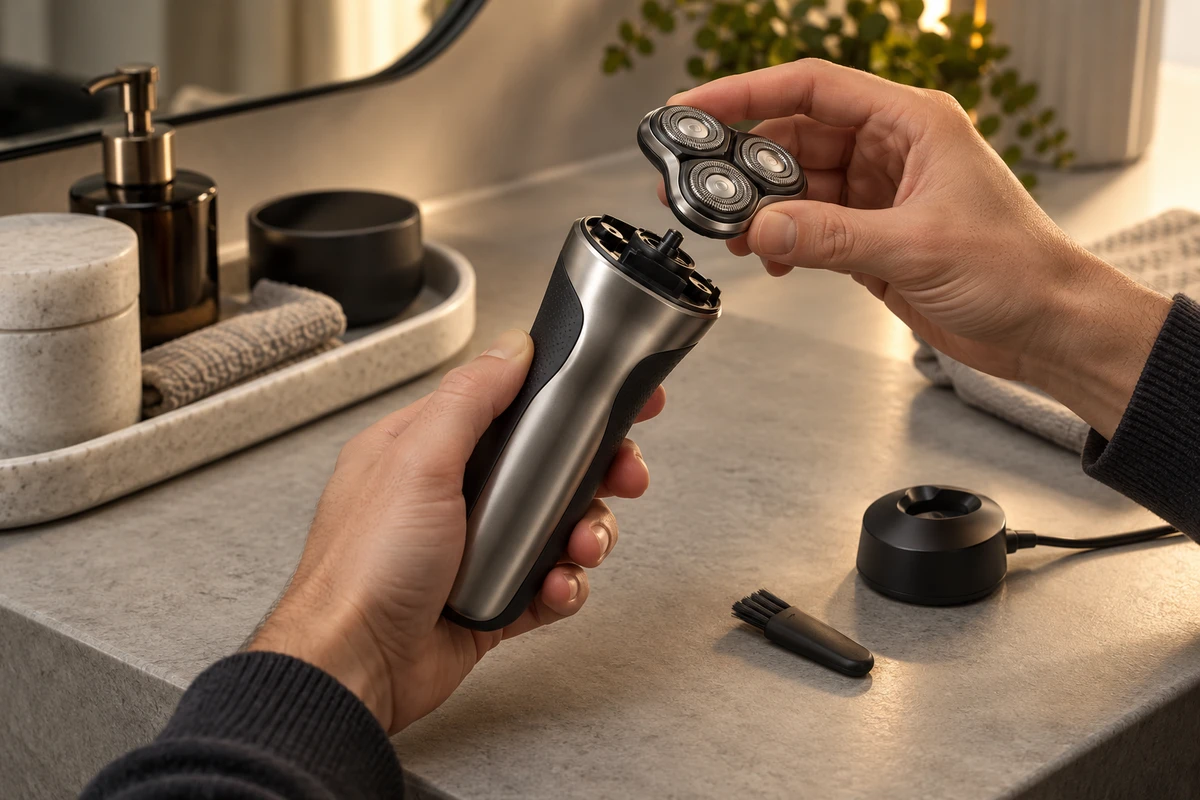
The third is cleaning and putting away. Head removal, rinsing, brushing, drying or returning the shaver to a stand must follow the instructions for that model. Cleaning is not a casual flourish at the end; it often determines whether a buyer considers daily maintenance acceptable. A continuous action communicates more than the phrase “easy clean.” If a brand shows running water and a smile without making clear which parts may contact water, the image can widen misunderstanding.
ONCE’s guide to performance claims and shot-level acceptance for consumer electronics puts the copy, the visible proof and the conditions that must survive the edit into one review process. The public FO12B air-fryer ecommerce video case also illustrates a broader production principle: hands and continuous operation are most useful when they explain structure and steps. That case shows an expression method; it is not evidence of Saudi preferences.
A Setting Matters When It Changes the Action
An electric shaver can appear on an uncluttered bathroom counter, in bedroom storage, in a getting-ready space or in a travel-packing scenario. The choice should not come from landmarks, luxury cues or a fixed idea of family life. It should come from the product question.
To explain wet use and cleaning, the location of water, mirror, towel and safe power use affects the action. To explain a travel lock, protective cap and charging method, storage and packing become useful. To depict a quick trim, the relationship between the person and mirror, the contact area, and the before-and-after state must remain visible. If a setting changes neither the action, the risk nor the buyer’s understanding, it is merely an expensive background.
This distinction also shows what can be filmed in a controlled studio before local production is fixed. Product rotation, head construction, package contents, charging interface, assembly and manual-compliant cleaning can be shot with the same sales SKU, leaving room for Arabic captions and multiple aspect ratios. Facial demonstration, local spoken language, the live sales page, promotional terms and after-sales route should wait until the audience, performer, publishing account and local product version are locked.
If the brand genuinely plans to film in public or tourist locations in Riyadh, Saudi Arabia’s national portal currently lists a no-objection certificate for commercial filming in public and tourist locations for media entities. This is not the same activity as filming a product in a Shenzhen studio, filming a person in a private interior, or licensing a piece of foreign media. The portal separately lists an audiovisual media content production license, which should be checked against the actual Saudi production entity and work rather than generalized to every overseas asset.
Individual Ad Licensing, Ecommerce Duties and Cinema Clearance Are Different Rules
As checked on October 7, 2026, the Saudi national portal’s service for an individual license to provide advertising content through social media platforms applies to individuals promoting brands, products or services through their own accounts, including audiovisual, audio, written and image formats. The General Authority of Media Regulation’s 2026 State of the Media Sector report likewise identifies individual social-media advertising as a licensed activity and describes an exception for individuals advertising their own product or service through their personal account.
That scope matters. When a brand hires an individual to publish an ad on their account, the local counterparty should verify the publisher, account, identity, content and license status. It does not follow that every piece of footage made for every foreign brand needs the same individual license. Brand-owned account content, agency execution, publication on a personal account, cinema exhibition and audiovisual production inside Saudi Arabia involve different actors and routes. The national portal’s commercial advertisement clearance service is expressly framed around advertisements shown in cinemas; it should not be enlarged into a universal clearance rule for every social video.
Saudi Arabia’s Ministry of Commerce materials address a different layer of responsibility. Its official Trader Guide to the E-Commerce Law explains that electronic advertisements are contractual documents, must not mislead consumers through their content or presentation, should be marked as promotional, and should identify the product or service, service provider and contact information. A 2025 Ministry guide on advertising disclosure gives examples in which using only “AD,” “SP” or “sponsored,” without a clear Arabic disclosure, is treated as non-compliant.
A paid creator video therefore has to answer at least two separate questions: is the publisher a person for whom the relevant individual advertising license applies, and does the content clearly disclose its advertising nature while matching the merchant, product, price and sales page? A license does not substantiate a product claim; writing “ad” does not make a false promise true.
A Shaver Enforcement Case Shows Why “Certified” Is Not a Free-Form Selling Point
On August 22, 2023, the Saudi Ministry of Commerce reported enforcement concerning an electronic advertisement for an electric shaving product. The merchant claimed that its product was the only one to hold a quality certificate from the Saudi Standards, Metrology and Quality Organization. After checking, the authority said more than 168 similar products held the relevant certification. The ad was ordered removed and the matter entered the E-Commerce Law violation process.
The case does not say that brands should never show a certificate, nor does it establish the quality of a particular shaver. It shows that “has a certification,” “is the only certified product” and “therefore performs best” are claims of different strength. Video editing can collapse them: a certificate icon flashes, the voiceover says “the only approved,” and the picture implies superiority over competitors. A proper review goes back to the certificate name, holder, model, valid scope, comparison set and substantiation for the exact wording.
A script table can separate claims into three columns: directly observable facts, such as removal of the shaving head; performance claims that require conditions, such as battery life or water resistance; and compliance or certification information supported by formal documents. Shot, caption and voiceover may each go only as far as the evidence permits. If the local sales version has not obtained an applicable market authorization, the production team cannot pre-empt it with generic certification imagery. Product market access, media licensing and cultural expression are separate questions.
Generative AI Can Reduce Versioning Cost, but It Cannot Invent Local Experience
A brand may consider using generative AI to replace a bathroom background, alter a person’s appearance or adapt Arabic lip movement. The first question is not whether the technique looks convincing, but what the image claims. A synthetic setting can serve as a concept or background asset. It cannot give a person who never used the product an authentic experience. A generated person does not automatically solve creator licensing, likeness and voice rights, or prove a shaving result.
This research round did not find one current official rule that could accurately summarize every generative-AI product advertisement in Saudi Arabia, so this article does not turn conjecture into law. The safer production judgment is to continue applying existing duties of truthfulness, disclosure and responsible publication to synthetic content, while the responsible local reviewer checks the actual platform, product, people and date of release. Using AI to extend an aspect ratio, clean a background or create a verified structural illustration is not the same risk as generating a seemingly real local user who recounts personal experience.
A Minimum Test: Make Context and Product Action Earn Their Place Separately
Start with a limited comprehension test rather than asking which edit feels “more Saudi.” Hold the same shaver, price and sales page constant, and prepare two Arabic versions. Version A begins with a person getting ready, then completes grip, trimming and cleaning. Version B begins directly with the head, contact angle and continuous cleaning action. Keep the main performer, product facts, ad disclosure, duration, clarity and media opportunity as similar as practical.
After viewing, ask concrete questions first: Can the viewer say what is included in the package, which actions were actually shown, which conditions still need to be checked on the page, who is publishing the ad, and where to find price and warranty? Then record perceived relatability, language naturalness, liking, credibility, click and purchase intention separately. Comprehension, liking, trust, intention and incremental purchase are not interchangeable. A small sample can reveal misunderstandings; it cannot prove a national preference.
If the human situation raises liking but makes the head and cleaning steps harder to recall, keep the person and move the action earlier. If the direct demonstration is clear but nobody knows where to find the price and warranty, the problem lies in the call to action and transaction page. If both versions produce similar comprehension, the brand lacks a reason to reshoot the whole film for superficial local flavor. A useful test gives the team permission to abandon an expensive symbol that adds no understanding.
Delivery Decision: Lock Invariant Facts Before Deciding What Must Be Local
An executable Saudi version can be split into two production layers.
The shared layer locks the same SKU, appearance, packaging, accessories, head construction, switch feedback, assembly, charging and manual-approved cleaning actions, plus the conditions and documentation behind each performance claim. These elements suit one controlled shoot with horizontal and vertical protection, clean plates, text-free versions and voiceover space.
The local layer locks the audience; the division of work between Arabic and English terms; the person’s genuine experience; the use context; advertising disclosure; publication account; price and merchant information; warranty and service route; and any license or on-location filming condition requiring local review. If any of these changes the relationship between person and product, schedule a reshoot. If it changes only captions, voiceover and the call to action, retain the shared live-action assets and rebuild the language and information order.
The previous article on product-video trust in Nigeria and Kenya separated human relatability from price, delivery, returns and warranty. This article takes the distinction one step further for Saudi Arabia: the person must not only make the product approachable. The audience needs to know who is speaking, from which account, what was demonstrated, and which commitments belong to the merchant rather than to a performance.
If you are preparing consumer-electronics or personal-care content for Saudi Arabia, bring ONCE the defined audience, sales SKU, product page, claim documentation, publishing account and existing text-free footage. We can use our cross-border ecommerce product-video approach to separate reusable shots, local performance, Arabic information order and pre-publication checks before deciding what is worth reshooting.
Research scope: This research was current to October 7, 2026. The materials actually read or checked were the Saudi national portal pages for individual social-media advertising content, commercial advertisement clearance, public and tourist location filming, and audiovisual production; the General Authority of Media Regulation’s 2026 media-sector report; Saudi Ministry of Commerce ecommerce guidance, its 2025 advertising-disclosure guide and the 2023 electric-shaver enforcement notice; and the full text of Almoaily’s 2023 PLOS ONE study. The academic article is a content analysis of language in a particular set of young Saudi Snapchat advertisers, not a product-video effectiveness experiment. Regulatory and enforcement materials are not evidence of cultural preference. This is ONCE editorial analysis, not a systematic review, complete legal clearance or a claim about client results.