Cross-Border Product Video Market Research 07/10 · ONCE Cross-Border Product Video Market Research
A creator who speaks naturally, handles the product confidently and makes people want to keep watching can make an unfamiliar product feel more approachable. But if viewers still do not know which model they will receive, what they will finally pay, when the order will arrive or who will help when something goes wrong, that relatability has not completed the work of transaction trust.
This article narrows the question to a hypothetical decision scenario: a mid-priced pair of wireless earbuds marketed separately to urban adult consumers in Lagos and Nairobi, using creator-led short video to lead viewers to an ecommerce product page or a brand sales channel. It is not an ONCE client case and does not describe all Nigerian, Kenyan or “African” consumers. The production question is more precise: which doubts can the camera turn into evidence, and which must be resolved by real price, delivery, return, warranty and customer-service operations?
The central judgement is that the creator lowers the cost of understanding, the demonstration substantiates the product being shown, transaction information defines the buying conditions, and the operating system fulfils the promise. The four can connect, but they cannot substitute for one another. Lagos and Nairobi versions can share evidence shots of the same SKU. Presenter language, purchase route, price basis, delivery promise and redress path must be verified separately.
Do not begin with a “local personality”; begin with the unanswered question
“Find a local creator and film a natural unboxing” is not a complete brief. It does not tell us where the audience encounters the content, whether they know the brand, which price tier they are comparing, or whether the greater uncertainty concerns the product or the seller.
For the hypothetical earbuds, the viewing task could fall into at least three groups. Product understanding: what is in the box, how pairing works, and under what conditions the controls and microphone operate. Transaction checking: whether the advertised price is the final payment price, where delivery is available and how long it is expected to take. Risk handling: who is responsible if the order is wrong, incomplete, faulty or materially different from the demonstration.
An approachable presenter may make the first task easier to follow and may clearly signpost the second and third. Their expression and tone cannot prove inventory, delivery time, refund capability or a warranty network. Even if that creator personally had a smooth purchase, one experience is not a guarantee for every order.
Presenter selection should therefore begin with the task, not with a “Nigerian style” or “Kenyan style.” Who can demonstrate this exact product accurately? Whose real use context is relevant to the selected audience? Who can state necessary conditions naturally without turning the video into a recital of terms? Language requires the same discipline. English, Nigerian Pidgin, Swahili or mixed urban speech should not be assigned by nationality alone. The choice should follow the defined audience, the creator’s own speech, the brand voice and the purchase route, with review by someone who understands that context. Adding a few slang expressions is not localisation.
Relatability may help, but the evidence cannot rank two national preferences
This research round did not find a recent randomised experiment with a consistent design that directly compares product-video style in Lagos and Nairobi. Without that evidence, platform hits, agency case studies and national averages cannot establish what either market “prefers.”
One useful but bounded source is Ighomereho’s 2025 paper, “Influencer Marketing and Purchase Intention among Social Media Users: A Structural Equation Model Approach”, published in the RUN Journal of Management. Its repository abstract describes a cross-sectional questionnaire and structural equation model with 350 active social-media users in Osun State, Nigeria. It tested relationships between credibility, content quality, influencer-brand fit, reach, engagement, authenticity and self-reported purchase intention. Engagement and authenticity were significant in that model, while several other direct effects were not.
The study is useful because it warns against treating follower reach and perceived credibility as the same variable. Its limits are equally important: respondents were not Lagos earbud buyers, the stimulus was not necessarily a product video, and cross-sectional purchase intention is neither an order nor evidence that a particular creator style caused sales. It can only generate a testable script hypothesis: concrete engagement, an observable use process and product-relevant expression may be more useful to test than fame in the abstract.
Commercial platform and brand case studies show possible expressions, not portable causal laws. They often change the creator, media budget, offer, distribution and landing page at once. Their outcomes cannot be attributed to “local relatability” alone. A public case may help a production team inspect a shot structure. It does not prove that another product or audience will produce the same result.
This article therefore does not rank Nigerian and Kenyan creative preferences. A more defensible brief breaks relatability into observable variables: whether the opening names the item or begins with a commute/work situation; whether the creator genuinely completes pairing; whether the voice is formal explanation or conversational experience; how closely the camera shows the earbuds, phone and accessories; where price, delivery and after-sales information appears; and whether the CTA leads to a verifiable page or only to an ambiguous private message.
Four transaction questions belong to the camera, the page and operations
1. What will I receive? The camera can show it, but the sequence must be complete
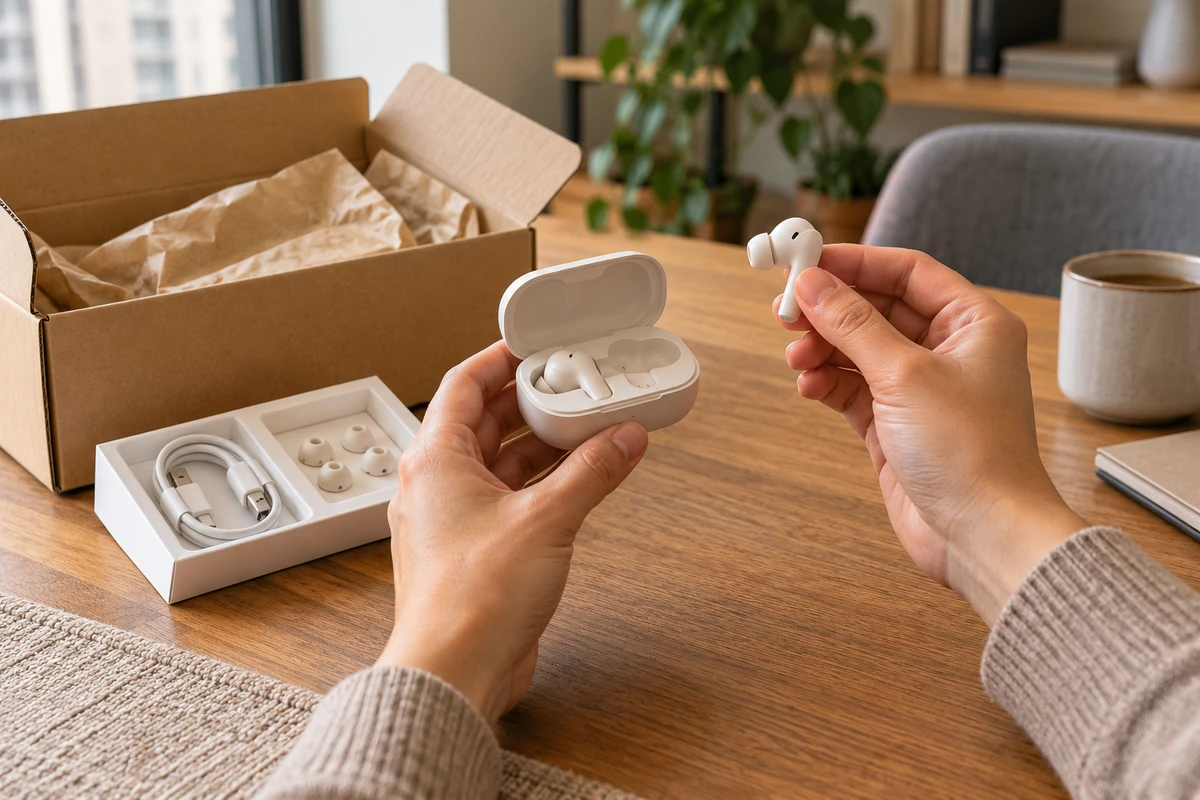
Product identity and operation are well suited to video evidence. During unboxing, the model on the retail box, charging case, left and right earbuds, cable and actually included accessories should remain identifiable. If packaging or accessories differ by market, the production cannot quietly substitute a sample from another version. A pairing sequence should preserve the connection from opening Bluetooth settings and finding the device to confirming connection, not jump directly to a success screen.
Controls, fit and microphone claims also require a distinction between seeing an action and judging performance. A viewer can observe a tap, an earbud in an ear and a call situation. They cannot infer all real-world audio performance from the finished soundtrack. “Clearer calls,” “low latency” or a specific battery duration requires traceable evidence, test conditions and, where relevant, a defined comparator. A creator’s statement that something sounds good should not be upgraded into a universal performance guarantee.
For the same reason, 3D animation and polished close-ups can explain structure or brand character, but they cannot impersonate real fit, real pairing or a real microphone test. ONCE’s guide to matching product claims with evidence, shots and on-screen qualifications provides a useful adjacent production check: what supports the sentence, what the image actually proves, and which conditions must survive the edit.
2. What will I finally pay? Video can signpost; the price system must remain consistent
A large price card is not full price communication. In Nigeria, the FCCPC consumer-rights page currently separates plain and understandable information, full price disclosure, transaction records, accurate marketing and timely delivery. Its business guidance on ecommerce also says product, price and promotional disclosures should be known before payment and that an effective complaint-redress mechanism should exist.
The production implication is not to paste legislation into a short video. It is to define the number: whether delivery or tax is included, who qualifies for an offer, when it ends, which currency applies and who the seller is. If price changes by city, inventory or channel, a more durable line may tell viewers where to confirm the current total instead of welding a short promotion into a long-lived asset.
Kenyan rules cannot be copied from Nigeria. Kenya Law’s Consumer Protection Act treats false, misleading or deceptive representations as unfair practices, including statements about performance, accessories, model, delivery time, price advantage, rights and remedies. A Competition Authority of Kenya discussion of drop-shipping also identifies payment, returns, delivery period, pricing and the responsible complaint party as issues that should be addressed proactively. For production, “buy now,” “last units” or “delivery across the city” must come from a real page and fulfilment system, not from editing energy.
3. When will it arrive? A creator cannot guarantee logistics
A presenter can explain why quick access to the earbuds matters in a commute or work context. They cannot promise an unverified arrival date on behalf of a logistics operation. Lagos and Nairobi versions should separately confirm delivery area, order cut-off, carrier or method, address requirements, tracking route and the process for communicating a delay. Even if the two cuts share most imagery, their CTAs may be completely different.
If the business can only support a delivery estimate in part of a city, the claim should narrow rather than hide behind “usually fast.” The order page supplies current service options and charges; customer service and logistics update exceptions; video takes viewers to the correct place to check. Faster editing will make a delivery claim more prominent. It will not make a parcel arrive faster.
4. Who helps when something goes wrong? Redress is part of seller identity
The CAK’s public consumer-complaint process describes possible administrative remedies including refund, replacement or repair, and withdrawal of misleading representations. Its drop-shipping discussion asks a particularly practical question: when a platform, drop-shipper and supplier are involved, who handles delayed delivery, poor quality or a wrong order? It calls for terms to identify the complaint recipient and the redress mechanism.
That translates directly into a cross-border video brief. The end frame should not contain only a brand line. The team should confirm the real seller, customer-service entry point, return period, warranty responsibility, repair or replacement route and the order information a customer must keep. A creator may say “see the product page,” but only if the page contains the information and the route works. If the brand has not decided who handles a fault, that is an operating-design problem, not a performance problem.
The two regulatory routes are separate; approval is not a cultural preference
As checked on 6 October 2026, the official ARCON advertising-vetting page says its process is intended to check misleading statements, spurious testimonials, visual or verbal exaggeration and misleading offers. It says advertisements in a vetting category should not be exposed before the Advertising Standards Panel issues approval. A 2022 ARCON public notice for bloggers, skit makers, influencers and other online creators also brought digital commercial communications into its compliance and pre-exposure approval reminder.
The local brand, advertiser, agency and compliance owner should determine whether and how the actual material, entity and channel must be submitted, and ensure the approved version matches the release. This is a Nigerian advertising process. It is not evidence that Nigerian audiences prefer formal advertising, and it cannot be applied to Kenya.
In 2026 the Nigerian FCCPC published exposure drafts that included proposed treatment of AI content and commercial influence disclosure. The official resources page read in this round continued to identify them as exposure drafts, so this article does not present the draft influencer provisions as rules already in force. For a current project, the sounder route is to check existing FCCPA consumer rights, official ARCON vetting information and the actual channel requirements. If a brand uses a synthetic presenter or synthetic testimonial, an appropriate local owner should check the latest status again.
In Kenya, the CAK says its consumer-protection function under the Competition Act covers false or misleading representations and unsafe, defective or unsuitable goods. The current Kenya Law text additionally addresses representations about price, performance, accessories, delivery and remedies. These are rules about commercial expression and transactions, not a Kenyan aesthetics checklist. Any other category, industry or platform approval still has to be assessed against the real SKU and release channel.
This article is not complete legal clearance for either country, and it does not assume that every creator asset follows an identical process. The practical production response is to maintain two independent checklists at script stage rather than to let one regional cut stand in for the other after editing.
How one asset system becomes a Lagos version and a Nairobi version
The shared layer should contain only product facts that do not change with the city: the appearance of the same SKU, box contents, pairing sequence, buttons and touch controls, and performance evidence obtained under the same defined conditions. These shots can be captured together in a controlled shoot, with room for translated captions, voiceover and different CTAs.
The local layer works backward from the buying task. Whether the presenter genuinely used the item, which language and register they use, whether the scene is a commute, office or home, and which doubt appears first should follow the selected audience. Price, delivery area, seller identity, return and warranty must connect to real local pages. A skyline, traditional dress or a collage of “African rhythms” cannot substitute for those decisions.
The two versions might use the same product demonstrator but require different end frames and disclosures. Or differences in audience, language and use context may justify separate presenter sections. The criterion is not the quantity of local symbols. It is whether each difference helps someone understand the product accurately or complete the transaction.
The earlier United States market article separated presenter identity, product evidence and endorsement disclosure. The South Africa article separated relevance, verifiability and operational fulfilment. This article takes the fulfilment question further by dividing it into four transaction questions, so a region’s trust problem is not handed to a single friendly face.
A minimum test: did the questions get answered, not which country liked whom
Define a segment at the same purchase stage separately in Lagos and Nairobi. Then compare two openings: one enters through a commute or work situation with a creator, while the other begins with the model, box contents and pairing action. Keep the SKU, offer, demonstration conditions, clarity, principal presenter and media opportunity as similar as possible. Do not change the creator, promotion and landing page at the same time.
After viewing, first ask people to answer four questions: what will arrive, what will be paid, when it will arrive and who will help when something goes wrong. Ask which answers came from the video and which still require a page check. Only then record liking, presenter relatability, claim credibility, click or purchase intention separately. Understanding, liking, trust, intention and clicking are not interchangeable. Causal incremental purchase requires a more appropriate randomised or holdout design.
If the creator opening is more liked but creates mistakes about accessories or warranty, keep the person and rewrite the information order. If the demonstration is understood but viewers still do not continue, price, delivery or seller identity may be the constraint. If the page is clear but the complaint route does not work, further video optimisation cannot complete trust. A test that permits the team to reverse its judgement is more valuable than the claim that “people here like authentic UGC.”
Conclusion: the friendly face opens the door; the complete transaction keeps it open
Nigeria and Kenya should not be collapsed into one “African version.” Even when the same earbuds and core demonstration are shared, the selected audience, presenter language, sales route, price, delivery and redress path in Lagos and Nairobi must be defined separately. Cultural style is not a filter applied to the final cut. It is the set of conditions through which people interpret the presenter, product and transaction.
A useful production brief should identify the target city and segment, viewing placement, real SKU, four transaction questions, presenter identity and experience, supportable claims and conditions, local seller, delivery and service route, and the result that would cause a revision. Lock those facts before choosing handheld or studio, formal or conversational, English or another language version.
If a brand is preparing cross-border product content for Nigeria or Kenya, ONCE’s cross-border ecommerce product video solution can help turn shared product evidence, local presenter sections, price and fulfilment information into a version list that can be filmed, reviewed and updated. A creator can invite the viewer closer to the product. Transaction trust comes when the camera, page and operation provide consistent answers.
Source scope: research was checked through 6 October 2026. This article read official ARCON vetting information and its public notice, FCCPC consumer-rights and ecommerce guidance, Kenya Law texts for the Consumer Protection Act and Competition Act, CAK consumer-protection and drop-shipping materials, and the institutional-repository abstract for Ighomereho’s 2025 study. That study is a cross-sectional survey from Osun State, not a Lagos/Nairobi earbud-video experiment; the CAK article is a regulator-authored analysis, not a national preference survey. This is ONCE editorial analysis, not a systematic review, client-results claim or complete legal opinion.