When a production partner turns a short brief into a long video prompt, what have you purchased? Formatting the request for a model and inventing additional shot or sound direction are different activities. Both may be useful. A word count does not tell a brand which one it received.
For overseas teams commissioning product content from China, the practical issue is the added decision: did the partner clarify your instruction, develop the creative treatment or quietly change the product? Review that difference before approving generation.
Why a formatting comparison matters
VideoGen executives David Grossman and Anton Koenig’s October 21, 2026 preprint on prompt expansion versus formatting compares raw, formatted and expanded versions of 30 authored prompts with one generator and a fixed seed, using one render per condition. Two automated evaluators did not fully agree on the overall gain beyond formatting, and visual-quality ratings changed little.
This is a short-clip pilot, not a human audience study or advertising effectiveness test. Its useful purchasing lesson is methodological: comparing a raw sentence only with a finished expansion does not isolate the value of creative additions from the value of reorganizing input.
Runway’s Enhancing your Prompts documentation describes adding camera, lighting, texture, motion and mood details, and tells users to review and adjust the result. We checked the page on October 28, 2026; it displays no publication date. That access date is not a launch date.
ONCE’s prompt change sheet
This is a proposed working method, not a completed client test. Keep the original request and the actual expanded text submitted to the generator. For consequential additions or changes, identify what changed, why and who should confirm it. Focus on decisions affecting what viewers see, hear or understand, rather than requiring approval for every adjective.
Separate three kinds of work. Formatting includes field organization, clarification and model-specific structure. Creative additions include framing, movement, performance, surroundings and score. Changes to product properties or already agreed requirements include structure, action, spoken lines and sequence; those require a return to the approved information and the relevant decision-maker.
Disclose defaults too. Adding ambience to a silent brief is an addition even if it happens during formatting. For batch work, a common rule set and an exceptions list may suffice. For bespoke shot development, use shot-level notes. The paperwork should fit the assignment.
Keep product information out of the invention process
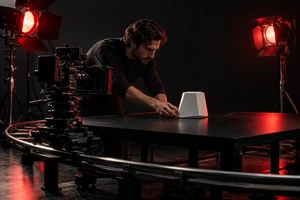
Consider a hypothetical brief: a white matte pump bottle on a table, with a hand pressing once. Side lighting and a slow camera move can be proposed as treatment options. Changing the bottle to transparent glass, adding a metal sprayer or showing mist changes the object or action. It is no longer merely a more polished instruction.
An added mechanical click also deserves attention. It may be a deliberate creative sound, but could imply that the product produces that feedback. If authentic operating sound is required, request a checkable recording or use an actual recording workflow. Plausibility generated by a model is not confirmation.
Before expansion, identify the approved product reference, required action, fixed lines and sequence. Then identify open choices such as lighting, framing and atmosphere. Missing product information should trigger a question or omission, rather than an invented detail in the enhanced prompt.
Approve the sample, with separate picture and sound judgments
Select a shot the team genuinely intends to produce. Retain a formatting-only version and an approved expansion. Compare them using the same tool, model version and controllable settings; record outputs and failures. If seeds or other controls are unavailable, disclose that limitation. Do not compare a carefully selected winner from repeated expanded generations with a single attempt at the control.
Check product identity and the required action first. Then assess picture, sound and their coordination separately. Richer music cannot establish more accurate product details. A pleasing overall impression cannot excuse a pump turning into a sprayer. If the purchase is intended to improve sound, say so in the acceptance objective.
If additions show no dependable help in the sample, remove unnecessary or conflicting instructions before expanding the experiment. A limited comparison cannot establish a universal advantage. Nor should a team keep paying merely to receive longer text.
Specify the service you intend to buy
Separate input preparation, shot development, sample generation, product checking and revision scope in the proposal. Formatting alone should not silently become a promise of complete creative development. Creative expansion should identify which ideas the partner may propose and which decisions return to the brand. Agree on sample limits and stopping conditions.
For ONCE, a potentially useful operating asset is a record of which additions helped which production tasks, grounded in actual outputs. That would require real delivery evidence; it is not a claim that a universal template or proven service result already exists. Begin the next engagement with a short change sheet and a formatting comparison, then choose the next investment from what the sample shows.
Sources checked October 28, 2026. Research findings, ONCE’s proposed method and the hypothetical bottle example are distinct. This article reports no original generation test, client performance or cost saving.