Your robotics team has booked a product shoot with a Chinese production partner. Marketing needs a launch film; engineering asks whether the same session can also supply training data. Sharing the venue may be sensible. Sharing one acceptance criterion is not.
ONCE recommends defining two deliverables before recording. The film serves an audience. The engineering package serves a specified data pipeline. If that pipeline requires robot actions and states paired with observations, a continuous camera recording can still leave essential information missing.
A public format makes the difference concrete
Hugging Face introduced Datasets v3.0 in its October 24, 2025 LeRobot v0.4.0 release article. The current LeRobotDataset v3.0 documentation describes multimodal time series, sensorimotor signals, multi-camera video and metadata. Its loading example includes state, action, images and timestamps.
The format also separates video, frame data and task or episode records. An episode is a bounded task recording. In v3, one video file may contain several episodes reconstructed through metadata, so counting files does not establish the number of accepted task records.
This is one concrete robot-learning format, not a universal requirement. Video-only learning, action recognition and other observation-based uses may need different material. This article addresses the case where the buyer explicitly requires paired robot actions and states. It does not claim that all training data needs those signals or that LeRobot is the only format.
Agree the engineering receiver before promising a dataset
A marketing edit can use close-ups, cuts, grading and time compression to explain a real capability. A data capture must satisfy the target task’s observation, timing and signal requirements. An attractive camera angle may not be the required observation view. Removing a pause can change its relationship to the action log.
Ask the engineering owner to define the intended use, receiving format, camera views, required signals, timing relationship, task boundaries, outcome labels and permitted processing. Calibration and additional sensors should follow that specification, not a universal film-equipment checklist.
The technical team owns robot operation, signal acquisition and meaning. The production team owns the agreed image capture and public communication. If there is no defined receiving and validation process, commission a demonstration video first rather than implying that raw footage includes an unspecified training service.
ONCE’s two-deliverable agreement starts with a usable sample
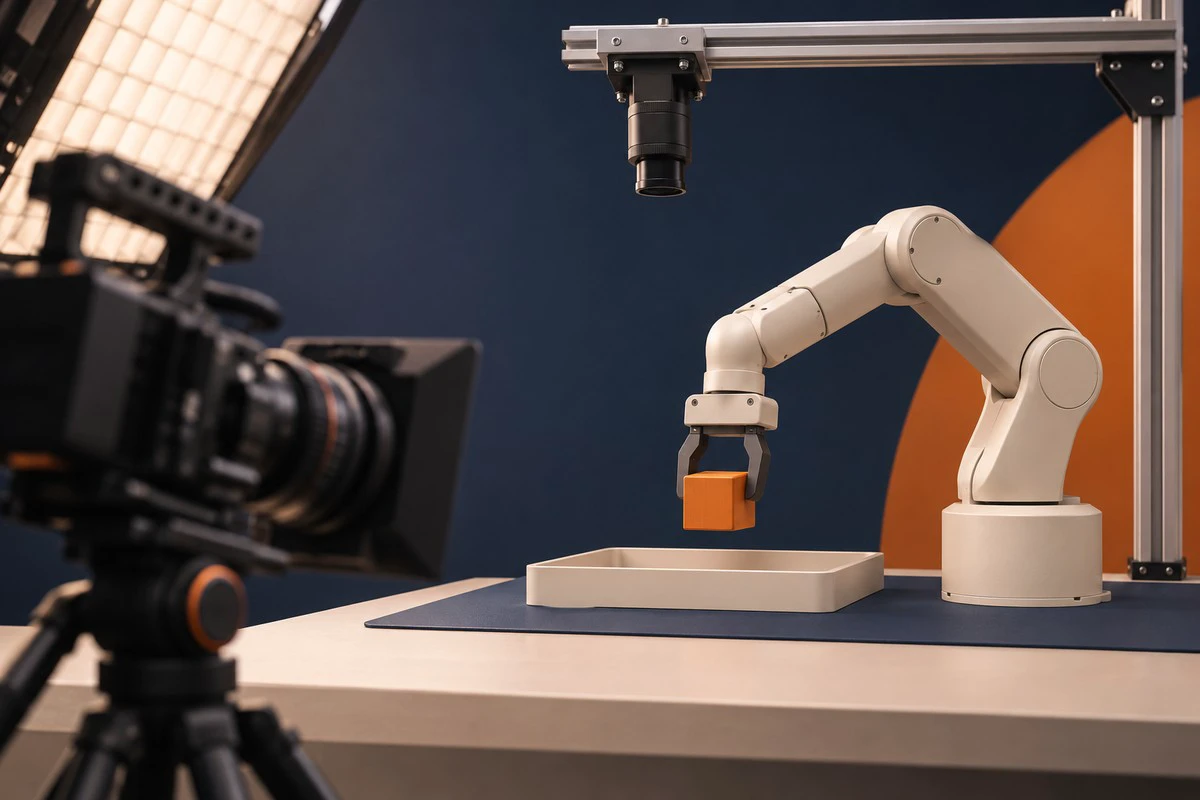
Imagine a fictional supplier demonstrating a tabletop sorting arm for an overseas launch. Before collecting at scale, record a representative task and have the receiving engineer load the package through the intended reader. One episode is a small integration starting point, not a sufficient sample for proving dataset quality or learning performance.
- Marketing acceptance: approved messages, footage, language and placement versions.
- Engineering acceptance: required observations, actions, states and metadata in the agreed structure, with recorded checks.
- Shared identification: task record, robot and software configuration, interventions, exceptions and permitted uses.
Playback is not enough. Check that required fields exist, a selected image time maps to the expected state and action, task boundaries are identifiable, and missing frames or exceptions can be detected and marked as agreed. The engineering owner sets tolerances; this article supplies no universal synchronization threshold.
If the receiver cannot load the sample, repair capture or packaging before expanding volume. If marketing simply needs a tighter beauty shot, record it as promotional footage rather than counting it as another engineering episode. Retention and labeling of interrupted attempts, resets and takeovers should follow the dataset’s purpose.
Share preparation where possible; preserve each file’s purpose
The product and set may be shared. Cameras, lighting and operating arrangements require specification-level agreement. Changing light for a reflection or moving an observation camera should trigger a check of its effect on engineering capture.
Identify original capture, engineering-processed versions and promotional derivatives in the file list, retaining their relationships. Do not silently write advertising speed changes, montage edits or AI repairs back into the engineering originals. If engineering requires transformations or synthetic augmentation, process and validate them under that separate method.
Continuous demonstration footage remains useful for technical review. It is distinct from an action-and-state dataset, a formal performance evaluation and a trained model’s eventual result. See ONCE’s video production articles for related planning.
Quote the responsibilities separately
Separate the launch film, capture integration, specified task recording, data preparation and engineering review. Identify shared preparation and distinguish creative revisions from recapture caused by an unmet data specification. Shoot duration, storage volume and edited seconds cannot alone stand in for engineering acceptance.
For ONCE, the opportunity to investigate is a traceable relationship between product knowledge, public footage and engineering records. Any data service would require suitable engineering partners and receiving capability. This article claims no existing ONCE dataset capacity, client results or improvement in robot learning.
Scope: Official materials checked November 8, 2026. This is current-source-backed production analysis, not a new-release summary. The agreement and sorting example are recommendations and hypothetical planning, not a capture test or certification. The original AI cover is conceptual.