A factory and a brand team can approve the same elegant fashion clip for different reasons. One sees a clean rendering; the other assumes that the blue, weave and drape will help a shopper understand the garment they will receive. If an AI pass quietly smooths the weave or changes the shoulder shape, a beautiful edit can become weak product information. The practical answer is to commission a verified product layer before commissioning endless visual variants.
What the Zalando requirement actually changes
In its video guidelines, updated August 31, 2026, Zalando says low-quality AI footage with artifacts such as pixelation, unnatural texture and anatomical inconsistencies is not permitted. The policy calls for fabric, colour, pattern, materials and finishes to realistically match the physical product, and for the correct colour variant to appear. It also addresses believable models, lighting and shadows.
This is a rule for videos submitted to Zalando, not proof that every retailer has adopted it or that all generated footage performs poorly. Its commercial implication for a brand working with a China-based manufacturer or production partner is nevertheless useful: the approval question for a product-detail-page video is not merely “Does it look premium?” It is “What could a shopper infer about the item from this frame, and is that inference true?”
There is also a delivery distinction. Zalando's current page says product videos should carry no written text or sound, should be portrait, ideally run about 15 seconds (with 12–18-second edits), and include a JPEG preview image. It specifies MP4/H.264, at least 24 fps and a 250 MB maximum. Treat these as a current channel checklist, not as universal creative specs; verify the page again before submission.
Commission two masters, with different approval owners
ONCE's proposed production method separates a physical-product master from an expression master. It is a workflow recommendation, not a new platform mandate.
1. Lock the physical-product master
For every sellable colour variant, collect the approved SKU identity, a physical swatch or production sample, close views of fabric and finish, construction details, and a fit or movement reference. Record whether the sample is pre-production or final. Assign one person who can resolve mismatches between the sample, the product specification and the final inventory.
Capture neutral-light front and back views, material details and movement in a controlled setup. These shots need not all appear in the final 15-second cut. Their job is to serve as a comparison set when the footage is graded, reframed, retouched or generated. If the approved final garment does not yet exist, a generated mock-up can still support internal concept work; it should not be mistaken for verified product evidence.
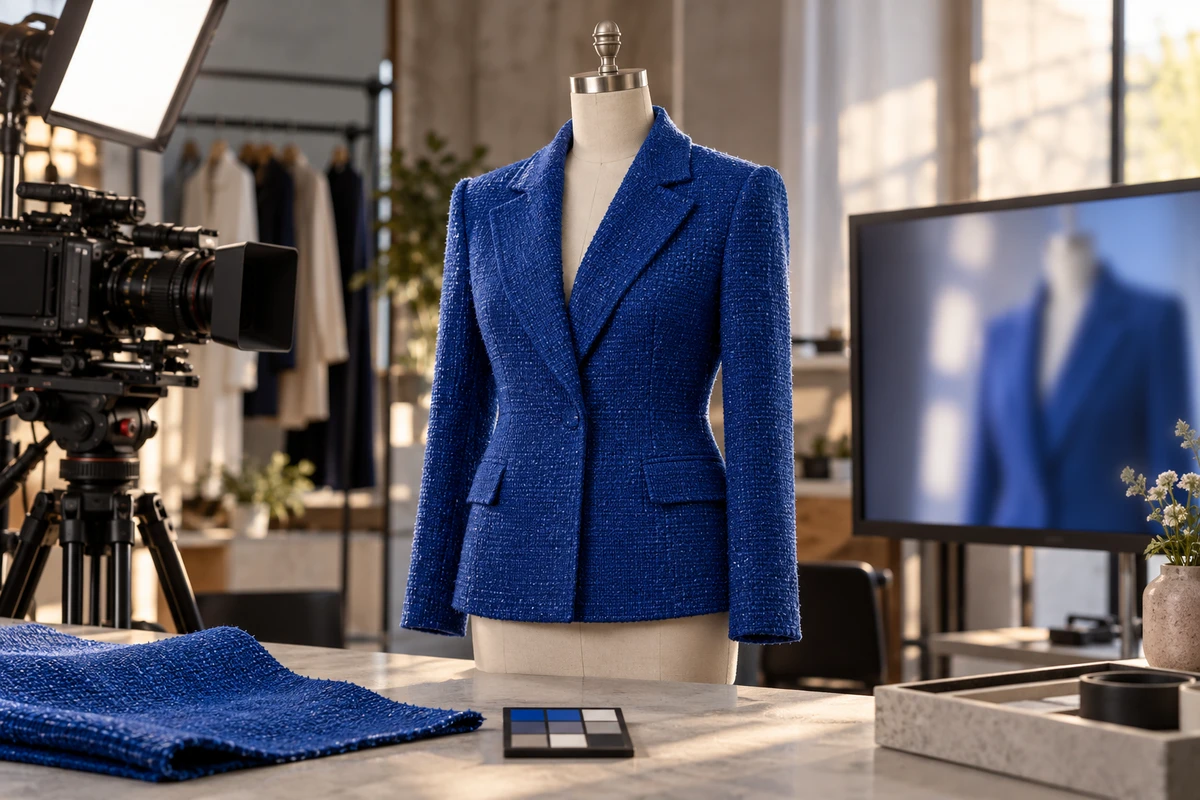
Consider a textured blue jacket manufactured in one facility and marketed by a team abroad. The exact colour family, weave, buttons, lapel shape and how the shoulder moves are product facts. A different background and a faster cut can change the story. Smoothing the weave into a plain cloth or creating a structured shoulder that the garment lacks changes the item itself. No AI model has authority to settle which sample is the sellable SKU.
2. Build expression variants around the locked item
Once the facts are approved, use creative and AI tools for scene development, concept frames, cleanup outside the product, sequencing and channel-specific reframing. Put generated edits affecting garment texture, colour, geometry, fit, model continuity or contact shadows through a frame-level comparison with the approved references. The point is not to ban AI; it is to keep product truth from becoming an accidental creative variable.
Keep a Zalando-specific export separate from paid-social or brand-film variants. Text, soundtrack and slogans may be appropriate elsewhere but are not permitted in this particular product-video submission. A single “universal” master often hides exactly this sort of channel conflict.
A four-question approval gate
Before a product clip leaves the production team, ask: Which exact variant is on screen? What physical properties does motion imply? Does the model or setting create a false fit impression? Does the exported file still pass both product and channel checks? Compare answer one to the approved item, not to another image generated by the same system. For answer two, watch how the material bends, shines and falls; a still frame alone is insufficient. For answer three, inspect body proportions, reflections, contact points and shadows. For answer four, inspect the actual delivered file and thumbnail, not the editing timeline.
Record each outcome as pass, reshoot or regenerate, with the SKU, reference sample, reviewer and version. A brand can then tell a vendor exactly what is missing. A vendor can price a factual capture package separately from scene variants and platform exports. That division will not guarantee fewer returns or higher conversion—neither is established by the guideline—but it makes the approval responsibility and potential rework visible before scale.
Our earlier product-scale workflow addresses how camera perspective can distort apparent size. Material and colour fidelity require a different check, even when scale is right. For overseas marketing teams using a China-linked supply chain, the next brief should request the physical reference owner and sellable sample status alongside the shot list. For production partners, show that reference set at the first review, not after the final export.
Source and limits
Source: Zalando Partner, “Zalando video guidelines,” updated August 31, 2026. The two-master workflow and four-question gate are ONCE's analysis. They have not been presented as Zalando rules, measured customer results or an industry-wide policy.