A living room can have a coherent palette, expensive furniture and perfectly placed accessories yet still feel like a location waiting for its next photo booking. The challenge in home product ad set design is not always to make the room prettier. It is to make the viewer believe that someone lives there and that the product participates in that life.
A crooked cushion and two casually scattered books do not automatically solve the problem. A lived-in feeling comes from meaningful relationships, not a quantity of clutter. Who puts the cup here? What were they doing a moment ago? What will they reach for next? These questions offer more direction than asking for “a little more authenticity.”
The Room Introduces Its Occupant Before They Appear
Gosling and colleagues’ 2002 study, A Room With a Cue, examined judgments of occupants based on offices and bedrooms. The researchers’ official overview describes some agreement and accuracy, varying by context and personality trait, with gender and racial stereotypes also influencing judgments. This was not an advertising conversion experiment, nor proof that a room reveals everything about a person.
For production design, the useful reminder is that environments invite inferences, and those inferences can miss our intention. Neat hardbacks might suggest reading or merely decoration. A desk full of instruments might suggest expertise or make a home resemble a laboratory.
A room does not need an exhaustive character biography. It needs a few facts relevant to the scene: whether the person lives alone, what else the table is used for, what they reach for daily and what they cannot quite bring themselves to put away. Props should respond to those facts rather than treat age, income or nationality as a ready-made decorating scheme.
IKEA’s Bring joy home feature for its Life at Home Report 2024 describes different households finding enjoyment through music, shared activities, personal objects and routines. Its value here is the variation, not a standard kit for a happy family. Our creative interpretation is to choose the particular life being portrayed before choosing its visual style, instead of compressing everyone’s aspirations into one beige living room.
One Side Table, Three Different Kinds of Scene
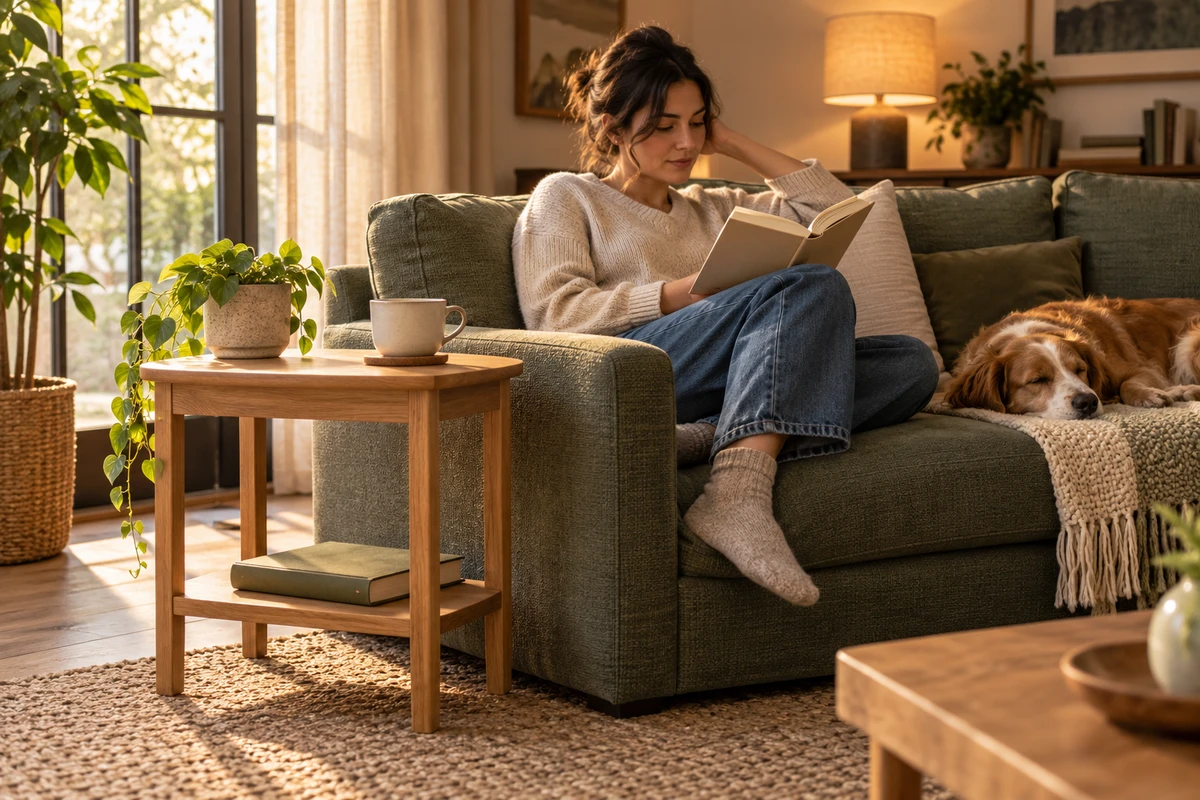
Imagine an ad for a side table with an open lower storage level, featuring someone reading on a sofa in the evening. This is a creative exercise, not an ONCE client case or instructions for a particular model. Dimensions, load limits and suitable placement must come from the actual product.
Catalogue Arrangement: Make the Design Legible
There is one cup on top and one book below. The silhouette, levels and materials are clear. Nothing needs explaining. This is a valid approach to a product display shot; it is neither inferior nor obliged to imitate a documentary.
The problem arises when an entire film uses this same state while claiming to show daily use. We see what can be placed there, but not why the table is needed at this moment.
Unmotivated Clutter: More Objects, No More Life
Add a remote, tablet, vase, headphones, magazines and snacks, and the room becomes fuller while the person becomes less specific. Are they reading, working, eating or waiting for someone? Objects added to fill gaps create another kind of display.
A particular warning sign is when every object avoids its natural position to keep the product visible. The cup sits beyond the actor’s reach; a book occupies a gap from which it cannot comfortably be retrieved. Every movement serves the composition. The supposed realism works only as a still.
A Changing Arrangement: Let Use Leave a Trace
Start with fewer objects. The person sits with a bookmarked book, moves another volume from the tabletop to the lower level, and puts down a cup. After reading, they replace the bookmark and leave the surface clear. The table supports temporary placement and storage within an activity. Voiceover need not explain every prop.
The point is not the number of books or cups. Their positions change for an understandable reason. What one shot leaves in a place must be picked up from that place in the next. The dressing now connects moments in time as well as suggesting a home.
Letting Life In Does Not Mean Hiding the Product
Home advertising needs a selective form of realism. An actual residence may contain clutter, layouts or light that do not help the film. Bringing all of it into frame may make the product harder to understand. Conversely, a minimalist home can feel credible when its actions and relationships make sense.
In a lifestyle shot, a hand, book or piece of clothing can briefly obscure part of the product. A shot devoted to construction or materials can then provide an unobstructed view. Every frame need not deliver both natural life and a complete catalogue image. Otherwise the person looks as though they are making way for the camera, not using the furniture.
Design and camera teams should also distinguish two problems: are props concealing a useful feature, or has the camera not found a helpful viewing position? Adjust the dressing for the first and the shot for the second. ONCE’s discussion of product ad camera angles explores viewing relationships; the room still needs an explanation for why its objects are there.
Some traces change the product’s meaning. A folded page can suggest a book has been read, whereas wear on the featured product may misrepresent its new condition. A few toys can indicate an earlier activity; a blocked walkway can turn an easy domestic moment into a hazard. Details should serve the story without adding unverified implications about quality or performance.
Brand style need not disappear. A controlled palette, restrained materials and beautiful lighting can remain. What needs questioning is perfection without a reason: every book opened only for the camera, every garment folded as if for a shop display, every actor sitting where the product is easiest to see.
Give the Room a Complete Action Before Filming
Alongside reviewing reference images, let an actor or stand-in physically follow the scene. Where do they enter? What do they pick up first? Can they reach it once seated? What do they take when they leave? Watch a simple recording of the whole action before adding music or polished transitions.
If the team must keep saying, “Do not put the cup there; it hides the product,” reconsider the arrangement and action rather than give the actor more forbidden positions to remember. If removing a prop costs nothing in character, action or product information, it may be decoration added through habit.
A real home supplies specific traces of life, but using its objects requires permission and care around private information. A studio set gives the team control but requires it to establish those traces deliberately. Neither location type is inherently truthful or false. Judge the resulting image, not the status of the space.
The same action check can guide AI or CG set exploration. Treat a generated image as a visual proposal, not proof of dimensions, load capacity or physical usability. Check the real product’s proportions, placement requirements and space for movement before deciding how to make the scene. This article does not evaluate any particular generation tool or treat a smooth-looking demonstration as a validated one.
Finally, ask someone unfamiliar with the script to describe the scene. What was this person doing? What did the product help them do? Which object seems unexplained? Their answers are not statistical evidence of advertising effectiveness, but they can reveal narrative gaps the familiar production team has stopped seeing.
For a home or appliance campaign, bring product information, a recording of actual use and the everyday moment you want to portray to ONCE’s product and video production solutions. A good room need not announce its authenticity. Letting someone naturally complete an activity within it is often the strongest starting point.
Sources checked October 14, 2026: the Gosling Lab’s Physical Environments overview and IKEA’s official Life at Home Report 2024 feature. The filming methods and side-table scenario are editorial analysis and a hypothetical exercise, not client results, consumer research findings or proof of product specifications. The cover is an AI-generated creative illustration.