Product advertising has a stubborn visual shortcut: the lower the camera, the more imposing—and therefore more “premium”—the product appears. That idea is only half right. A low angle can enlarge a product and give it authority, but it also places the viewer beneath the object. That relationship may suit a performance car, a loudspeaker, or equipment built around power. For consumer electronics, furniture, or anything that must be touched and operated, the same angle can make the product feel remote, cumbersome, or hard to understand.
A camera angle is not a style filter applied after the creative decision. It first determines where the viewer stands, then shapes the relationship in which the product is understood.
Camera Height Sets the Viewer-Product Relationship
When comparing low, eye-level, and high angles, the useful reference is not the studio floor. It is the position of the lens relative to the product’s visual center.
Low angle: place the product above the viewer
Looking upward increases apparent scale, monumentality, and resistance. It can work for strength, performance, protection, scarcity, or a dramatic entrance. The trade-off is equally clear: top surfaces, controls, and internal structures become harder to see, while a front edge placed close to the lens can become disproportionately large.
Eye level: invite inspection and comparison
Eye level is not the same as visually flat. It puts the product on the viewer’s plane, making silhouette, material transitions, controls, and proportions easier to judge. When a film needs to explain design logic, tactility, or use, eye level can feel more credible than a continuous run of heroic upward views.
High angle: offer overview and control
Looking down turns the product into something the viewer can approach, arrange, or operate. High angles are useful for layouts, unboxing sequences, modular relationships, and hand actions. They can weaken authority, but often increase accessibility and perceived usability.
The productive question is not “Which angle looks most premium?” It is “Should the viewer admire, inspect, or control this product at this moment?”
Why Research Does Not Support a Universal Low Angle
Practical cinematography instincts are not merely matters of taste. In two studies published in the Journal of Marketing Research, Joan Meyers-Levy and Laura Peracchio found that camera-angle effects varied with a viewer’s motivation to process the ad. Different angles mattered under low and moderate processing motivation; under high motivation, the same advantage did not hold in the same way. An angle that wins quick attention is not automatically the angle that helps a buyer evaluate information more deeply. Read the abstract.
Three experiments by Thomas van Rompay and colleagues similarly found that verticality cues can strengthen luxury impressions, while price expectations and purchase intentions vary with product type and consumer characteristics. The evidence supports a narrower claim: vertical relationships carry meaning. It does not support “low angles work for every premium product.” See the study.
This distinction matters in creative planning. If the film only needs to stop a fast scroll, a forceful angle may be useful. If it must explain a connector, compare capacities, or demonstrate an easy operation, clarity may deserve priority over dominance.
Anthropomorphism Can Reverse the Meaning
Brands often give products a face: two circular sensors become eyes, a light strip behaves like an expression, or a body movement resembles a nod. At that point, viewers are no longer judging only object size. They are reading a social relationship.
A Journal of Advertising paper based on four experiments, including a field experiment, reported that consumers preferred looking up at non-anthropomorphized products, while looking down could improve evaluations of anthropomorphized products. The authors connected this reversal to dominance and expectations about how the product would treat the viewer. The finding has boundaries and should not be applied mechanically, but it is a useful warning: a friendly home robot may not benefit from being staged as a monument looming over its owner.
If the intended role is “reliable guardian,” a modest low angle may fit. If the role is “helpful companion,” eye level or a slight high angle will often feel more natural. The angle should serve the character, not a generic idea of prestige.
Do Not Confuse Angle With Focal Length
Many supposed camera-angle effects are actually caused by changing height, distance, and lens at the same time. Canon’s guidance on wide-angle imagery notes that wide lenses enlarge nearby subjects while making the middle and far distance appear more remote. Nikon’s focal-length guide likewise explains that focal length determines angle of view and magnification; normal lenses retain a relatively natural view, while telephoto and macro lenses support tighter product framing and detail. Canon explains wide-angle perspective here and Nikon explains focal length here.
Two upward-looking shots can therefore feel completely different. A camera pushed close with a wide lens exaggerates the nearest base or bezel. A camera moved back with a longer lens produces a more restrained perspective and more stable industrial-design proportions. The first creates impact; the second is usually better when shape accuracy matters.
If a test does not record focal length, distance, and product size in frame, the team may learn the wrong lesson from “high versus low.”
Three Product Tasks Need Three Viewing Relationships
Hero introduction: establish status first
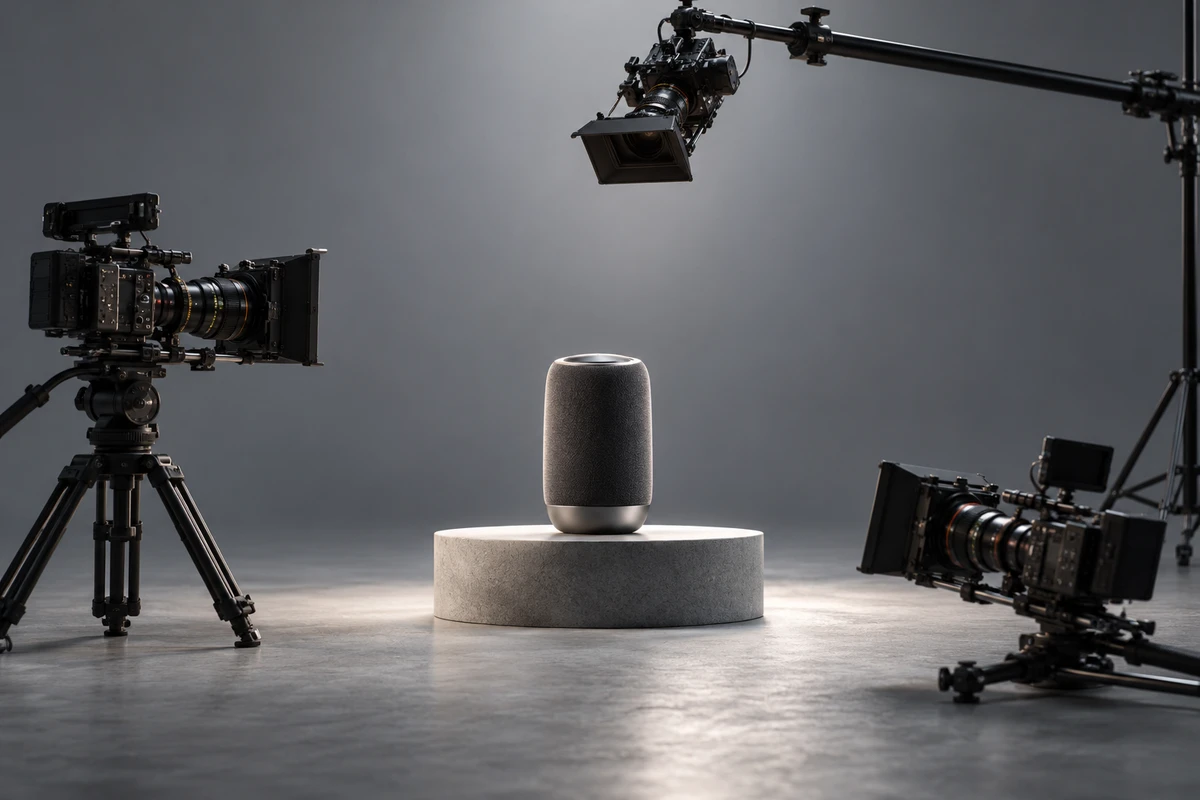
A performance vehicle, professional tool, or premium speaker can open with a slightly low camera to establish presence, then return to eye level and detail shots. Impact owns the first impression; clarity provides the proof. The entire film does not need to remain in a posture of admiration.
Feature demonstration: keep actions readable
When the value proposition involves opening, turning, connecting, folding, or a visible hand action, eye-level and high angles are often more useful. They make direction and component relationships readable. Prestige should not come at the expense of understanding how the product works.
Companion product: make proximity inviting
Home robots, small appliances, children’s products, and wearables often need an approachable personality. Eye level, a slight downward view, and enough negative space can make the product feel interactive rather than idolized on a pedestal.
Vertical Video Redistributes the Power Relationship
A low-angle shot designed for landscape can fail when cropped to 9:16. The enlarged base may dominate the frame while the top of the product collides with interface overlays. Google Ads advises keeping logos, products, and important information within safe zones because buttons, descriptions, and other interface elements can cover the edges of vertical video. See Google’s vertical video guidance.
Vertical delivery is therefore part of camera design, not merely a post-production crop. During production, check three frames independently: the landscape master, the complete product inside the vertical safe area, and the product’s recognizability without captions. If an angle only works in a wide frame, it is not a true multi-platform master.
Shoot Three Versions and Compare Meaning Before Beauty
The most useful decision method is not another mood-board search. It is a controlled three-angle camera test before principal photography. Keep product, lighting, background, action, and focal length constant. Place the lens center slightly below, close to, and above the product’s visual center. Move the camera enough to maintain a comparable product size in frame, and record the distance. Review all three versions first without music, copy, or transitions.
Ask four questions. Does the first read communicate power, usability, or intimacy? Is any key feature hidden? Does the product feel easy to touch and operate? Does its character remain consistent in both landscape and vertical frames? Those answers are usually closer to the commercial task than “Which version looks cooler?”
AI-generated angle explorations need one additional check: are interfaces, proportions, and reflections still describing the same product? Current generative-video research continues to identify precise camera control and 3D consistency as open problems. AI frames are valuable for exploring viewer-product relationships, but they should not be mistaken for a controlled camera experiment.
A strong product shot does not always elevate the product. It places the viewer where the value is easiest to understand. If you are planning a product film that must balance a hero image, feature clarity, and multi-platform crops, explore ONCE’s video production approach or contact the team to bring camera-angle testing into storyboards and pre-production.
Sources
- Meyers-Levy, J., and Peracchio, L. A. “Getting an Angle in Advertising: The Effect of Camera Angle on Product Evaluations.” Journal of Marketing Research, 1992.
- van Rompay, T. J. L., et al. “Embodied Product Perception: Effects of Verticality Cues in Advertising and Packaging Design on Consumer Impressions and Price Expectations.” Psychology & Marketing, 2012.
- “Looking Up or Down? Effects of Camera Angle on Consumer Evaluation of Anthropomorphized Products.” Journal of Advertising, 2023/2024.
- Canon, “Visual Power in Wide-Angle Imagery.”
- Nikon, “Understanding Focal Length.”
- Google Ads Help, vertical video and safe-zone guidance.