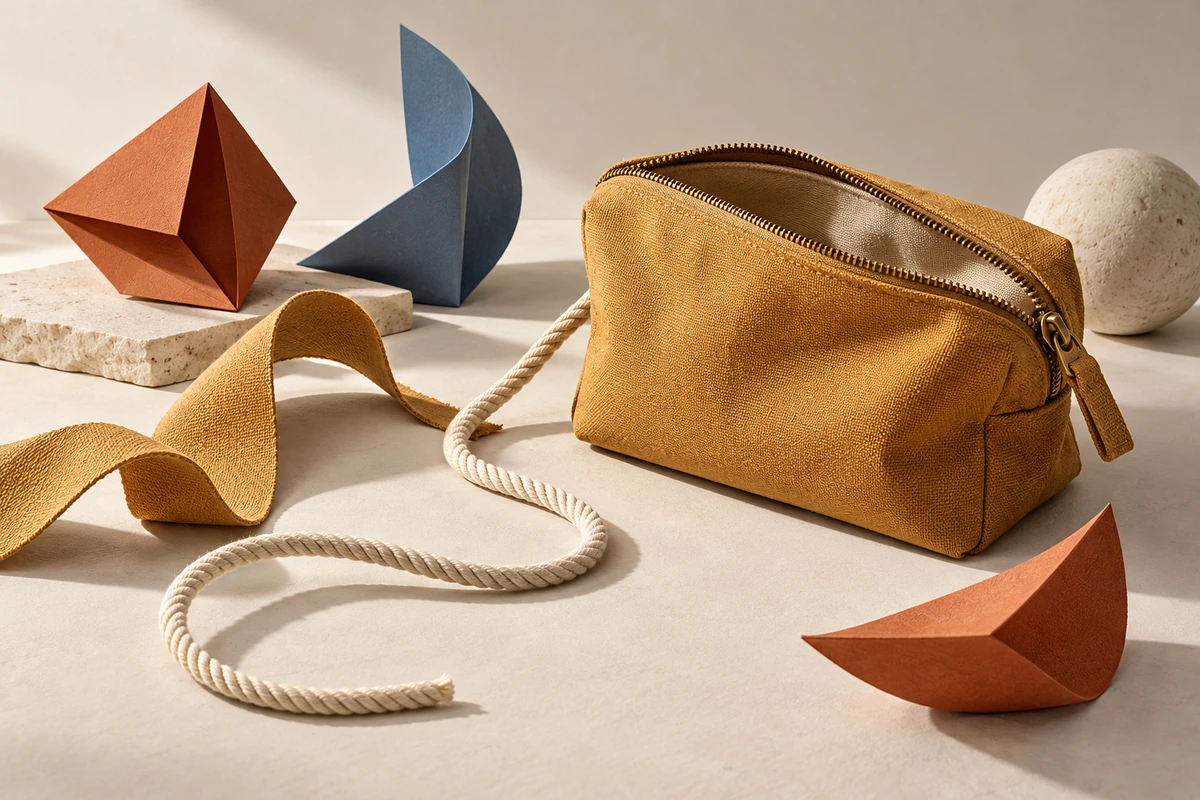
A storage pouch hopping around a tabletop can be charming. A zipper travelling around its opening, turning flat fabric into a volume, starts to tell us something about the object. Both can be animated in stop motion, but one mainly creates activity; the other connects movement to structure. This is a creative hypothesis, not a client project.
The reason to invest in stop motion product advertising is not simply a slightly staccato image, or the assumption that handmade work is inherently more sincere than digital production. It gives materials that cannot move by themselves a character: paper folds, thread pulls, components find one another. The question is whether those actions help people understand the product or create a feeling that belongs to the brand.
Let Materials Become Characters, Not Just Scenery
In a Dragonframe production interview with SoDaze about Strathberry, published July 10, 2026, the animator describes two craft films. One follows a spool and thread; the other lets a leatherworking tool drive the action. Fine wire inside the thread helped it hold its poses. This is a production account, not our independent viewing test or evidence of sales impact.
The useful idea is not merely to make a bag move. It is to bring materials and tools normally left backstage into the story. Thread has a job that can carry the action; tools do more than suggest a professional workshop.
Start by asking which verbs suit a material. Paper might fold, turn and stack; thread might pull, wrap and tighten; rigid parts might align, connect and rotate; fabric might unfold, rise and gather. These are creative possibilities. The actual material still needs testing to establish what can be animated reliably.
Not everything has to move. If thread is guiding the product while rulers, scissors and packaging all dance around it, the action may lose its hierarchy. One material leading, with other objects providing direction or resistance, can be clearer than giving the whole tabletop a personality.
A Handmade Look Should Say Something Relevant
Rough paper edges, fabric texture and small impressions are a visual language. They do not automatically mean quality, warmth or sustainability. A cardboard world might make a toy feel playful but make a precision component seem poorly fitted. Meaning comes from the relationship between material, product, action and tone.
Hornet’s Happy Honda Days project description explains that the Honda and RPA holiday campaign used wrapping paper and combined stop motion with CGI. The material has a connection to seasonal gifting. Paper was not simply an arbitrary sign of creativity. This reading uses the production company’s written account, without inferring commercial results.
Ask whether changing the material would change the meaning. Needle-and-thread action could suit a repairable fabric product better than metal spheres orbiting it. A product positioned around precise assembly might call for readable component relationships rather than deliberately crooked edges.
An ad need not reproduce a factory. Metaphor is legitimate, but it should not be edited into an apparent manufacturing documentary. Pieces of cloth assembling themselves are animation. If the voiceover simultaneously claims that the actual product is entirely hand-stitched, that requires production evidence. A handcrafted image cannot establish that the merchandise is handmade, more durable or more sustainable.
Design Behaviour Before Choosing a Stepped Look
Applying a stuttering treatment across every shot changes the surface of movement. It does not give objects behaviour. Stop motion can be awkward or extremely precise; the choice depends on the object’s role.
Return to the hypothetical pouch. Spinning it mainly presents its exterior. Moving objects into suitable positions can communicate organisation. Closing the zipper along the real construction can guide attention to the opening. These are different tasks, not a ranking of good and bad ideas. Saying that all three are entertaining avoids the necessary choice.
Product-use actions must respect the object. Do not enlarge its capacity, imply that a manual step is automatic, or make a rigid shell bend simply to improve the shot. Deliberate exaggeration should read as imagination, not an undisclosed performance demonstration.
Think of an action as preparation, resistance, change and a visible result. Slack before thread tightens, alignment before a lid closes, or a pause after paper turns can establish behaviour. Speed, holds and movement increments can change with the action rather than obeying one mechanical beat throughout. This is a directing approach, not a validated conversion formula.
Space must support it. Viewers should understand where an object comes from, where it goes and why it stops. ONCE’s discussion of product ad set design explores that related problem. In stop motion, attractive props must not obscure the material’s path.
Physical Texture and Digital Production Can Work Together
Aardman’s May 26, 2023 Thatchers production account describes physical puppets made largely from silicone, with the two main characters’ faces tracked and added in CG. Digital work and physical materials are not mutually exclusive.
For a brand, the useful discussion is which elements deserve physical photography and which need digital control. Fabric weave, metal reflections and contact with a tabletop might be photographed. Supports may be removed; complex expressions or environments may use suitable digital methods. The choice depends on the intended image and project constraints, not on technological purity.
Keep three descriptions separate. Moving physical objects between photographs is practical stop motion. Designing comparable movement in 3D software creates a CG stop-motion style. Generating clay-like or paper-like footage explores a generative aesthetic. The results may resemble one another, but they are not the same production process.
Generative imagery can be one concept-development route for an imaginary paper world. When the selling point is an actual object’s construction, stitching or assembly, a pleasing generated image cannot replace verification. This article has not tested a particular model and does not claim that any route is always faster or cheaper.
Handmade Character Does Not Include Uncontrolled Flicker
Chosen texture and capture errors are different things. Dragonframe’s official flicker guidance identifies changing ambient light, inconsistent power, reflections from clothing and aperture movement as possible contributors. Camera and lens combinations need their own tests; there is no universal setting to copy.
There is more to the shoot than locking the camera. A few seconds on screen can span many physical adjustments. Daylight, people near reflective surfaces and a slightly shifted tabletop all need attention. A beautiful still frame does not establish that the sequence will be stable.
Nor should every material feature be erased for a cleaner finish. A crease, fabric fibres or small coating variations may serve the image. Accidental exposure jumps, visible supports or unintended product distortion pull attention away from the idea. Handmade character is a selection of visible qualities, not a blanket excuse for defects.
Make One Action Work Before Expanding the Film
Before developing the whole script, try a short movement with the real sample. This is not a miniature version of the entire ad. Choose the part most likely to determine the style: whether thread holds a curve, fabric can rise incrementally, or a reflection stays stable across frames.
The trial answers creative and practical questions together. Remove music, captions and slogans: can you still tell what the object did? If voiceover alone explains why the product is present, reconsider its action or role. Then try another rhythm. Does it feel precise, playful or hesitant? Such exploration helps a team choose; it is not a market-effectiveness test.
Some products do not need an entirely stop-motion film. An important continuous operation or real-time response may be better served by conventional live action. Stop motion can handle only an opening, transition or material transformation. A small, purposeful use can be stronger than an indiscriminate full-film treatment.
The pleasure of stop motion is the sense that this object could only behave this way, not merely that it finally moved. If you are developing a distinctive product story, bring the physical object, material details and the one value you want people to understand. Explore ONCE’s brand and video production solutions to discuss an appropriate creative and production approach.
Sources checked October 14, 2026. The cases use published written accounts from Dragonframe/SoDaze, Hornet and Aardman; technical guidance comes from Dragonframe. They do not establish general pricing, production speed or marketing returns. Pouch and fabric-product examples are hypothetical. The cover is an AI-generated concept image, not a photograph of an actual stop-motion production.