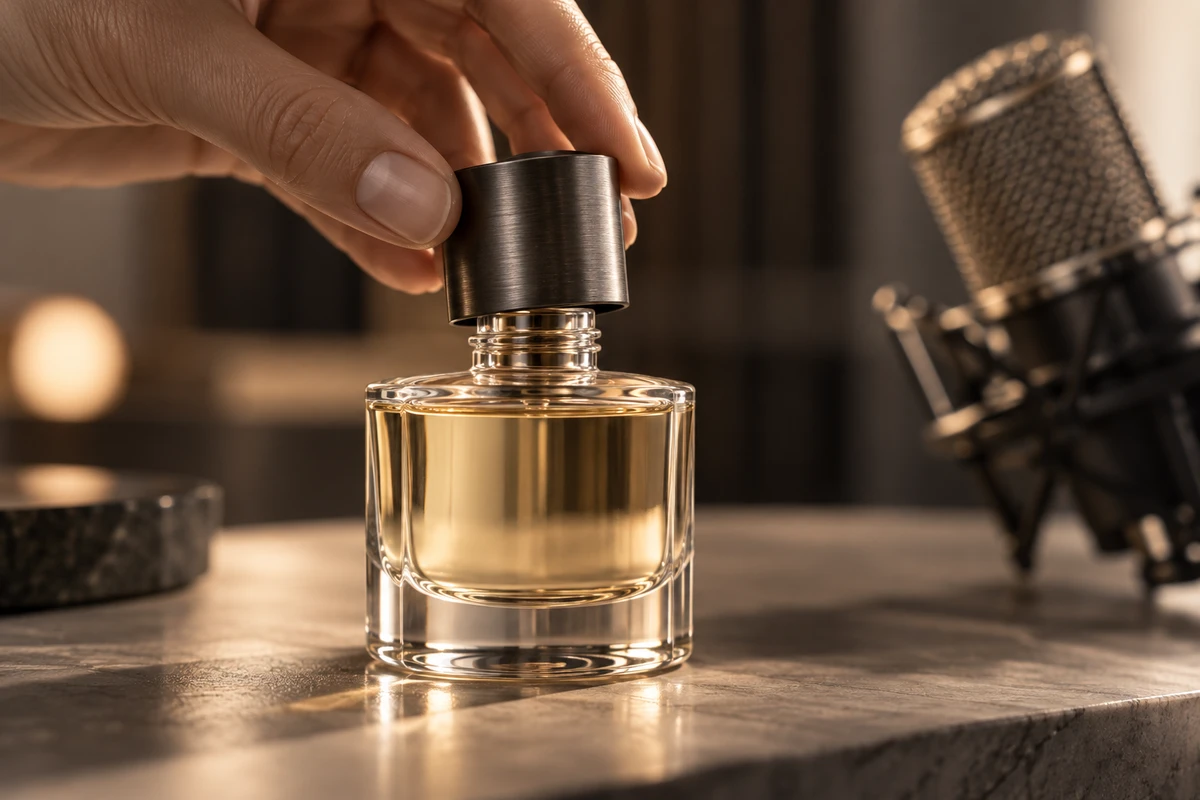
Imagine a perfume ad in which a hand turns a cap, lifts it and puts it back. The picture is clear, the lighting attractive and the music dramatic, yet the moment when cap meets bottle is inaudible. Remove the music and the object seems suspended in the image: the action is visible, but the contact has no presence.
Not every product shot needs a sound. Product ad sound design decides which actions deserve attention, which sounds can recede and which exaggerations belong to the creative rather than an account of the actual product. The bottle scenes here are hypothetical production exercises, not client work or listening experiments.
A moment of contact can contain a small story
Putting a cap back might involve a fingertip brushing the surface, contact with the neck, friction during rotation and a brief sound as movement stops. Not all of these need to survive the edit. Choosing one selects the relationship with the product that viewers should notice.
For a clean, decisive operation, the final sound may matter most. For a careful everyday ritual, the movement before contact may deserve room too. A strong effect on every step could turn the action into a mechanical demonstration. These are creative directions, not measured audience responses.
The sound also needs a considered relationship with shot size. A close-up can invite attention to otherwise unnoticed details. When the film cuts to a room-wide view, keeping tiny friction as prominent as if it were beside the listener’s ear could create a deliberate sensory style or disrupt the sense of space. The question is not simply how loud it is, but how close to the object it places the viewer. No universal setting resolves that choice.
A specific note in the boards is more useful than “premium sound effects”: keep the approach quiet, leave a short closure sound after contact and avoid a large impact. It tells the shoot which action to preserve and post-production what should not cover it.
Actual sound provides a reference; Foley shapes the expression
Adobe’s official guide, How to add sound effects to videos, describes Foley as sound created for a production, often timed to on-screen action, and distinguishes it from ambience and other effects. Foley is a way of making an action work in a film, not simply replacing every location recording with a louder clip.
Recording the actual object establishes a starting point. A cap placed on different surfaces or turned with different grips may not sound the same. Retaining those conditions helps distinguish the product from the surrounding surface and the performed action. This need not be presented as measurement; it is a creative reference.
If the location recording does not suit the finished film, Foley can re-perform the action or use a suitable source, with timing and layers adjusted. A heavy metal impact attached to a thin plastic cap might feel forceful, but could also imply a different weight or material. Whether to use it depends on whether the film is clearly stylized or intended to explain actual use. Those jobs should not be quietly conflated.
When sound itself is the benefit—operating noise, button feedback or loudspeaker performance—Foley cannot stand in for a recording of the actual product. Explain recording conditions and processing, and choose a presentation appropriate to the factual claim. This article is not an acoustic measurement protocol or legal clearance.
A creative scene can depart from realism. Opening a cap into the sound of a forest breeze might create an association, provided the picture and tone make the imagined connection clear. It need not imply that the cap produces that sound. ONCE’s discussion of visual metaphors in product ads explores a related question of expression. Sound can be poetic without posing as proof of performance.
Music can remain while making room
If a closure lands exactly on a drum hit, the listener may hear the beat rather than the product. Raising the action sound repeatedly may make a subtle touch abrupt without solving the problem.
Try letting the music do less at that moment: move an element, reduce a layer or leave a brief space for contact. Alternatively, make the cap’s short sound part of the musical rhythm. The first approach brings attention closer to the object; the second brings the action into a designed brand mood. Neither is always right.
A useful working version can contain only action and necessary ambience before music is added. First listen for whether the action works; then ask what the score contributes. This is a discussion method, not a rule that sound must wait for picture lock. If music drives the movement, plan them together before shooting.
Space does not have to mean muting every track. A faint environment may make a nighttime dressing-table scene feel quiet, while a completely empty soundtrack might feel more abstract. Decide which space viewers should enter rather than treating “clean” as “no background at all.”
Generated effects offer variations, not an audio record of the object
Adobe’s Generate sound effects using your voice as a guide, updated August 18, 2026, says Firefly combines a text prompt with a recorded voice performance to guide an effect’s timing and energy. The feature does not generate dialogue or sung lyrics. This is a vendor description, not our test of accuracy or productivity.
Such tools can explore action rhythms or nonliteral transitions. A prompt for a short, solid or soft sound does not establish knowledge of a particular cap’s real construction. A plausible effect may still be wrong for the object. Synchronizing an action does not verify its material, weight or operating behavior.
Compare clearly different directions against the same picture: an actual-product reference, restrained Foley and overt stylization. Avoid giving one version both a louder overall mix and more appealing music, which makes it difficult to identify the reason for a preference. Listen on headphones and everyday playback devices, noting inaudible contacts or overlong tails rather than asking only which sounds more premium.
This is an internal creative comparison, not a sales forecast or a substitute for acoustic testing. Its narrower purpose is to align cinematography, editing and sound around the intended experience and expose mismatches.
For a product ad, bring actual-use footage, the intended feeling and functions that must be explained accurately to ONCE’s product video and brand commercial solutions. The effect worth keeping may not be the most spectacular one. It is the one that gives a visible action a convincing moment of contact.
Sources checked October 14, 2026. Official documentation supports the Foley definition and the described tool mechanism. Scenes and listening suggestions are creative analysis, not tested outcomes. The AI-generated cover is a concept illustration, not a client product or a real recording session.