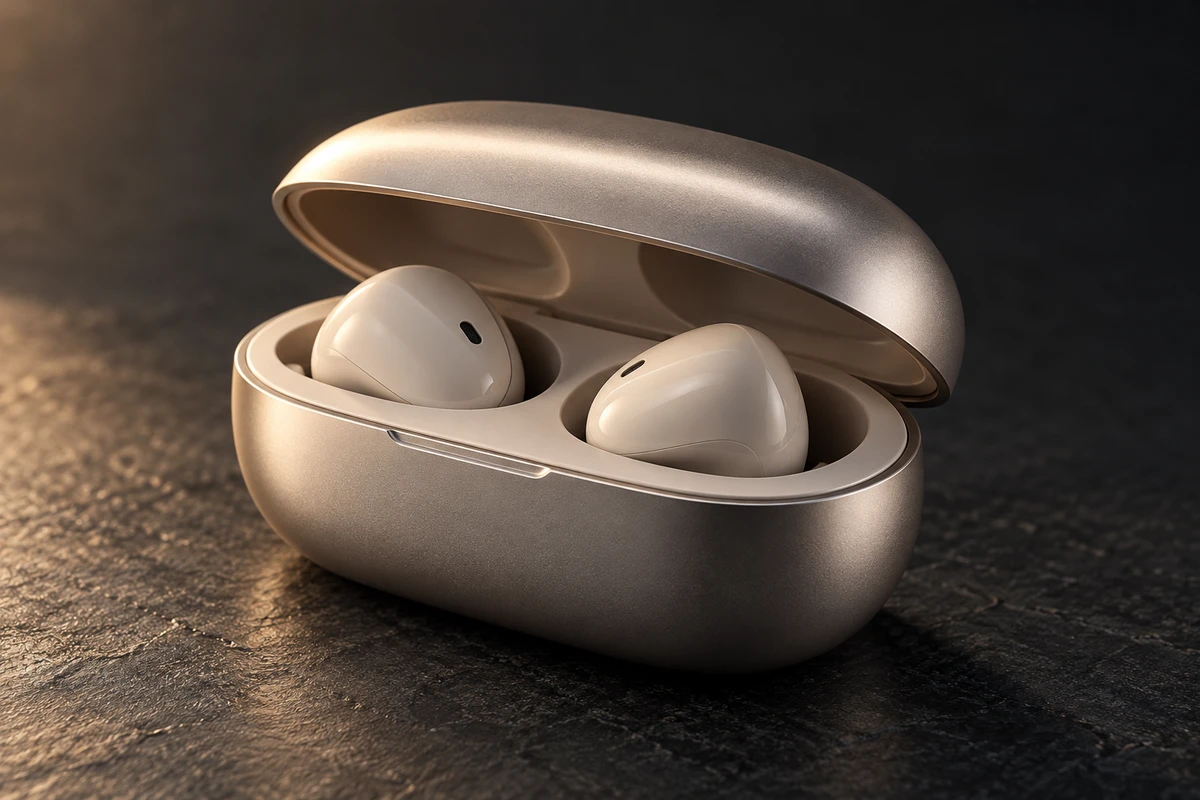
Imagine an earbud commercial cutting to the edge of a charging case. A highlight travels across the frame, the surface resembles a landscape, and the lid closes with a crisp click. It looks beautiful. Yet viewers may not know whether they are looking at the lid, an earbud shell or an abstract material. Macro product advertising has a particular tension: moving closer reveals detail while removing the context that gives it a home.
A macro shot need not explain everything. A curve, seam or point of contact can be its entire subject. But if the ad wants people to understand construction, size or operation, the enlarged view needs a route back to the physical object. This is a discussion of shot selection, not a lens recommendation or a claim that a beautiful close-up constitutes a performance test.
Life-size on the sensor is not life-size on the screen
Canon’s official guide, Canon for Video: Full Frame Macro Lenses, explains that 1:1 refers to an image on the sensor or film matching the subject’s physical size. It does not describe the size shown on a phone, monitor or advertising display.
For example, a 10 mm feature reproduced at 1:1 occupies 10 mm on the sensor. Its eventual screen size also depends on cropping and presentation. This is an illustration of the definition, not a camera test. Saying “we used macro” does not answer a customer asking how large a connector actually is.
Start by identifying the relationship that needs enlargement. To show the finish on a case lid, a small patch of surface might fill the frame. To explain where a finger opens that lid, the shot needs space for the finger, edge and case body. Both can be attractive, but they are not interchangeable.
A size reference does not always require a ruler. A normal pickup, the complete product in a palm, or its connection to an actual accessory can establish relative scale. Hands vary and perspective affects appearance, so such views aid understanding rather than replace accurate dimensions. Claims about pocket fit or connector compatibility still depend on the real product.
Depth of field determines which relationship stays visible
Canon’s Depth of field guide describes the range that appears in focus. It explains that, with other conditions unchanged, a wider aperture gives shallower depth of field, and moving closer also narrows the sharp range. In a macro ad, the question is not simply whether the background is beautifully blurred. Can the relevant parts of an action be seen together?
Return to the hypothetical charging case. If only the lid’s leading edge is sharp while the corresponding part of the body is blurred, viewers may see an elegant line without understanding how the pieces meet. Consider changing the angle to bring the relevant edges closer to the same plane of focus. Other options include reducing magnification, adjusting the aperture, or dividing a complex relationship into connected shots. The choice depends on the actual equipment, lighting and product movement; there is no single aperture setting for every macro scene.
A focus pull can say “notice this, then that.” It does not necessarily show both at once. Alternating between a sharp front edge and a sharp rear edge may still leave their relationship unclear. If fit between components is the message, retain a view in which that relationship can be judged rather than relying entirely on shifting focus.
Movement also needs a purpose. A camera travelling along a surface can describe its changing shape; a hand opening the case can explain operation. Combining both may make the emphasis harder to follow. In a rough test, hold the camera still while the product moves, then hold the product still while trying a camera move. This compares expressions; it does not establish that static shots are always better.
A visible surface is not proof of performance
Macro can show the appearance of a seam, but a seam alone cannot establish a waterproof rating. Metal texture does not establish abrasion resistance. The image records the visible appearance of a particular sample under particular light, from a particular angle and at a particular moment. Performance claims need appropriate supporting tests or documentation, not the apparent precision of the image.
This gives beauty a specific job rather than diminishing it. A texture shot can draw attention to material, an opening shot can show an action, and a wider pickup can explain use. If narration suddenly says “more durable” over a surface close-up, ask whether the image demonstrates durability or merely looks sturdy.
Enlargement also changes the prominence of small marks. Dust left on a sample can become the dominant object, while an actual assembly seam may be mistaken for damage. Cleaning a sample and changing its construction are different acts. Removing foreign dust should not turn into erasing real seams, finishes or design details to create a smoothness the product does not have.
CG or generated imagery can help explore a macro composition, provided the result is clearly treated as a proposal or illustration. This article does not evaluate a model. The principle is to avoid treating a proposal’s invented texture, connection or internal structure as product documentation. Where the image explains the actual item, it needs a physical reference or confirmed construction information.
Give the detail a way in and a way out
The hypothetical case could form a short visual thought: a hand picks up the complete object, the camera moves into the opening detail, and the sequence returns to an earbud being removed. The whole establishes where the detail belongs, the close-up explains what deserves attention, and use gives it a purpose.
This is not a mandatory three-shot formula. An abstract material film may open in macro and reveal the object later. A product already established in the preceding sequence may not need another introduction. What deserves scrutiny is a string of beautiful, unfamiliar surfaces with no view connecting them to the same object.
Try removing one macro shot from the edit. If no information disappears and the sequence becomes clearer, the shot may be decorative repetition. If its removal makes finger contact or component fit hard to understand, it has a specific function. This relates to the role of objects in home-product set design: detail gains value through relationships, not quantity alone. Macro adds the distinct problems of optical scale and the range of focus.
Review the rough sequence twice: once at the intended phone viewing size to see whether the emphasis remains legible, then enlarged to check whether real details have been misrepresented or removed. The first asks what viewers can understand; the second asks what the production actually shows. Neither guarantees clicks or sales.
If you are planning an ad for consumer electronics, accessories or everyday products, bring an actual sample and one detail you want people to notice to ONCE’s product video production solutions. Discuss framing, action and the connection between shots. Keep that beautiful highlight from the opening not because the camera has moved close enough, but because it leaves viewers understanding the product better.
Sources checked October 14, 2026. Optical definitions come from the two Canon guides linked above. The shot methods are editorial analysis and the charging case is hypothetical; no product or campaign performance was tested. The AI-generated cover is a commercial concept image, not a photographed sample or client project.