Video Production Services in Shenzhen 09/10 · ONCE Guide to Video Production Services in Shenzhen
Consider a Shenzhen brand preparing a cross-border product video for a portable power station. The brief calls for beauty shots, ports and display details, multi-device demonstrations, carrying sequences, campsite setup and a solar-panel scene. Two weak production plans appear often: moving the entire shoot outdoors simply because the product is “outdoor,” or building a campsite indoors and editing it as if the product had been validated in real environmental conditions.
A stronger plan starts with the evidentiary job of each shot. Product identification and repeatable operating details usually belong in a controlled studio. Scale, people and domestic workflows can be shown in a furnished set. Only actions that genuinely depend on sunlight, terrain, distance or real carrying should move to a permitted outdoor location. This division protects the schedule without allowing atmosphere to masquerade as testing.
Classify the Evidence Before Choosing a Location
Before scouting, the buyer, product owner and production team should label every proposed shot by evidence type. The label tells the director whether a scene merely needs to look plausible or whether the event must actually occur under stated conditions.
Product identification
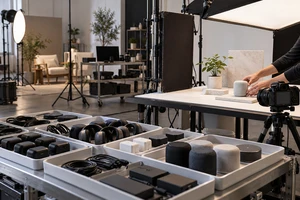
These shots answer what the product is and where its controls, ports, screen and accessories are located. Beauty shots, connector close-ups, accessory layouts, handle movement and display readability are normally easier to repeat in a controlled studio. Lighting, reflections, dust, fingerprints and continuity can all be managed deliberately.
Functional demonstration
These shots answer whether an approved action can be completed: connecting a cable, powering on, changing a display mode, supplying an approved device or unfolding a solar panel. The action may be filmed indoors or outdoors. The deciding factor is whether the environment is part of the function, not whether the background looks adventurous.
Any claim about output, charging time, runtime, noise or temperature should come with an approved model, test condition and public wording from the product owner. A production company can document an action faithfully; it is not a laboratory, certification body or product-safety authority.
Usage context
These shots show how the unit is stored, carried, positioned and connected in a home-backup, vehicle or campsite workflow. A furnished studio or approved lifestyle location may be sufficient. It demonstrates scale and relationships, but a forest seen through a window or an actor wearing outdoor clothing does not establish wilderness use, rain resistance or extreme-temperature performance.
Environmental or performance validation
These claims depend on actual sunlight, terrain, wind, distance or a complete test duration. Positioning a solar panel in real sun or carrying a unit from a vehicle to a campsite may warrant an outdoor location. Full-load runtime, water resistance, drop performance, extreme-temperature operation and long-term durability cannot be established by a short advertising take. If formal evidence is needed, the project must separately define the test standard, responsible party, records and publishable result.
Allocate Shots With a Location Matrix
The matrix below is not a universal shot list. It converts a vague request for “more outdoor feeling” into production conditions a buyer can approve.
| Buyer question | Preferred environment | Conditions that must be present | Evidence boundary | Backup |
|---|---|---|---|---|
| Are the body, materials, ports, accessories and display clear? | Controlled cyclorama or product table | Controlled reflections, cleaning, stable power and monitoring | Establishes appearance and control positions, not output performance | Complete indoors |
| Does the connection, startup and interface sequence work? | Studio or quiet furnished set | Approved firmware, sample charge state, connection order and product owner | Shows this sample completing the action under stated conditions | A recorded UI may explain the interface but must not impersonate live status |
| Does the unit fit naturally in a living room, vehicle or campsite? | Furnished set or approved lifestyle location | Furniture scale, workflow, props, outlets and actor movement | Establishes scale and use relationship, not an actual outage or wilderness performance | Move to a controlled lifestyle set |
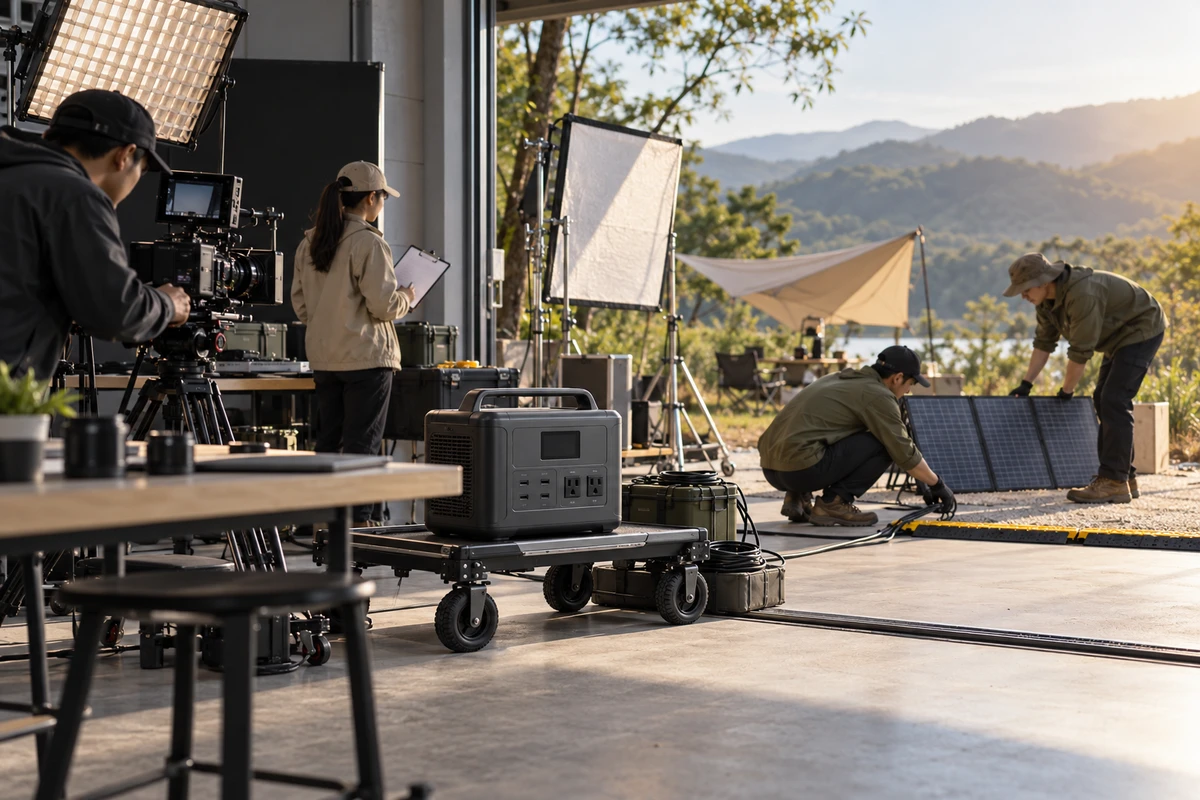
| Is unloading and carrying across real ground credible? | Permitted outdoor or semi-outdoor location | Vehicle access, safe unloading route, terrain and handling plan | Establishes the real carrying action | Covered loading bay or approved walkway version |
| How is a solar panel unfolded and oriented in sunlight? | Real outdoor location | Sun direction, wind, secure mounting, cable route and crew safety | Can show setup; a brief take does not prove full charging time | Film the procedure in overcast conditions and use only approved data for performance |
| Is the display readable in a night-use context? | Controlled exterior or studio night set | Ambient-light control, display settings, noise limits and strike time | Establishes visual readability, not overnight runtime | Studio night scene, clearly treated as context |
When one proposed hero shot is expected to look beautiful, demonstrate a feature and prove performance, split it. Film the product close-up in the studio, the user action in the appropriate location, and support any performance statement with approved documentation or a separately designed test. One overloaded shot is usually harder to produce and easier to overstate.
A Studio Provides Control, Not a Fake Outdoors
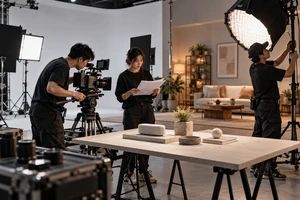
U-STUDIO currently describes an 800-square-metre Shenzhen production base with multiple technology and home environments and a 64-square-metre white cyclorama. This type of facility can place product-table work, lifestyle scenes and crew resources within one production plan. Availability, power requirements, props, load limits, vehicle access and any special effect still need project-specific confirmation.
The controlled studio is usually the right place for:
- product turns, body details, materials, ports and accessories;
- displays, buttons, cable sequences and hand interaction;
- short functional demonstrations with approved loads;
- repeatable motion-control shots and version changes;
- footage requiring strict control of reflections, dust, sound and continuity.
A furnished set is useful for showing scale against people, furniture and storage, and for connecting the sequence from retrieval to setup. It should not be presented as an actual overseas home or real wilderness location. “International lifestyle” has to be defined through the target market’s plugs, dimensions, props, habits and visual context, not through a generic decor label.
ONCE’s current cross-border e-commerce video page includes a portable power station example framed around outdoor use and multi-device scenarios. A public example can help a buyer inspect how the product, setting and action are combined. It does not prove an undisclosed location, performance result, permission status or commercial outcome.
When Real Outdoors Becomes a Necessary Input
An outdoor location is not justified merely by cinematic scale. It is justified when the environment carries information that a set cannot honestly provide. Scouting becomes worthwhile when:
- the unit’s size and weight need to be understood through real unloading or carrying;
- solar-panel area, orientation, cable distance and anchoring affect the user decision;
- the shot must show an actual route from a vehicle or tent to the powered equipment;
- daylight readability or spatial relationships must be observed in real conditions;
- the brand needs an establishing shot from a real place and can secure permission.
A location cannot be approved from a mood photograph. A practical scout checks vehicle and crew access, parking and unloading, carrying distance, gradient and ground condition, sun path, shade, wind, sound, public traffic, visible third-party marks, sanitation and reinstatement requirements, emergency access and the permitted strike time.
Shenzhen Bay Park provides a useful specific warning: its published rules prohibit commercial film production without permission. That rule should not be generalized to every Shenzhen location. It does show why the production manager must confirm current requirements with the operator of each proposed site instead of assuming that public access equals commercial filming permission. The broader Shenzhen park rules also require activities to follow published procedures and avoid disrupting normal order.
Put the Weather Backup in the Shot List
An exterior schedule should classify shots as green, yellow or red before the forecast becomes urgent.
- Green: move directly indoors. Product details, ports, displays, connection steps and most close-ups should not be hostage to weather.
- Yellow: preserve the action but change the setting. Vehicle unloading, campsite preparation, folding and storage may move to an approved covered space or furnished set, with the evidence boundary rewritten accordingly.
- Red: the environment is an input. A solar-panel setup under actual sun, a specific-terrain carry or an establishing view of a permitted location must be rescheduled or removed when conditions fail. Editing an indoor action to imply a real outdoor result is not a backup plan.
The call sheet should also identify who makes the weather decision, the cancellation terms, which shots may be substituted, which require a second booking, and how the standby of talent, vehicles, equipment and samples is handled. This turns “what if it rains?” into a priced and approvable production condition.
Battery Samples and Transport Need a Separate Chain of Responsibility
A portable power station is not an ordinary prop. Before filming, the product owner should confirm the sample model and version, firmware, cosmetic condition, permitted charging and discharging method, adapters and cables, approved connected devices, warning meanings and stop conditions. Production should record the handover, maintain an approved backup sample and give the product representative authority to stop a high-risk action.
Air transport is a separate issue from on-set charging. The IATA 2026 Lithium Battery Guidance Document states that, from 1 January 2026, certain lithium-ion batteries packed with equipment are subject to reduced state-of-charge conditions unless relevant approval applies. Classification, packaging, marks and operator requirements depend on the actual goods and shipment. The manufacturer, freight forwarder and carrier must confirm them. A transport state-of-charge rule is not a universal charge level for filming.
For any connected appliance, the shot list should contain the product owner’s approved device, power condition, startup behavior, cable, reset time and stop criteria. One successful filmed connection proves only that the specific sample completed the demonstration under the recorded conditions. It does not automatically establish performance for every unit or environment.
AIGC and 3D Can Extend Expression, Not Evidence
When the design is frozen and an approved model and material set exists, 3D or generative workflows may help previsualize sun direction, frame a campsite concept or make standardized product images that do not imply real-world performance. Adobe’s enterprise 3D digital twin workflow, updated in April 2026, specifies inputs such as a USDZ model, preset angles, lighting and output settings.
Such imagery cannot establish functional behavior under real sun. Synthetic rain, dust or terrain should never be edited as if the product had passed the corresponding environmental test. The script, estimate and delivery list should identify synthetic shots, and the buyer should confirm rights for models, generated material, fonts and third-party assets.
Five Deliverables to Require Before the Shoot
A production-ready Shenzhen plan should give the buyer at least five concrete records:
- Indoor-outdoor allocation sheet: location, environmental dependency, sample state and owner for each shot.
- Evidence-boundary column: product identification, functional demonstration, usage context or a performance claim requiring separate validation.
- Scout and permission record: current location operator, vehicle and crew access, noise, public traffic, reinstatement requirements and emergency route.
- Weather and reschedule plan: how green, yellow and red shots move, change or return on another date.
- Sample and safety checklist: handover state, firmware, charging, cables, approved loads, backup parts, product owner and stop authority.
The completion standard is not that the film “feels outdoorsy.” Every shot should explain why it belongs in that environment, what it genuinely demonstrates and what happens when its conditions are unavailable. The first guide in this series, choosing a Shenzhen studio from the shot list, provides the earlier venue-selection layer; this article adds environmental dependency and proof limits.
If you are planning a portable power station or mobile-energy video in Shenzhen, send the product manual, target markets and channels, Shenzhen or factory location, schedule, sample status, approved claims, proposed exterior sites and existing assets. ONCE can first allocate the shots across controlled studio, furnished sets and real outdoor production, then define the necessary scout, crew, equipment and post-production scope—without promising sales, certification or performance results.