Video Production Services in Shenzhen 10/10 · ONCE Guide to Video Production Services in Shenzhen
Two buyers can both ask for “video production in Shenzhen” while needing completely different services. One may only need a suitable studio. Another may need the space plus a compatible camera, lighting package and technicians. A third may have a prototype and a launch date but no executable story, production plan or delivery workflow.
The useful question is not which supplier has the largest studio, the longest equipment list or the lowest headline price. It is this: which production responsibilities can your own team already carry from approval to delivery? Keep the mature parts of the workflow in-house and buy the missing layer locally. This prevents a studio booking from being mistaken for production management, or technical support from being treated as if it automatically included a script, talent rights, post-production and final delivery.
Choose by production readiness, not company size
When the project is examined at shoot-day level, three procurement paths become clear.
Scenario 1: a mature production team only needs a Shenzhen studio
An international brand or a Shenzhen-based company may already have an approved script, director, producer, cinematographer and post team. The shot list, talent, insurance, file specifications and approver are all named. In this situation, studio-only hire can be the right choice because the creative and operational chain is already complete. The venue needs to supply the contracted space, agreed facilities, access conditions and house rules—not re-produce the project.
Before making an enquiry, this buyer should be able to provide dates and working hours, headcount, vehicles and equipment, set-build requirements, power and sound needs, unusual actions, insurance or deposit requirements, and reinstatement standards. The venue is deciding whether the plan can be executed safely in the space. It is not taking responsibility for whether the script is strategically sound.
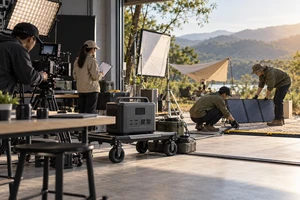
ONCE’s current U-STUDIO page separates full brand production from studio booking for another team. It also describes an 800-square-metre Shenzhen facility, multiple environments and a 64-square-metre white cyclorama. Those facts establish a candidate space, not real-time availability or automatic approval of a particular build, power load, sound condition, vehicle movement or special action. Those details still need project-specific confirmation.
Scenario 2: the buyer has creative leadership but needs local equipment and technical support
The second buyer already knows what to film and has a producer or director who can make decisions, but lacks a locally compatible camera package, lighting crew, transport, monitoring chain or studio technical support. This buyer may need a middle layer: studio plus equipment and technicians, without purchasing creative development and full production management again.
The value of this layer is system compatibility and reliable execution. Camera bodies, lenses, wireless video, monitoring, continuous lighting, diffusion and negative fill, support, motion tools and power have to form a working package. Someone must also receive, test, build, troubleshoot and return the equipment. ONCE’s equipment rental catalogue is a useful configuration reference, but it is not live inventory or a confirmed quotation. A catalogue entry does not establish ownership or availability. Models, quantities, accessories, dates, technicians, transport, deposits, tax and backup units should be confirmed separately.
Technical support answers “how will the equipment and set work?” It does not automatically answer “why should the story be told this way?” If there is no approved script, talent release plan, substantiation for product claims, post-production owner or delivery specification, the middle layer still leaves a responsibility gap.
Scenario 3: the buyer has product information or needs a complete crowdfunding narrative
The third buyer may have a prototype, a feature list and a launch date, but no market-facing narrative, shootable script, evidence plan, casting approach, location strategy, production schedule, edit structure or language-version workflow. Studio-only hire does not reduce scope in this case; it simply leaves essential work without an owner.
A complete project should connect requirements, creative strategy, script, budget, production, locations, talent, filming, edit, sound, subtitles or voice-over, versions and approvals. A crowdfunding film makes these dependencies especially visible: founder presentation, engineering demonstration, prototype status, product claims and lifestyle scenes all affect one another. A production partner can organise those inputs, but the buyer still owns product truth, performance data, compliance material and final business approval. Our related guide to planning engineering demonstrations and lifestyle scenes in Shenzhen addresses that on-set split; it does not equate a finished film with a funding outcome.
Map the responsibilities before comparing quotations
A line item such as “one shoot day” is too broad to show whether a project is complete. A better procurement document names the owner, input, output, approver and change trigger for every workstream. The following matrix is a starting point; the signed scope and project documents remain authoritative.
| Workstream | Studio only | Studio plus equipment and technical support | Complete video project | Responsibility the buyer retains |
|---|---|---|---|---|
| Business goal and target market | Buyer has defined them | Buyer has defined them | Producer translates them into creative and delivery scope | Confirm use, channels, markets and priorities |
| Product information and samples | Buyer supplies shoot-ready units and an operator | Same, with a technical test window | Producer creates a sample register, demo workflow and risk list | Confirm facts, functions, versions and claims |
| Script and shot list | Buyer freezes and executes them | Buyer leads; technical team tests feasibility | Producer proposes, revises and manages approval | Name one final approver |
| Sets and art direction | Buyer selects the studio and brings art/props | Venue and technicians confirm build, load, power and access | Producer scouts, designs, procures and manages reinstatement | Approve brand and market expression |
| Camera, lighting and crew | Buyer supplies them | Split by an agreed equipment and crew list | Producer assembles and manages the crew | Disclose operational limits and internal participants |
| Talent, likeness and asset rights | Buyer manages them | Normally buyer or its agent manages them | Producer can cast and handle agreed paperwork within scope | Approve talent, territories, term, media and budget |
| Permits, safety and insurance | Buyer’s producer leads; venue supplies available documents | Allocated by contract across equipment, venue and crew | Producer coordinates; special permissions and insurance depend on written confirmation | Disclose product, battery, liquid, smoke, vehicle and other risks |
| Edit, music and sound | Buyer owns them | Buyer owns them unless specifically included | Producer delivers the agreed edit, sound, grade and licensed-asset workflow | Review and approve the master on schedule |
| Language and platform versions | Buyer defines and creates them | Buyer defines and creates them | Producer outputs agreed versions from an approved master | Supply accurate terminology and language reviewers |
| File acceptance and archive | Buyer manages them | Buyer manages them | Producer supplies agreed masters, selected assets and records | Accept against the file list and agree retention |
The point of this matrix is not to move every duty to one party. It is to expose interfaces. A complete project may include English subtitles, but the producer cannot independently approve specialised engineering terminology. A technician may guarantee the agreed monitoring chain, but not the buyer’s own storage media or downstream edit workflow unless those items are explicitly in scope.
A hybrid model often fits cross-border production best
Many Shenzhen projects do not fit one pure category. A global brand may retain its agency and director while asking a Shenzhen team to supply local production, studio, crew and sample coordination. A Shenzhen exporter may keep the product brief and final approvals in-house while commissioning production and post. Both can be sensible hybrid models.
The usual failure is not a lack of talent. It is two teams assuming that the other team owns the same task. Name one producer who controls the integrated schedule, then freeze four documents before filming: a responsibility matrix, current script and shot list, schedule and call sheet, and a delivery-and-approval table. The global creative team can approve visual direction and the local producer can determine what is practical in the selected space, but the set needs one escalation path.
Role definitions in the wider industry support this distinction. ScreenSkills describes a production manager as responsible for schedules, budgets and practical execution, including permissions, suppliers and call sheets, while noting that the precise remit changes with scale, budget and genre. That is why renting a physical space cannot replace production management—and why a full-service proposal still needs to specify exactly what it contains.
Three common ways buyers purchase the wrong layer
Mistake 1: treating an equipment list as proof of complete delivery
Cameras and lights establish that certain shots may be technically possible. They do not prove that the script is approved, product claims are substantiated, talent rights cover the intended use, music can be licensed or language versions will be reviewed. Equipment scale is not responsibility coverage.
Mistake 2: booking a studio and assembling freelancers without a producer
If the buyer has no production owner, separately booking a director, cinematographer, lighting crew, talent and editor fragments the schedule, contracts, file specifications and change control. Each supplier may be competent, yet no one owns the finished film.
Mistake 3: assuming “full service” removes the buyer from the process
A production company cannot confirm an unfrozen feature, performance figure, market-specific term or brand decision on the buyer’s behalf. Full service removes coordination gaps; it does not remove the buyer’s product and approval responsibilities. Prototype changes, failed functions and late approver changes can still trigger a revised schedule or scope.
Prepare one minimum input pack before asking for a quote
Use the same base information for all three service levels so proposals are comparable:
- Product, target market, use channels and launch date.
- Shenzhen office, factory or sample location, plus sample quantity, version and operating status.
- Existing script, shot list, brand guide, references and prohibited expressions.
- Confirmed director, producer, cinematographer, talent, post team and internal product owner.
- Required sets, dates, headcount, equipment, effects, power, sound and transport conditions.
- Master duration, aspect ratios, languages, subtitles or voice-over, cutdowns, stills and source-file scope.
- Product substantiation, rights documents, review gates and final decision-maker.
If this pack is complete, a venue can assess whether studio-only hire is enough. If the only gaps are the equipment system and on-set technicians, the middle layer can be specified. If objectives, story, people and deliverables have not yet become an executable plan, complete pre-production should happen before the studio and shoot date are locked.
This approach also makes platform deliverables concrete. Amazon’s May 2025 official product-video guide distinguishes overview, unboxing, how-to, setup, troubleshooting and brand-story videos. That does not create a universal platform formula, but it shows why “one product video” is not a sufficient brief: the buyer has to name the job each version performs.
The pre-shoot gate should be readable, not merely discussed
A Shenzhen video project is ready to film when at least five conditions are visible in current documents:
- the responsibility matrix names an owner, approver and exclusion for every workstream;
- the current status of samples, script, sets, talent and rights can be read back;
- studio, equipment, crew, insurance, safety and unusual actions are confirmed for the dates involved;
- masters, language versions, revision rounds, file formats and acceptance points are in a delivery table;
- sample failure, personnel change, venue loss or approval delay has a written escalation and rescheduling rule.
The final procurement decision is therefore not a binary choice between “rent a studio” and “hire a production company.” Ask whether your team already owns a responsibility chain that can independently reach delivery. If it does, buy only the missing space or technical module. If it does not, appoint one production owner to build that chain before the shoot.
If you are planning a product film, cross-border e-commerce package or crowdfunding video in Shenzhen, send ONCE the product, target market and use, Shenzhen or factory location, timing, sample status, and any existing script, crew and post-production plan. We can first determine whether studio-only hire, equipment and technical support, or a complete project is the appropriate scope. That assessment does not promise sales, funding or platform results.