The easiest mistake in trade show video production is to take an existing three-minute corporate film, replace the opening title and hand it to the booth contractor as a loop. The film may be perfectly good. The problem is that it assumes viewers will sit down, turn on the sound and watch from beginning to end. On a show floor, people are walking, talking, looking at neighbouring booths and joining the screen at arbitrary moments.
The project should therefore begin with four use states rather than one runtime: what makes the right person stop at a distance, what remains understandable without audio, what a salesperson can pause and explain, and what can be sent after the visitor leaves. The same source footage can support all four states, but one edit should not be forced to perform every job.
Ask for the screen and floor plan before asking for a duration
Before deciding on pacing, collect:
- the actual pixel canvas, physical dimensions, aspect ratio and mounting height of every display;
- the main aisle, secondary approach and meeting area, including likely viewing distances and directions;
- the media player, codec, loop behaviour, power and network conditions;
- organiser rules for amplified sound, live activities, copyright and displayed material;
- required languages and the three questions sales expects to answer most often.
AVIXA's April 2026 Display Image Size for 2D Content in Audiovisual Systems standard distinguishes between basic and analytical decision-making needs and applies to both permanent and temporary systems. For a booth, the useful lesson is not a universal font size. It is to decide whether the farthest viewer only needs to recognise the brand and product, or must read specifications, process diagrams and evidence. In the second case, content detail, display size and viewing positions must be evaluated together.
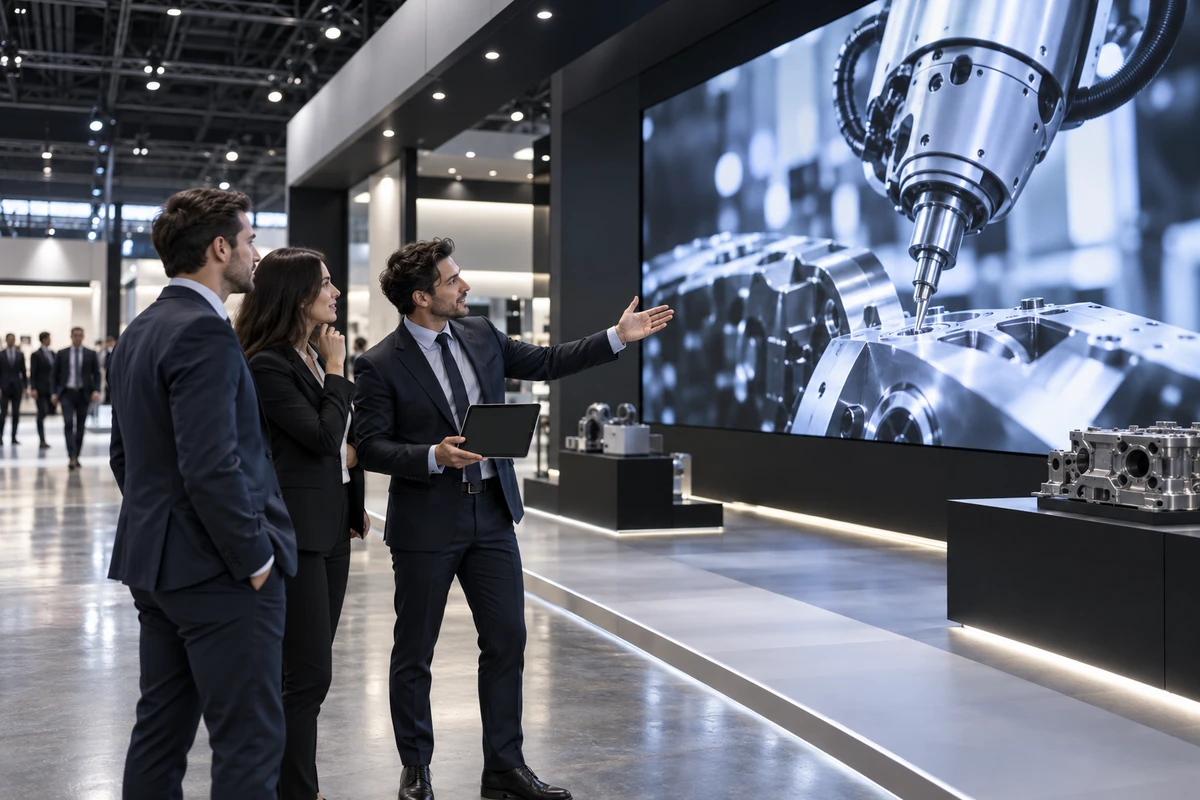
That is why a six-metre LED does not automatically justify more information. A distant attraction shot needs a strong silhouette, limited copy and a legible action. Detailed specifications, cutaways and workflows belong to the closer analytical layer. Combining both tasks in every frame often leaves distant viewers without a focal point and nearby viewers without enough time to read.
The attraction loop has one job: signal relevance
The long-distance loop is not a compressed company history. It needs to establish three things: what the product or capability is, which buyer problem it addresses and why the viewer should come closer.
Build the loop from independent attraction modules. Each module enters on a clean frame, uses one distinctive product action or result to create recognition, and resolves on a frame that can connect naturally to the next module or the start. Critical meaning should not depend on continuous narration or a reveal at the very end.
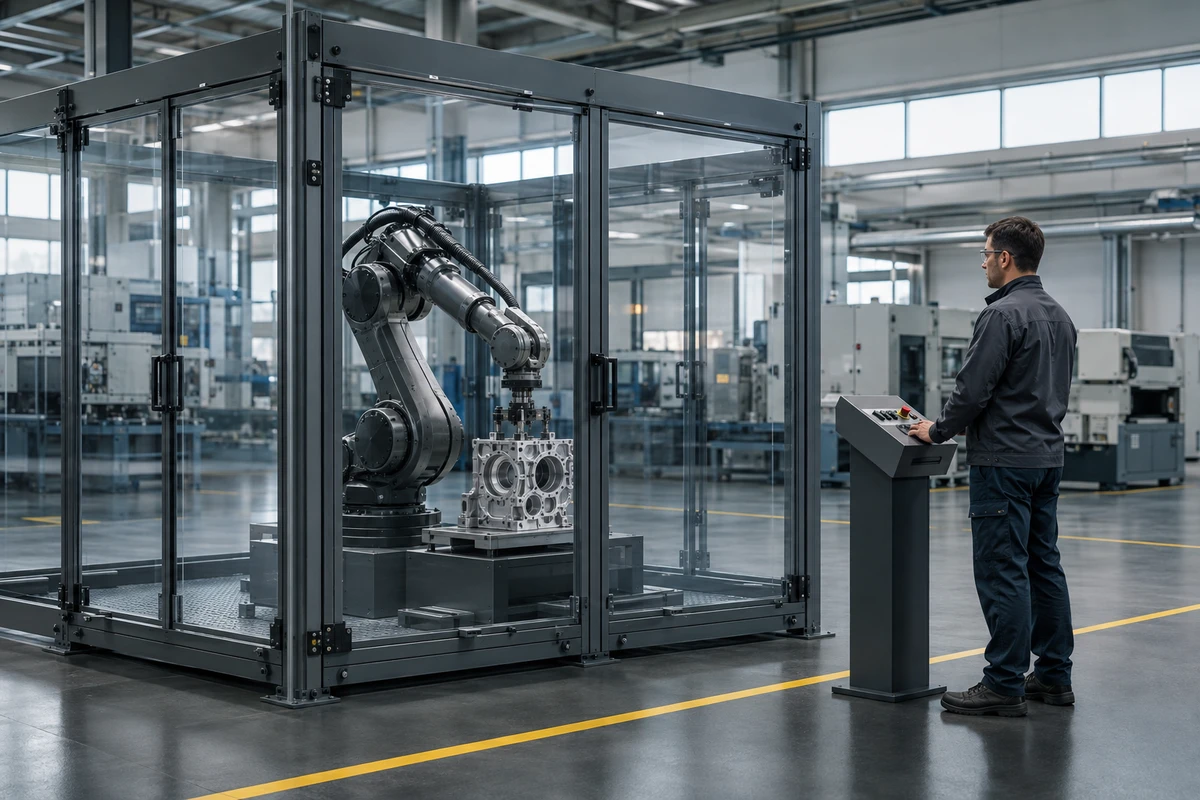
For industrial equipment, that may mean showing the machine complete its most recognisable action before introducing the factory or brand story. A short visible statement can identify the object and application. The closer layer can then explain accuracy, process or deployment conditions. Atmospheric footage still has a role, but it should not take the first recognition position away from the product and business problem.
Review the export on the actual player, not only on a laptop. Test from the main aisle, the edge of the booth and the meeting area under show lighting or a credible approximation. The question is not merely whether the image looks premium. It is what the first glance identifies, whether the message survives the walk toward the booth and whether the loop creates a black or jarring seam.
Silent-first does not mean turning the entire voice-over into subtitles
Design the booth version so its main meaning survives with the sound off. The current Canton Fair exhibitor manual portal is a useful reminder that organiser and venue requirements must be checked for the specific edition. A production team should not assume amplified sound will be available or treat last-minute volume as the solution.
W3C's WCAG 2.2 guidance says captions for prerecorded synchronized media should provide text for audio information required to understand the content, including meaningful non-speech sound. Its open-caption technique explains that embedded captions remain visible without special player support. On a show floor, this supports a practical design rule: each module should form a visible chain of meaning.
- Show the object or problem.
- Show the product action, interface response or process change.
- Use one concise line to state what the evidence demonstrates.
If sound is itself the proof, such as an alarm, noise-reduction comparison, device prompt or operator command, translate it into a visible state, waveform or short explanation, or reserve it for an actively guided sales module. Long blocks of voice-over text without visual evidence simply turn the LED into a moving slide deck.
Test captions at the real pixel dimensions and viewing positions. Parallel Chinese and English, multi-line copy and text close to the edge can fail after LED mapping, player scaling or physical obstruction. Delivering a caption safe-area reference alongside the master is more useful than handing over only an MP4.
A sales demo must start at the buyer's question
Salespeople rarely ask a visitor to wait three minutes while a corporate film reaches the relevant scene. Buyers usually begin with capacity, accuracy, compatibility, lead time or a specific industry application. Sales needs to retrieve the appropriate evidence immediately.
The sales version should therefore be more than the attraction loop with a pause button. Split it into independently callable modules, such as:
- the complete operating or production workflow;
- one critical feature, structure or performance demonstration;
- deployment conditions, service process or application scenarios;
- manufacturing, supply or company capability.
Every module needs an obvious entry image, a self-contained conclusion and an end frame that can remain on screen while the conversation continues. The salesperson should not have to remember that a requested proof appears at 2:17. If specifications are still changing, keep copy and interface layers replaceable so one number does not trigger a full edit.
When the same project also supports a launch, place booth modules and press, event and sales assets in one delivery tree. Source footage can be shared; caption density, narration, end actions and playback logic should be managed separately.
Deliver a working set, not one film
For many B2B booths, a practical package includes:
- Attraction loop: mapped to the main display, understandable without audio, accessible from any entry point and free of disruptive loop seams.
- Sales modules: organised by buyer question or product capability, easy to select, pause and repeat, with the necessary specification and proof frames.
- Follow-up version: full narration, context and next action restored for email, the brand site, LinkedIn or post-show review.
LinkedIn's current B2B live event guidance separates activity before, during and after an event and recommends following up with targeted marketing and sales materials. The production implication is straightforward: the post-show version should not simply resend the silent attraction loop. It must restore the context that a salesperson supplied verbally at the booth.
The package should also include caption files or editable caption layers, a clean text-free master, a language-version list, poster frames, key stills and playback notes. For unusual display canvases, identify which masters are rendered to the actual pixel map and which are general 16:9 backups. This prevents the booth contractor, brand team and sales team from independently creating three untraceable transcodes.
Final acceptance happens in the real playback chain
The finish line is not a file called final.mp4 in a shared folder. It is a complete walk-through on the intended playback chain. Check:
- seamless looping and automatic recovery after a power restart;
- scaling, crop, colour and brightness changes that may hide critical information;
- recognition of the product, audience and main action from the farthest viewing zone;
- comprehension of the central claim with audio muted;
- fast retrieval and pause control for sales modules;
- current organiser rules for sound, live activity, copyright and display content;
- ready-to-send follow-up files, QR destination or email assets before dismantling begins.
A single narrative film may still work in a small, closed meeting room where viewers sit and watch completely. Once the environment becomes an open hall with multidirectional traffic, constrained audio and sales conversations that can interrupt at any moment, video should be designed as a set of working tools.
Send the booth drawings, screen specifications, product information and sales questions to ONCE VISUAL. We can separate distant attraction, close viewing, guided explanation and post-show follow-up, then define the production scope, version tree and acceptance method through our corporate and B2B video production solutions.
Sources consulted: AVIXA, “Display Image Size for 2D Content in Audiovisual Systems” (April 2026); W3C, WCAG 2.2 guidance for prerecorded captions and open captions (updated August 2026 and July 2025); Canton Fair official exhibitor manual portal (accessed 3 October 2026); LinkedIn, “The Power of Live Event Streaming in B2B Marketing” (accessed 3 October 2026). This article provides production and procurement guidance; the current organiser, venue and booth contractor requirements remain authoritative for a specific event.
Production examples and next steps
Build a factory-film brief around observable work and approved access. The Jiyang equipment and automated-manufacturing film provides an example of industrial subjects.
Review Factory and corporate video production in China and Jiyang Zhuyun: New Energy Equipment and Automated Manufacturing Corporate Film. To discuss your project, send the processes to show, filming permissions, interview roles and sales uses through the English project enquiry form.