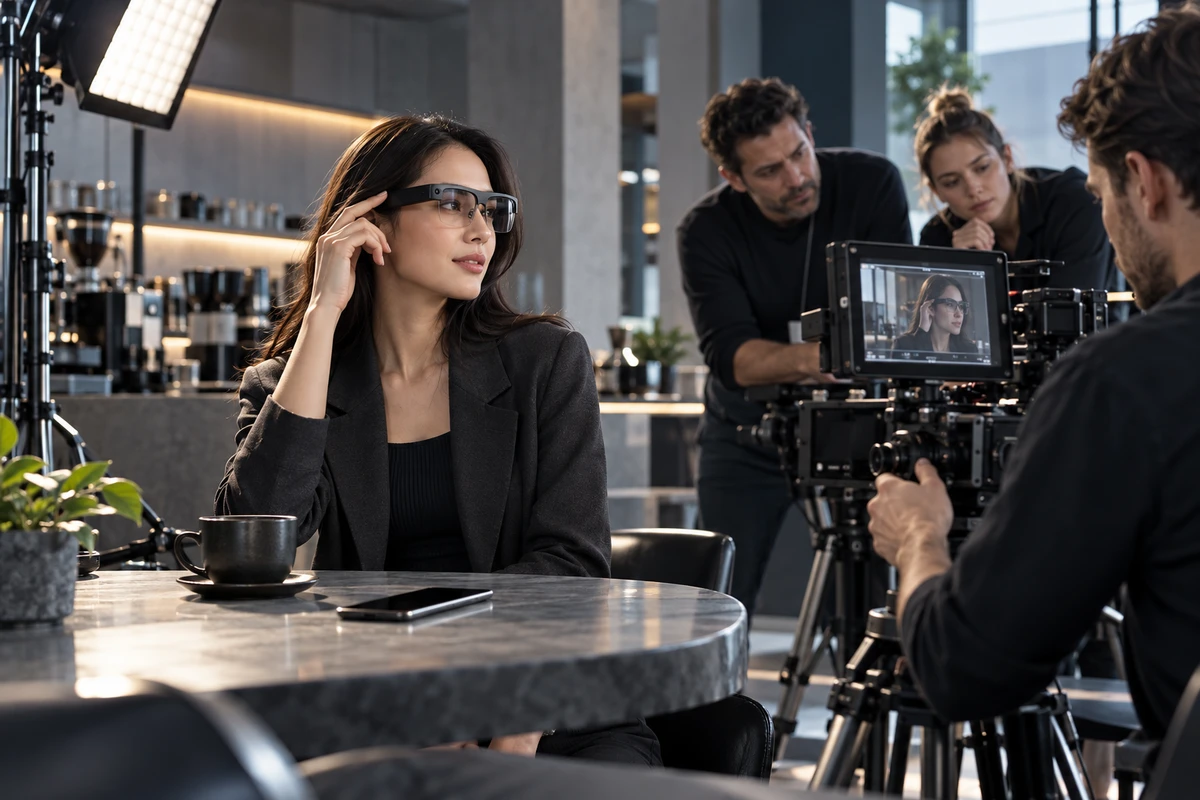
AI glasses product video production creates an easy-to-miss deliverable: the raw first-person files generated during the shoot. They can contain bystanders’ faces, ambient conversations, real contacts, account names, location prompts, vehicle plates and device notifications. The finished film may use three seconds; the production chain may still inherit a much larger set of unnecessary data.
This should not be reduced to a post-production question about what to blur. Before storyboards are locked, draw a simple asset-flow map: what the glasses can see and hear, where captures are stored first, who can export them, who receives them and which files must be deleted later. This is a production-management method, not legal advice, and it does not replace the brand’s compliance review. Its purpose is to give real product experience a controlled path into commercial content.
Proving an experience does not require keeping real life intact
POV footage is persuasive because it brings the viewer close to the wearer’s line of sight. “Real,” however, does not mean handing an uncontrolled street, personal account and social graph to the camera unchanged.
Before the shoot, separate five layers:
- Environment: which signs, screens, doors, plates and private areas may enter the view;
- People: which performers, crew members and background figures can be clearly identified;
- Device: whether capture lights, voice prompts, touch actions and phone-pairing states need to remain visible;
- Account: whether contacts, messages, calendars, photos, maps and cloud sync use a dedicated demo account;
- Interface: whether the final image is native output, a product-approved composite or a clearly identified concept visualisation.
These layers define what has a reason to enter the asset library. China’s Personal Information Protection Law defines personal information broadly as information related to an identified or identifiable person. It also establishes purpose limitation, data minimisation and limited retention principles. For a commercial shoot in China, the practical production rule is straightforward: information that does not serve the shot should not be retained merely because the device can capture it.
A controlled exterior is often more credible than an uncontrolled one
Commuting, sport, shopping and café scenes are common in AI glasses campaigns because they explain wearability better than an isolated beauty shot. A truly open public space, however, can be inefficient when the same interaction must be repeated, the capture light checked, audio reviewed and native files exported.
Use open environments for atmosphere while keeping unrelated people non-identifiable. Film the feature-proof POV in a controlled route, permitted area or coordinated background-performance setup. This does not make the experience less authentic. It allows the action, device state, audio and participant permissions to belong to the same controlled take.
In its July 2026 guidance, Meta says the white capture LED on its AI glasses blinks while photos or video are being captured, and the camera is disabled when blocking or tampering is detected. Meta’s product-testing guidance also says testers should avoid locations with an expectation of privacy and avoid voice commands that may accidentally capture private conversations. These are product-specific statements, not universal rules for every device or country. They still make two production points clear: a capture indicator should not be erased as visual clutter, and ambient audio should not be treated as harmless until editing begins.
Set explicit stop conditions: an unplanned person enters the close frame; a private conversation starts; the lens reflection or POV reveals an unapproved screen; a real notification appears; or the device switches to a personal account or unexpected cloud sync. Stopping the take is cheaper than spreading the same issue through backups, transcodes and review links.
A demo account is part of the product demonstration
Many AI glasses features call a phone, contact list, photo library, calendar, map or third-party app. If the shoot uses a performer’s or product manager’s personal account, the hardest material to clean may be notifications, avatars, history and recommendations around the feature rather than the hero image itself.
A dedicated demo account should:
- use fictional names, contacts, messages and appointments prepared for the scene;
- disable unnecessary photo, contact, location, email and cloud-drive sync;
- record the network, phone model, operating system, app version and firmware state in the camera report;
- assign an owner for account shutdown, asset export and deletion after the shoot.
China’s Cyberspace Administration published a January 2026 policy Q&A listing faces, voiceprints, user accounts, communication records, location and device information among categories that can fall within personal information; it also identifies common sensitive categories, including biometric and precise movement information. A production team should not make the brand’s legal classification for it. It should identify what a shot will access, and challenge any real data that exists only to make the demo feel casual.
When a feature genuinely depends on a real region, merchant or navigation result, the product and compliance owners should approve that scope before production. The crew should not be forced to decide on location whether a visible address is “probably fine.”
Native output, approved composite and concept need different labels
POV footage often needs finishing. The native aspect ratio may not fit the campaign, an in-lens display may not be directly recordable, or the launch interface may still be changing. Compositing is not the problem. The problem is allowing an explanatory image to be read as evidence of a released product capability.
Use three asset labels:
- Native capture: output recorded or exported by the device, with the original file and export path retained;
- Approved composite: an interface treatment confirmed by the product team against an actual function, with design version and approval recorded;
- Concept visualisation: an illustration of direction or future capability that must not be mixed into a live-product proof sequence.
Our earlier guide to AI glasses action, feedback and first-person footage explains what each shot can prove. This workflow begins one step later: who can access those captures, how they may be altered and when the source should be removed.
If generative tools replace background people, notifications or interface elements, the brand must also check the destination platform’s current disclosure rules. YouTube’s current Help documentation describes “altered or synthetic content” disclosures for realistic content that has been meaningfully changed or generated, including disclosure information carried through supported Content Credentials. This does not mean every routine cleanup receives the same label, but platform disclosure cannot be left until after delivery.
Do not send raw POV directly into a broad review channel
Conventional product beauty footage can often be reviewed by a large team. Raw first-person media may include minutes of ambient sound, setup, account switching and unintended people beyond the approved three-second selection.
Split the asset flow into three levels:
- Restricted source: device originals, export records and essential technical metadata, available only to named production and product owners;
- Sanitised working media: irrelevant sections removed, unapproved personal information concealed and demo interfaces substituted before editorial and client review;
- Release masters: approved native segments, composites, captions and sound, with the intended channel recorded for each version.
When client, production and overseas teams all receive source material, establish who decides the processing purpose, who retains files, whether assets cross borders and how they are returned or deleted. China’s PIPL separately addresses entrusted processing, sharing with other processors and cross-border transfers. The brand and qualified advisers must determine the applicable route for a real project; one generic appearance release cannot answer every data-handling question.
Acceptance includes four records beyond the film
A successful upload does not prove the production files are clean. Add four items to acceptance:
- Scene and participant record: controlled areas, appearance permissions and exclusions for minors or sensitive locations;
- Device and account record: sample unit, firmware, phone, app, demo account and sync settings;
- Interface version record: which files are native, approved composites or concepts;
- Asset disposition record: who keeps restricted originals, how working media was sanitised and which files are returned or deleted after the project.
If a film is shot entirely in a closed studio and contains no people, audio, account access or POV output, this workflow can be reduced substantially. Once the creative promise is that the glasses can see, hear, recognise or record the world, the asset boundary should be approved alongside the storyboard, not repaired with emergency blurring the night before launch.
If you are preparing content for AI glasses, smart wearables or another camera-and-microphone product, send the function list, filming territory, required POV, account dependencies and release channels to ONCE VISUAL. We can separate native capture, controlled scenes, interface compositing and media sanitisation into a filmable, reviewable video production scope and quotation.
Sources: Personal Information Protection Law of the People’s Republic of China (adopted 20 August 2021; MIIT page accessed 3 October 2026); Cyberspace Administration of China, “Personal Information Protection Policy and Regulation Q&A” (January 2026; accessed 3 October 2026); Meta, “Meta’s AI Glasses: Your Questions Answered,” “How We Test New Products,” and “Responsible Innovation in AI Glasses & Quest” (accessed 3 October 2026); YouTube Help, “Understanding How This Content Was Made Disclosures” (accessed 3 October 2026). This article offers production-management guidance, not legal advice. The brand should confirm the rules that apply to its filming territory, data flow and release plan.