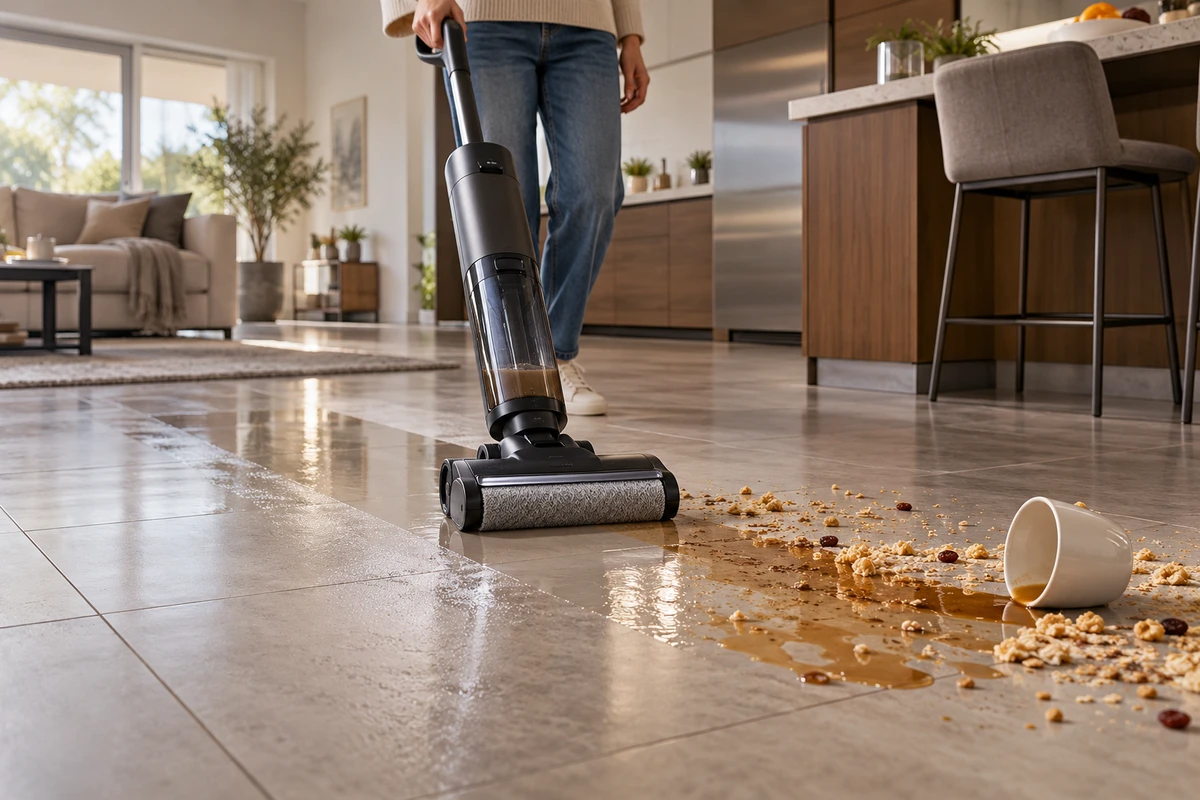
On the review monitor, a floor washer glides past a kitchen island. Coffee, cereal and a small spill occupy the floor in one shot; the surface is clean in the next. The performer continues into the living room. The light is polished and the movement feels effortless, yet three people stop the review for the same reason: was the mess identical between takes, were tile and wood filmed in one pass, how many times did the machine actually cross the floor, and why has its operating sound disappeared?
This is a hypothetical review, not an ONCE client case. It represents a recurring buying problem in home appliance scene production. A sequence can already look like advertising while still failing as a product-page demonstration. The answer is not another “powerful cleaning” caption. Production needs two distinct jobs: advertising shots build a relationship with the home and the user; proof shots preserve conditions, actions and results that the product team can review.
Diagnose the first symptom: a clean result does not explain the process
Floor-care performance is often compressed into one satisfying action: the head crosses a spill and the surface immediately shines. The image sells relief, but it may omit four things a buyer needs to check: the starting condition, the machine's entry point, whether it was pulled back or passed repeatedly, and how much moisture remained afterwards.
Keep at least one continuous take that does not depend on a jump cut. The camera can be simple. It only needs to show the boundary of the mess, the cleaning path and the finished surface at the same time. The advertising edit may accelerate or shorten that take. The product-page version should preserve the order of events. If the approved demonstration requires more than one pass, editing should not turn those passes into a one-pass claim.
Public floor-care ads often join wet mess, dry debris, hair, edge cleaning and self-cleaning into one energetic sequence. That pacing is useful for discovery, but each segment may have different demonstration conditions. At quotation stage, decide which shots create desire, which carry functional proof, and which are approved explanatory visuals.
Turn each mess into a repeatable capture card
A real home setting does not mean pouring coffee randomly onto a floor. Colour, viscosity, particle size, area, dwell time and floor joints all change the image. If every take begins with a different mess, the director cannot protect continuity and the product team cannot tell whether two angles belong to the same cleaning action.
Give each mess a simple capture card:
- material and whether the approved product documentation allows that use;
- quantity, spread shape and dwell time for the take;
- floor sample, grain direction and joint position;
- operating mode and clean- and dirty-water tank state;
- entry direction, travel distance, whether a return pass is allowed, and which take is the proof master.
The card is not a laboratory report, and a set demonstration is not an independent product test. Its purpose is repeatability across angles, versions and pickups. When one take appears cleaner than another, the team can inspect the conditions before arguing from appearance alone.
Preparation also varies by model. Tineco's official FLOOR ONE S2 support page treats cleaning solution, water flow, tank state before self-cleaning, warning indicators and operating sound as separate product questions. BISSELL's official CrossWave support library separates hard-floor cleaning, area rugs, tanks, brush rolls, streaking and excess water into different help topics. Those pages do not create universal rules for every floor washer. They show why the sample model and approved manual must be locked before the shot list.
The floor is not a backdrop
Glossy tile can make a water film obvious. Dark wood grain may conceal residue. A matte floor can suddenly reveal moisture under a low backlight. Art direction usually seeks a coherent and attractive room; a proof shot needs enough contrast to keep the mess, head edge and final surface readable.
Test samples before committing to a whole location. Run the product across light tile, dark wood grain or the client's specified surface and review reflections, joints and the path of the cleaning head. Then choose the hero environment. ONCE's video production guidance provides a broader framework for separating environment, product detail and user action. The filmed model's approved documentation still controls the demonstration.
The movement path should serve the shot. Chair legs, rug edges, cabinet voids and walls can explain turning, edge work or low clearance, but do not put every obstacle into one take merely to make the room feel lived-in. One primary question per shot helps the audience understand whether it is watching reach, manoeuvrability, edge cleaning or simply a lifestyle moment.
Separate recorded sound from advertising sound design
Once the machine starts, its roller, motor, water pickup, voice prompts and room reflections overlap. A kitchen has many hard surfaces and can sound brighter; a soft-furnished living room absorbs more sound. Replacing everything with a designed effect may improve rhythm, but it removes a useful reference for the product-page version.
Preserve a continuous sync track in the approved mode, room tone before and after the action, and isolated operating details. The advertising version may lower the machine, add music or redesign transitions. The proof version should not turn that treatment into an unverified quietness claim. If copy includes a decibel value, the brand should supply the exact model, mode and measurement conditions rather than asking production to infer a number from another product or a set recording.
Tineco's current S2 support page states a manufacturer figure of up to 78 dBA for that model. It cannot substantiate another sample. The production decision is simpler: determine whether a noise metric is actually part of the message. If not, treat authentic sound as experience material, not as a measurement.
Capture the product page and the campaign as separate tracks
Amazon's May 2025 official product-video guidance lists product overview, unboxing, how-to, setup and troubleshooting as distinct video types. It also recommends showing home products in real-use settings so shoppers can understand scale and placement. Current Google Ads video specifications cover horizontal 16:9, vertical 9:16 and square 1:1 assets across relevant formats. These documents point to a practical conclusion: channel adaptation is not just cropping one horizontal commercial. The information task changes.
One production can capture five coordinated tracks:
- Product-page proof: clear conditions, continuous action, limited cutting, plus mess cards and shot logs.
- Campaign emotion: people, space, rhythm and product beauty, with more expressive camera movement.
- Detail explanation: tanks, brush head, mode changes, self-cleaning and maintenance as separate readable actions.
- Multi-ratio safety: keep the cleaning head and mess inside both horizontal and vertical compositions.
- Approved explanation: use CGI or AIGC for internal water paths or mechanisms only when engineering references constrain the result; label it as explanation rather than live proof.
This does not require every asset to be filmed three times. It gives every storyboard row a purpose before the camera rolls. One extra “use” column in pre-production can prevent a later attempt to force a campaign beauty shot into functional evidence. ONCE's production solutions can help define the hero film, product-page cuts and platform versions as one scope without pretending they share one approval standard.
Approve a reusable asset set, not just a clean floor
The difficult part of a floor-washer video is not making the floor look clean. It is making every clean result traceable to a condition and a channel. Advertising can use omission, music and emotion. A product page benefits from direct action and outcome. Training or support may require complete steps. They can share one production without sharing one acceptance test.
If you are preparing scene content for a floor washer, robot vacuum or another home appliance, send the sample model, approved surfaces and messes, target platforms, aspect ratios and feature list to ONCE VISUAL. We can separate proof shots, campaign scenes, sound capture and multi-format delivery into a filmable scope, then prepare a production approach and quotation.