A beauty device product video should no longer be commissioned as a single, polished hero film. Amazon’s current seller guidance allows up to four shoppable videos for an ASIN and separates formats such as Product overview, How-to, Setup, and Troubleshooting. That structure mirrors the questions a shopper is actually trying to answer: Can I hold and place the device correctly? Which mode do I choose? What is a complete session? What happens when the device does not behave as expected?
Amazon also reports that, in its January–June 2026 internal data, detail pages adding their first shoppable video saw an average 24% sales increase compared with pages without video. This is a platform observation, not a causal guarantee or a forecast for an individual brand. It should not replace a controlled test. It does, however, change the procurement question from “What does one video cost?” to “Which uncertainties can this production remove, and how many commercial uses can the footage support?”
One production day, four distinct buyer decisions
The common mistake is to compress product beauty, operation, claims, setup, and troubleshooting into one 45-second cut. Every topic appears, but no question is answered clearly enough to change a decision. ONCE’s four-part stack gives each asset one job.
1. Grip and contact
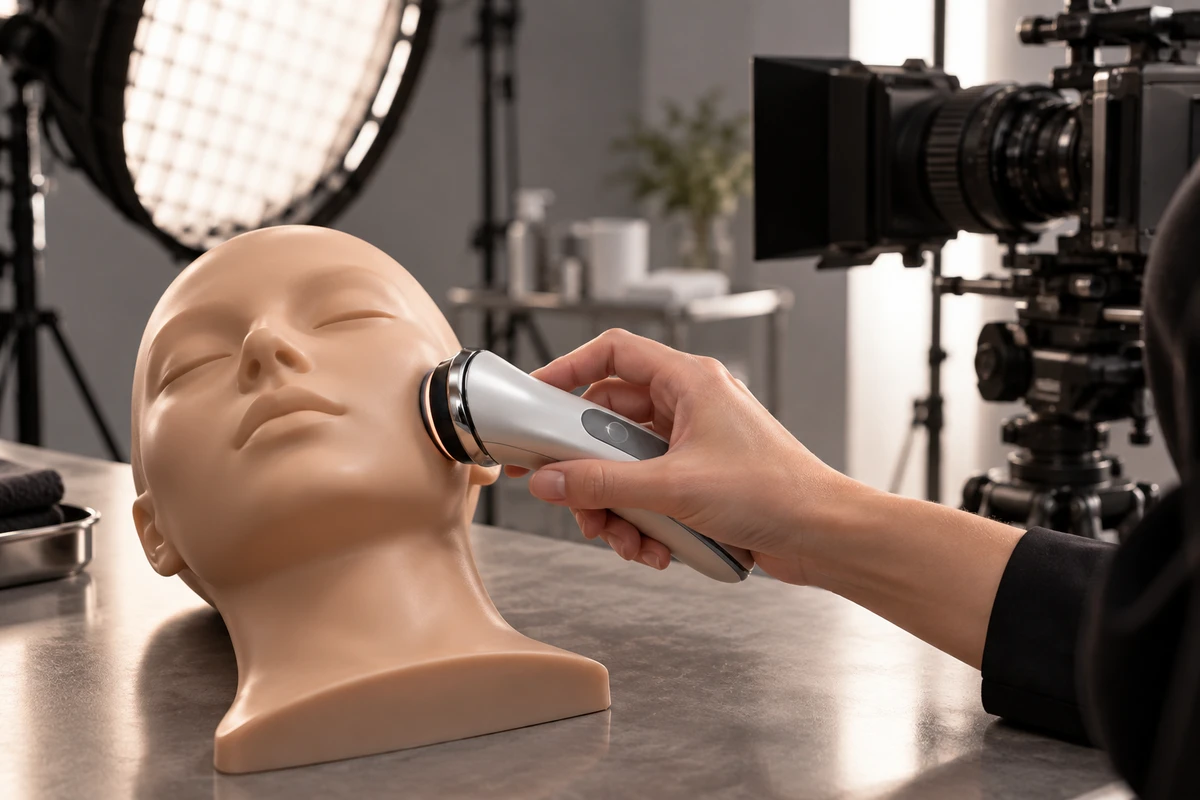
Use a medium close-up that keeps the operator’s fingers, the treatment head, the contact surface, and the direction of movement visible together. If the product requires gel, conductive medium, damp skin, or a specific attachment, show the amount, the placement area, and the sequence before activation. Do not rely on a model’s reaction shot while hiding the actual contact point.
This video should also establish what not to do: prohibited areas, incorrect angles, excessive pressure, or insufficient contact. Those details are not merely “instructional.” They shape whether a shopper believes the device will fit into a real routine.
2. Modes and the full operating sequence
Record one unbroken path from power-on through mode selection, intensity adjustment, timing, shut-down, cleaning, and storage. Editing may shorten repetition, but it should not erase warm-up time, automatic pauses, indicator behavior, or the number of steps required to finish a session. For a device with zone timers or automatic shutoff, elapsed time is product information.
The acceptance test is simple: a reviewer unfamiliar with the prototype should be able to repeat the approved workflow after watching the cut. If the reviewer still needs a live explanation from the product manager, the video has not completed its job.
3. Expected experience, limits, and intended use
This is not a dramatic before-and-after montage. It explains what a user may normally observe during operation, what the footage does not establish, which body areas or users may be excluded, and where the brand’s approved claims stop.
For the U.S. market, the FDA notes that classification depends on a device’s intended use and indications for use. The FDA also explains that aesthetic devices may be regulated depending on intended use and whether they affect the structure or function of the body. Creative teams should therefore work from approved labeling, instructions, and market-specific claim language; they should not expand efficacy, body-site, population, or frequency statements simply because a more dramatic line sounds persuasive.
4. Troubleshooting and care
Show common failed-contact states, low battery, unrecognized attachments, thermal protection, cleaning, and storage. This asset can appear on a product detail page, in post-purchase email, inside a help center, and in customer-support replies. For a question that repeatedly consumes support time, a clear troubleshooting clip can have more operating value than another emotional ad variation.
Build the brief from uncertainty, not from equipment
Brands often begin a scope with the camera package, crew size, location, and styling. That is backwards. Start with the last 60–90 days of support questions, reviews, return reasons, and instruction-manual errors. Score each uncertainty on four dimensions:
- Frequency: How often does the issue appear in support, reviews, or returns?
- Economic impact: Can it affect purchase, correct use, returns, or support hours?
- Visual explainability: Can a shot explain it faster and more accurately than text?
- Reuse: Can the answer work across Amazon, Shopify, paid media, support, and localized versions?
High-frequency, high-impact questions that are easy to demonstrate and broadly reusable should receive production priority. The resulting brief becomes a chain of buyer question → decisive action → acceptable shot. It is more useful than a feature list read aloud.
For teams sourcing production from China, this also improves handoff. Product engineering can approve the exact device behavior before the shoot; the overseas market team can approve claims and disclosures; the production team can then design hand models, macro lenses, motion-control passes, and localized cut-downs around a stable shot list. ONCE’s video production guidance is built around this kind of verifiable scope rather than an open-ended request for “premium content.”
Budget against retained-order contribution
There is no responsible industry-average answer for how much a beauty-device brand should spend. The ceiling depends on traffic, current conversion, contribution margin, return patterns, support cost, and the useful life of the content. ONCE recommends an internal planning model:
Acceptable video budget = expected incremental retained-order contribution + expected avoidable return loss + reusable asset value − maintenance cost.
A retained order is a completed purchase that is not returned. Avoidable return loss should include only reasons that clearer operation, fit, sequence, or expectation content could plausibly improve. Product defects, shipping damage, or price-driven returns should not be assigned to video. Reusable asset value should be grounded in actual planned uses: ASIN count, market versions, paid placements, support flows, and the period before the product or interface changes.
If the brand lacks reliable incremental data, use a planning baseline rather than a fabricated ROI claim:
- 45% for the evidence capture: product geometry, hands, contact, controls, and a repeatable operation;
- 35% for the four decision edits, aspect ratios, language versions, captions, and channel packaging;
- 20% reserved for post-launch review, copy updates, and necessary pickup shots.
This 45/35/20 split is an ONCE scoping starting point, not an industry benchmark. A high-margin device with several markets may justify more versioning. A fast-changing prototype may need a larger maintenance reserve. A single-market product with low traffic may need a leaner first test.
The picture can make a claim even when the script does not
The FTC’s Health Products Compliance Guidance asks marketers to assess both express and implied claims and the net impression created by words, product names, charts, and images together. When qualifying information is needed, it should be clear, conspicuous, and understandable. If the claim is made both visually and audibly, the qualification generally needs to work in both forms.
For a beauty-device video, that means a dramatic treatment-result image cannot be “fixed” by a tiny disclaimer at the end. Before production, create a claim map that marks every line, caption, result image, facial reaction, and graphic as approved, qualified, or prohibited. Review the short vertical cuts separately: a disclosure visible in the long master may disappear when the edit is cropped or shortened.
The FDA’s device classification guidance and aesthetic-device overview are useful starting points, but the actual regulatory analysis depends on the specific product, intended use, claims, labeling, market, and risk. A production framework does not replace legal or regulatory advice.
Four signals that call for a reshoot, not more media spend
- Support and return records keep repeating an operating misunderstanding for which the existing video has no decisive shot.
- Firmware, interface, attachment, or instructions changed and the current cut now shows an outdated sequence.
- A material qualification appears only at the end of the long master and disappears from paid or vertical versions.
- The demonstration required repeated failed takes to produce one successful result, while the edit presents that result as stable and immediate.
In each case, additional distribution amplifies the same information gap. The better decision is to capture the missing action, update the affected versions, and then observe conversion, support questions, and return reasons again.
Deliver an updateable system, not four isolated files
The delivery package should include camera originals, clean demonstration selects, caption and voice scripts, a claim-approval map, aspect-ratio safe areas, localized text, and a buyer-question-to-shot index. When the brand changes a color, attachment, interface, or approved claim, the team can replace the affected module instead of commissioning the whole production again.
ONCE’s product-content team can turn support data, instructions, market requirements, and platform uses into a production scope, then combine live-action hands, macro product detail, motion-control passes, and versioned post-production. For a useful estimate, provide the product materials, target markets, channels, current buyer questions, and the expected number of language and aspect-ratio versions.
Sources and scope
This analysis uses Amazon’s current shoppable-video seller guidance, including its note on January–June 2026 internal data; the FDA pages linked above; and the FTC guidance published in December 2022. Platform capabilities and regulatory requirements can change. Verify the current rules for the target market and the specific device before publication.