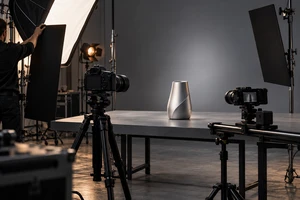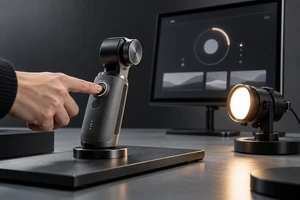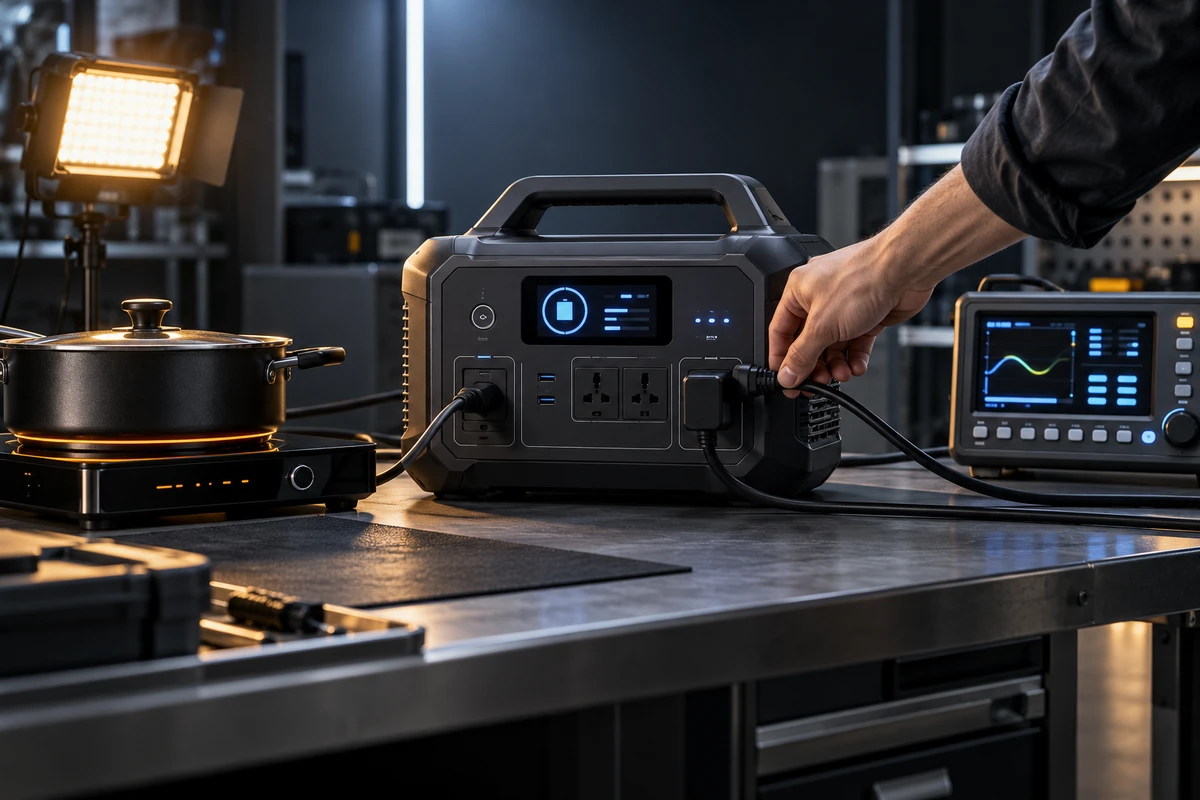
If a portable power station is already running a coffee maker, induction plate and campsite light, why should the load meter and product display stay in the same frame? Because an appliance switching on proves only that it worked at that moment. It does not automatically prove continuous output, surge capacity, runtime or every aspect of safety. When a renewable-energy product video compresses all of those ideas into one polished montage, the footage may become harder for procurement, engineering and legal teams to approve.
A more reliable production separates three kinds of claim: a visible use fact, a performance fact that depends on stated conditions, and a safety or compliance fact that must come from a certificate, test report or approved product document. The camera records what is actually visible. Graphics explain mechanisms that cannot be seen. Documentation states where the supporting evidence comes from. None should impersonate another.
First decide what the shot is meant to prove
“It powers this coffee maker” is not the same claim as “it can sustain this output.” Surge output and rated or continuous output do not operate on the same time scale. DJI's Power 1000 FAQ provides a useful public example: it separates continuous output from an approximately 30-second output condition and lists laboratory conditions such as temperature and battery level. The production lesson is simple. A wattage figure without duration, starting charge, ambient temperature and load type can make the video imply more than the approved specification.
Turn each selling point into an approval question before the script meeting:
- Is the shot proving that one port powers a device, or that the system runs it continuously?
- Is it showing several connected devices, or claiming every port reaches its maximum at the same time?
- Is the film explaining what the BMS monitors, or showing a protection event actually being triggered?
- Is it stating that the battery passed a transport test, or making a broader “completely safe” promise?
The narrower the question, the easier it is to decide whether the shot needs an uninterrupted action, a meter reading, a product interface, or a confirmed technical document.
Preserve the load-test timeline, not only the result
A credible load demonstration needs an unambiguous beginning. Show battery state, output mode, ports and the load device before connection. After power is enabled, keep the load meter, product screen and appliance response visible together. Run the setup for a period approved by the product team, then record the ending state. The final edit may change framing, but the master proof take should preserve continuity instead of hiding warm-up, errors, throttling or restarts behind a cut.
The shot log should identify the sample, firmware, starting state of charge, ambient temperature, output port, load model and recording duration. A commercial set is not replacing a laboratory. It is making the visible facts in the film traceable to one defined setup. If the brand only wants atmosphere, complex numbers can stay out of frame. Once a performance figure appears in the copy, its conditions belong in the script and approval sheet.
ONCE's video production guidance offers a broader framework for turning product information into filmable assets. Lifestyle footage answers why the product matters. A load-and-display proof shot answers what actually happened.
A surge is a window, not a timeline editors can extend
Surge output often helps start equipment with a brief power demand, but the claim may depend on time, temperature, battery level and load type. The common production error is to cut away the moment an appliance starts, show a pleased user, then let the caption imply continuous performance. The audience loses the timeline and the brand loses a clean basis for review.
Design the surge scene around the start event: record the appliance at rest, connection, the instant of startup, the product reading and a visible time reference. Use a different load plan for continuous output and show both stable operation and the ending state. The two sequences can share a location without sharing the same performance conclusion.
The US Federal Trade Commission's Policy Statement Regarding Advertising Substantiation says objective product claims, whether express or implied, should have a reasonable basis. In production terms, statements such as “tests prove,” “runs all day” or “works with every appliance” are not copy-only decisions. Shot structure can also imply a level of performance that the supporting documents do not establish.
Check safety documents before designing safety drama
Energy-storage products are poor candidates for improvised destructive demonstrations. Penetration, crushing, overcharge, water exposure, drops, extreme temperatures and induced faults require the right equipment, location, risk assessment and qualified personnel. A commercial studio should not treat them as bonus coverage. If third-party laboratory footage exists, first verify its licence, test article, standard version and conclusion before quoting it.
IATA's current Battery Guidance Document states that lithium cell and battery types permitted for transport must have passed applicable tests in UN Manual of Tests and Criteria subsection 38.3. Its subject is transport classification and requirements. The production inference is that a UN 38.3 test summary may support the corresponding transport statement, but it does not by itself prove waterproofing, cycle life, home-backup performance, thermal-runaway protection or every other safety message.
A safer film structure combines document facts with normal use. Certificates or summaries show only the approved name, model and conclusion. Live action shows correct connections, ventilation clearance, port protection, status indications and manual-compliant operation. Smoke, fire and alarm effects should not simulate an unperformed fault test and then be edited as if the product had passed it.
Use live interfaces for BMS status and graphics for internal logic
The US Department of Energy's 2025 Battery Energy Storage Systems Report lists measurements such as state of charge, temperature, voltage, current and power input or output, and connects them with functions including charge control, thermal management, fault detection and load management. A portable product's exact interface and protection logic must still come from its own approved documents. The report nevertheless suggests a useful visual division: capture states that can be read on the actual product or app; use verified graphics or 3D to explain cell, inverter, thermal-management and energy-flow relationships that cannot be filmed directly.
Animation can simplify a mechanism, but it should not invent live telemetry. Lock the engineering block diagram, terminology and interface references first. Then label which numbers came from the recorded unit, which are specification examples and which visuals explain principles only. This prevents a stylised energy-flow sequence from implying real-time measurement and keeps English, localised and short-form versions aligned on the same facts.
Give brand, engineering and production separate approval sheets
Before production, the brand team confirms the selling points, target markets and documents cleared for publication. Engineering confirms the specification conditions, sample state, permitted loads, port combinations, firmware and safety limits. Production translates that information into shots, props, meters, graphics and delivery versions. ONCE's production solutions can provide a practical starting point for defining that scope without treating one hero film as every required asset.
The call sheet should separately assign electrical and fire-safety responsibility: who approves loads, checks cables and adapters, confirms ventilation, and has authority to stop when a sample behaves unexpectedly. Outdoor work adds weather, ground conditions, ingress rating and generator separation. Studio work adds circuit capacity, cable routing and control of combustible materials. Creative tension is useful; stop conditions need to be written first.
Approve the proof takes as well as the final edit
The hero film explains the product and its context. Short versions isolate one buying reason. Clean plates and text-free masters support localisation. When a shot carries a performance claim, delivery should also preserve the uninterrupted take, meter close-up, starting and ending states, and its shot log. Those files may never appear publicly, but they allow later copy changes, market versions and new edits to remain connected to evidence.
Final approval can ask four questions. Is the product state on screen genuine? Does the caption exceed the approved document? Have surge and continuous output been confused? Are certificates, tests and explanatory graphics clearly assigned different roles? When all four answers are clear, a portable-power video can feel powerful without asking the viewer to believe more than the production actually showed.
If you are planning content for a portable power station, mobile battery system or renewable-energy device, send the specification sheet, sample status, target markets, load scenarios and delivery list to ONCE VISUAL. We can divide the claims into filmable proof, document-supported facts and mechanisms best handled with verified graphics, then prepare a production scope.