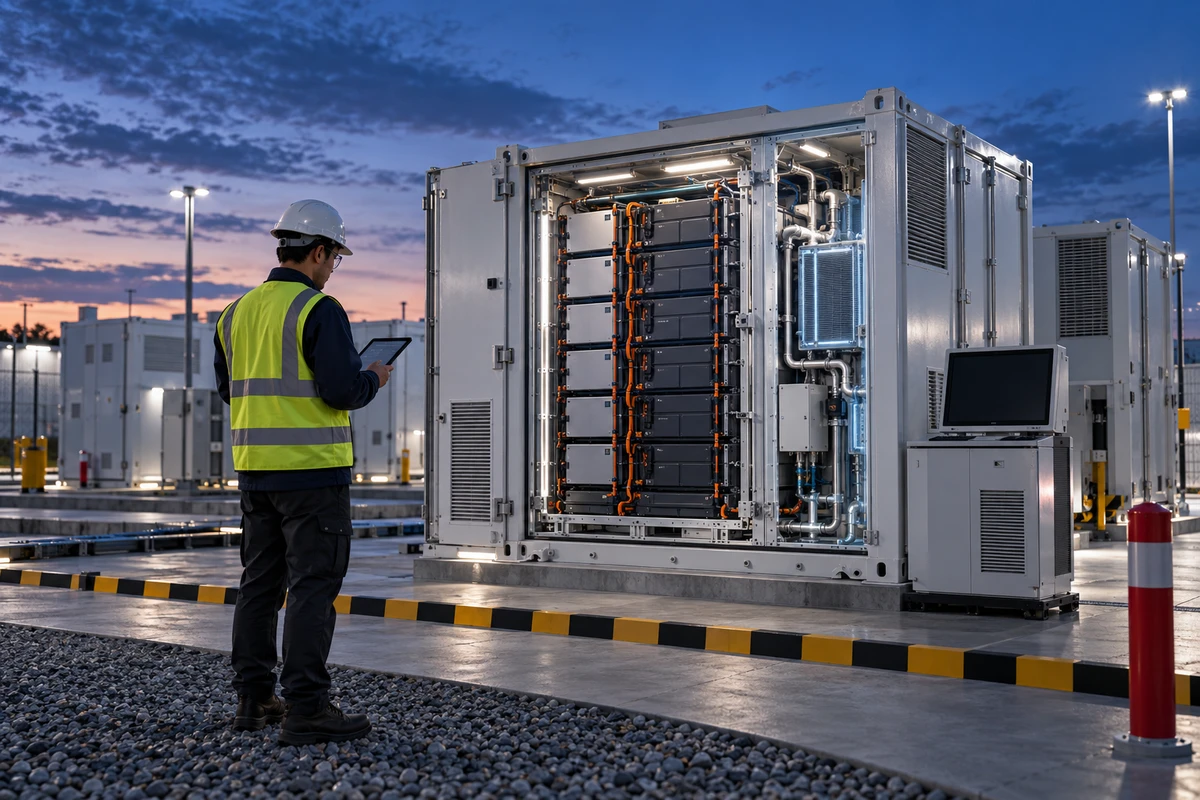
A battery energy storage video can have elegant aerials, immaculate cabinets, controlled lighting and a monitoring screen filled with moving numbers. The buyer may still finish the film without knowing where energy enters, which components convert and protect it, how the equipment is installed and maintained, or what happens when the system detects an abnormal condition.
The problem is not image quality. The film has shown that the product exists without showing how the system works. A useful BESS production brief should begin with an operating-state chain: standby, charging or discharging, monitoring and decision-making, alarm and response. Each state is then assigned to one of four evidence modes: live operation, authorized demonstration, interface capture or engineering visualization.
Turn the equipment list into an operating-state chain
A 2025 U.S. Department of Energy implementation briefing describes a typical BESS as batteries and a BMS, an inverter or PCS, switchgear, a transformer, protection and control. It also maps auxiliaries such as air conditioning and fire detection and suppression, together with SCADA and a local HMI. For filmmakers, the important point is that storage is not one cabinet. It is a relationship among equipment, power conversion, auxiliary protection and control.
The script should therefore start with an operating question, not a beauty shot. When surplus power is available, how does energy enter the system? When demand rises, how is power dispatched? Where does an operator see power, temperature and status? When an abnormal condition appears, which layer detects it and which layer acts?
Before writing scenes, build a state chain for production use:
- Energy path: the relationship among supply, PCS, the DC side, battery racks, transformer and load;
- Control path: what the BMS, EMS, SCADA or local controller observes and decides;
- Human path: who installs, commissions, inspects, acknowledges alarms and performs maintenance;
- Safety path: how detection, isolation, thermal management, fire protection and emergency procedures connect.
This map does not need to appear in full on screen. It tells the director which relationships can be filmed, which require concise graphics, and which data or engineering details cannot be disclosed.
Live operation should show a change of state
Live material is persuasive, but it is not enough to point a camera at energized equipment. The brand team must confirm that the target operating condition can occur during the shoot and that the crew can observe it safely and lawfully.
Useful operating footage usually has three layers:
- System context: the spatial relationship among equipment, the site, supply, loads and supporting infrastructure;
- Visible action: charge or discharge transition, thermal-management activity, access points and the authorized operator's checks;
- Synchronized information: power flow, state, temperature or alarm information from the same moment.
An exterior without synchronized information does not establish that the system is operating. A dashboard alone loses the physical context. Every critical shot should therefore state the operating condition, who confirms it and which interface value explains what the camera sees.
At a customer site, agree in advance which areas, screen fields, customer names, site capacities, network details and operating data may be filmed. ONCE's factory video shoot planning method covers production windows, sound, restricted areas and fallback shots; a BESS project adds energized zones, authorized operators and abnormal-state controls.
Installation and maintenance cannot be staged casually
Installation films often become unsafe or misleading when a team asks technicians to repeat wiring, remove modules or open equipment that should remain closed in its current state. The resulting scene can also make a qualified process appear simpler than it is.
Separate installation and maintenance material into three modes:
- Real work: qualified personnel follow the site's existing procedure while the crew records from approved positions;
- Authorized de-energized or isolated demonstration: hand positions, connectors, inspection points and tools are filmed under agreed conditions and are not presented as normal live operation;
- Engineering visualization: internal connections, energy flow and control relationships that cannot be seen are explained without pretending the images are live footage. When generative or hybrid techniques are involved, the asset-locking approach in ONCE's hybrid AI video workflow provides a useful control model.
Rules differ by jurisdiction and facility. The U.S. OSHA control-of-hazardous-energy standard, for example, requires procedures that prevent unexpected energization, startup or release of stored energy during covered maintenance and servicing, with isolation verified before work begins. The production lesson is universal: a camera request must never override the site's authorized operating procedure.
The call sheet should record equipment state, the approving person, required PPE, camera access and who confirms restoration after the action. If a step cannot be repeated safely, capture horizontal, vertical, still and close-detail requirements while it genuinely occurs instead of assuming it can be reconstructed after commissioning.
Prepare a demonstration environment for monitoring screens
Monitoring software is where a BESS film can be most accurate and most exposed. A live interface may reveal the site name, capacity, topology, accounts, network information, historical alarms and customer operating data. Blurring a few numbers rarely solves the whole problem.
Before production, product, operations and information-security owners should agree on three things:
- Which pages are public and which fields must be replaced or hidden;
- Whether a sandbox, offline demo account or approved historical record can be captured;
- Whether the scene explains normal operation, a trend, alarm acknowledgement or a response procedure.
A useful screen sequence forms a short loop: normal status changes, the system produces a pre-approved indication, the operator acknowledges the information, and the defined action follows. Do not trigger a real fault for drama. Do not invent a red warning panel in post that implies a diagnostic capability the product team has not approved.
Texas Instruments' March 2025 high-voltage BMS demonstration separates cell-voltage monitoring and balancing, rack current, voltage and insulation monitoring, and overall system control across BMU, HMU and BCU levels. The production implication is clear: a single overview dashboard is not enough when the claim depends on a specific monitored object and control layer.
If the interface is redrawn, preserve field names, units, state logic and timing, then have a technical owner review the sequence. Cleaner graphics are useful; converting demo data into an apparent customer outcome is not.
Show safety mechanisms, not a generic safety claim
China's National Energy Administration guidance on electrochemical storage separates safety work across risk assessment, equipment selection and inspection, construction acceptance, grid testing, routine inspection, battery-health assessment, safety monitoring, staff training, fire-protection maintenance and emergency drills. A film cannot compress those different responsibilities into one claim of multiple safety protections.
Organize safety content into four mechanisms:
- Physical and environmental controls: zoning, access, thermal management, ventilation and visible parts of fire-protection systems;
- Detection and control: sensors, the BMS, protection equipment, alarm and isolation logic;
- Operational controls: inspection, authorization, verification, maintenance records and handover;
- Verification records: test, inspection or certification documents relevant to the project, shown only within the scope they actually support.
UL Solutions describes UL 9540A as a test method for evaluating thermal-runaway fire propagation in energy storage systems. A film must not expand the use of a test method into a promise of absolute safety in every application. A fire-suppression close-up is also not a substitute for the product's actual test record under stated conditions.
When emergency response belongs in the story, record an approved drill, training activity or standard procedure. Do not improvise smoke, alarms or panicked movement for the camera. The more important the safety message, the more carefully the edit must distinguish live state, controlled demonstration and explanatory graphics.
Lock four evidence modes into the quote and approval process
Before pricing a BESS video, label every required scene with one of four modes:
- R: Real operation — requires a site, operating condition, time window and data permission;
- D: Demonstration — requires a defined de-energized, isolated or demo condition and an authorized operator;
- U: User interface — requires a demo account, field list, data masking and technical review;
- V: Visualization — requires CAD or topology inputs, confirmed control logic and a disclosure boundary, with a clear distinction between explanation and live footage.
Only then should the proposal assign shoot days, sites, 3D shots, interface redraws, language versions and revision rounds. The buyer is no longer comparing two three-minute films. The comparison is between the preparation, permissions and verification required by each evidence mode.
Approval should also test more than visual polish. Confirm that system relationships are correct, live and demonstrated states are not confused, fields and units remain accurate, safety records are not over-interpreted, and every language version preserves the same technical meaning. International sales versions should keep the same technical limits even when their pacing and terminology change.
If you are planning video for storage, charging or other energy equipment, prepare the system topology, four target operating states, approved interface pages, installation and maintenance windows, and available safety documentation. Then contact ONCE VISUAL for a production scope organized around R, D, U and V evidence modes.
Technical sources were checked on October 1, 2026. This article offers production-planning guidance, not engineering, compliance or site-safety instructions. Local procedures and qualified technical owners remain authoritative.
Production examples and next steps
Use the TVC brief to connect the selling point, performance and product presentation. The Red Devils × Tencent Games commercial is a finished-film reference.
Review TVC and commercial production and Red Devils × Tencent Games: A Passionate Competitive TVC for Young Players. To discuss your project, send the script, storyboard, required formats and approval dates through the English project enquiry form.