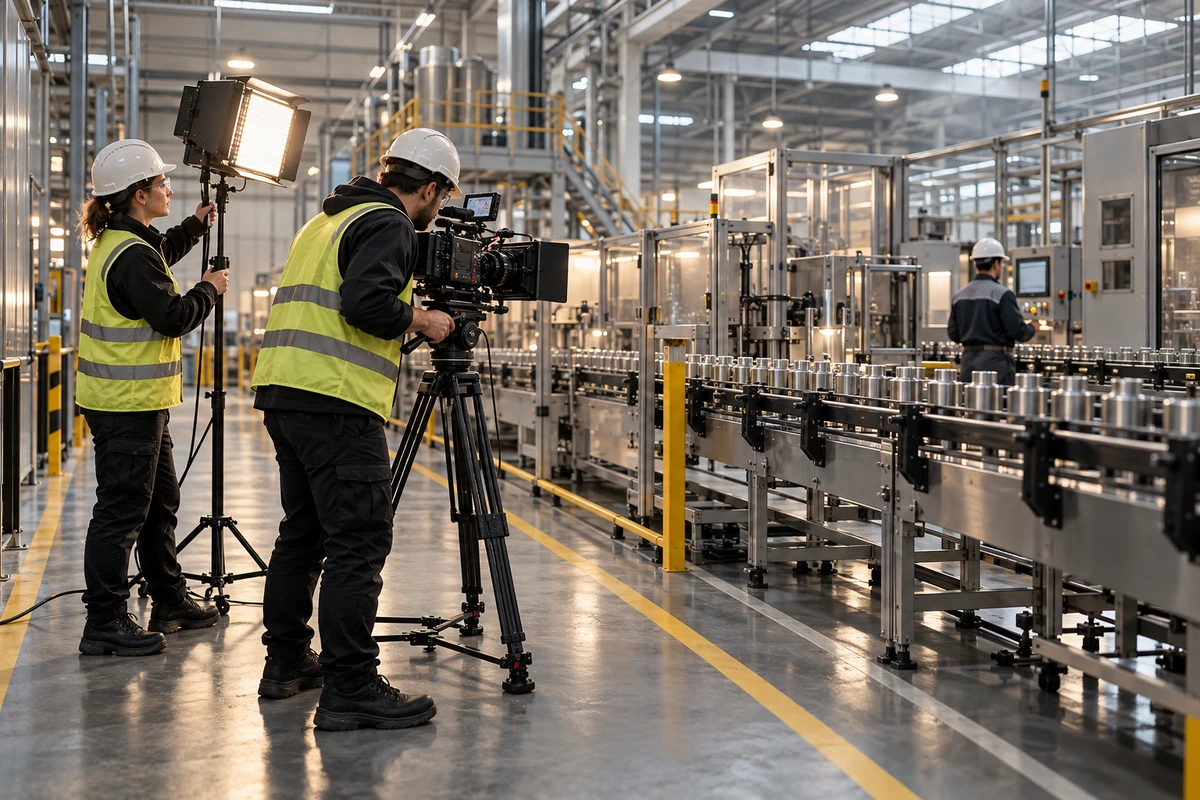
A factory film can lose its most valuable asset before a camera rolls: an already coordinated production window. The crew arrives while the key line is changing material. An interview is placed beside a compressor. An operator is asked to repeat an action that normally happens only during maintenance. After the shoot, a control screen or customer label turns out to be confidential. The day was busy, but very little footage is usable.
A factory video shoot plan should therefore be more than a shot list. Start by giving every important scene a site control card: its production state, filming window, sound approach, no-film boundary and fallback if the plan fails. This document is also a better test of whether a production company understands a factory than a showreel alone.
Separate three production states before designing the shot
“Film the robot arm picking up a component” sounds like one shot. On the floor, it may describe three very different states.
The first is live production. The machine runs at its normal pace, the operator follows the established process, and the camera waits in an approved position. The footage is closest to real operating conditions, but timing, camera position and the number of repeats all remain constrained by production.
The second is a controlled pickup. A plant supervisor may approve slower operation, repeat loading or a separate demonstration, provided the action does not change safety conditions or product facts. This may reveal useful detail, but the adjusted condition must remain clear in the script or review record. It should not be presented as normal throughput.
The third is a safety demonstration. Equipment is in a factory-approved isolated, stopped or demonstration state, and an authorized person shows an inspection, maintenance or changeover step. OSHA’s public guidance on hazardous energy control illustrates why servicing and maintenance require formal procedures and trained personnel. This is not a claim that US rules govern every shoot in China. The production lesson is narrower: a film crew must never ask someone to defeat a guard, restart isolated equipment or operate a machine merely to make a shot more dramatic.
These states should not be edited together as vague “real production.” Before the shoot, the plant owner for the scene should confirm its state, who can issue start and stop instructions, and which status indicators may appear. For a related method covering access and safety boundaries, see ONCE’s guide to planning safe factory-tour shots. This article focuses on when those shots can safely and truthfully happen.
Give every critical scene five control fields
Replace “production line in the morning, interviews in the afternoon” with five practical fields for every critical scene.
Production state: Is this live production, a controlled pickup or a safety demonstration? Does it require a specific material, order, operator or quality specialist?
Filming window: Which shift contains the action, how long does it last, and what changeover, cleaning, heating, cooling or maintenance happens around it? How early can the crew enter, and can the scene be repeated later that day?
Sound approach: Does the film need intelligible sync dialogue, machine sound, or a separate ambient recording? Must the interview move to a quieter space?
Visibility boundary: Where may the camera stand? Which screens, labels, drawings, employee identities or unreleased products must stay out of frame? Who releases the footage for editing?
Failure fallback: If the line stops, material is unavailable, a contributor is absent or an area closes, which approved alternative comes next? Does the crew film interviews, exteriors or quality details, or does the project schedule a short return visit?
The fields depend on one another. A filling process that runs only at night cannot support a pre-approved daytime backlight. A housing that opens only during maintenance is not an “anytime” interior shot. A line that must recover temperature or pressure cannot repeat an action by simply pressing Start again.
A useful plan turns waiting into approved work. While the key process is unavailable, the crew can capture location context, material preparation, instrument details, portraits or isolated ambient sound. Those alternatives should be cleared in advance; they are not permission to wander through the plant looking for footage.
A loud machine is not a reason to leave dialogue to post
Before recording sync sound, ask one question: what must the audience hear directly from this person in this location?
If the content depends on an operator’s judgement, tone or live interaction, sync dialogue may be valuable. The interview position should still be separated from major noise sources and tested during the scout. If the person is explaining a process, specification or company fact, moving the interview to a quiet room and covering it with factory footage is often more reliable than forcing speech beside running equipment.
As checked on October 1, 2026, NIOSH lists 85 dBA averaged over eight hours as its recommended occupational noise exposure limit and notes that background noise can make communication difficult. That is occupational-health guidance, not a filmmaking rule that automatically prohibits recording above a particular number. For a shoot, the practical questions are whether people must hear alarms and instructions, whether protection changes communication, whether a contributor can speak naturally, and whether the pursuit of clean dialogue would move anyone into an unsuitable position. NIOSH also describes scheduling, distance and quiet areas as administrative controls; the factory’s own safety program remains authoritative on site.
Build sound in three layers: record clear interviews in a quiet approved area; capture machine starts, cycles, pneumatics and alarms separately from approved positions; then decide in post how narration, sync dialogue and ambience should relate. Even when the main film uses narration, do not replace every sound with generic industrial effects. The cadence of the actual machines can be part of what makes the facility credible.
Compare production companies with one difficult control card
During procurement, give each shortlisted team the same difficult scene and ask for a completed control card. For example: “Film the automatic inspection line detecting and diverting a failed part.” Do not ask only which camera they would use. See whether they ask:
- Will the defect appear naturally, or may an approved test part trigger it?
- How long is the wait before and after diversion, and can it be repeated?
- May the control screen appear, or do values need to be hidden or recreated?
- Does the proposed camera position cross personnel, logistics or machine movement?
- Is the location sound part of the story or only an ambient layer?
- If no defect appears that day, what footage will deliver the same factual point?
These questions reveal whether the team merely lists shots or can translate a creative idea into production, EHS, confidentiality, sound and post-production conditions. A strong showreel proves that a team has made good images before. A complete control card shows whether it can produce this project in your facility.
Put conditions and failure rules into the contract and call sheet
Factory conditions change. A contract should not assume that every line, person and area will remain available without limit. It should identify what each side must prepare and what happens when a confirmed condition fails.
The brand or plant can confirm accessible areas, production windows, authorized operators, PPE and inductions, approved public information, contributors, materials and release owners. The production company can confirm camera positions, power, crew and equipment lists, expected occupation time, sound plans, daily footage checks, fallback scenes and the basis for return-shoot pricing.
Separate three types of change: an omission caused by the production team; a site condition that was confirmed but not supplied; and an unplanned shutdown or safety restriction beyond either side’s control. Waiting, resequencing, return filming and additional post work should not all disappear into “changes to be discussed.” The agreement should at least state who declares a window unavailable, how the day will be resequenced, when a return shoot begins, and which costs require new approval.
This method is designed for operating facilities with real shifts, noise, confidential zones or formal safety procedures. It can be simplified for a closed showroom or inactive demonstration line. Chemical, medical, cleanroom and critical-infrastructure environments require the company’s own procedures, applicable law and qualified safety advice; a film-production document never replaces a formal operating procedure.
A credible factory film does not turn the plant into a film set. It makes the capabilities that matter to the audience understandable without disrupting real production. If you are evaluating production partners, contact ONCE through the English site with one critical and difficult process and request a project diagnosis. Complete the site control card first, then decide the script, shoot day and budget.