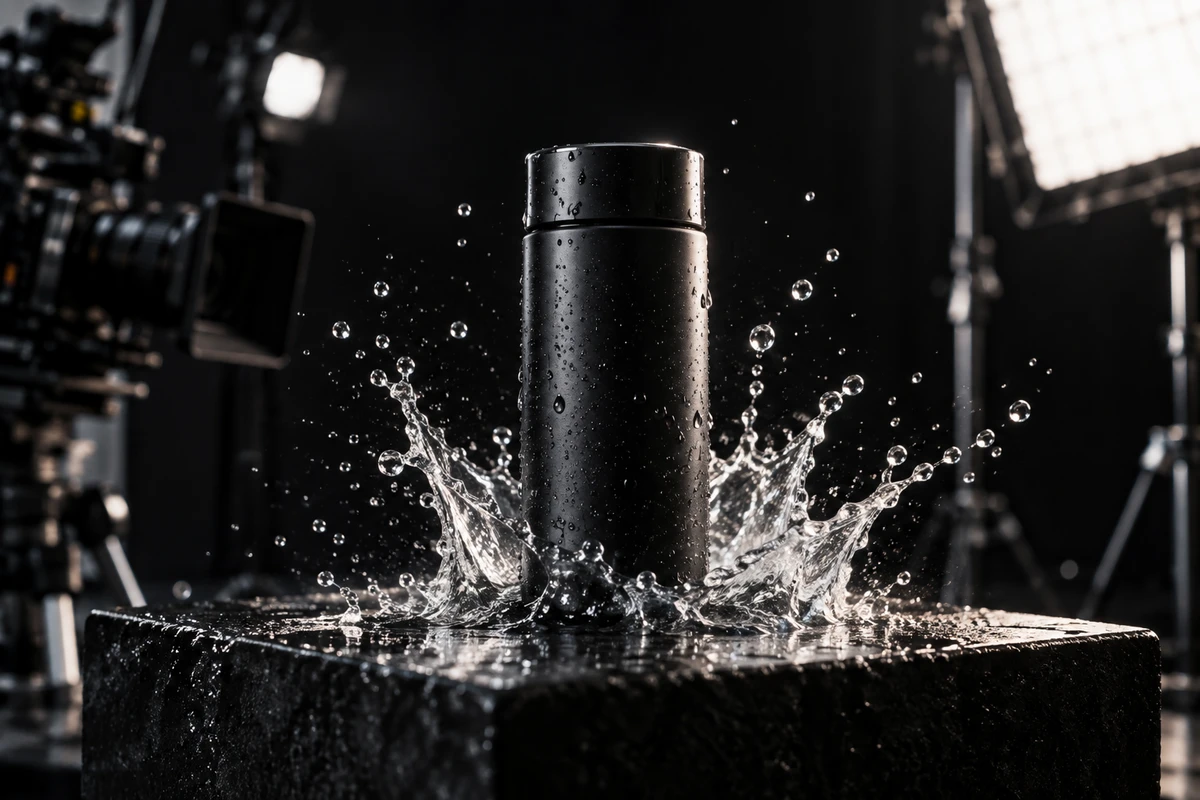
Imagine a drop leaving a pipette and hitting a product surface in just 0.4 seconds. The creative calls for the deformation, splash and rebound to remain on screen for four seconds. The first buying question is not, “What is the camera’s maximum frame rate?” It is how those 0.4 seconds should expand into four seconds, and which details must survive the expansion.
At a 25 fps delivery rate, four seconds requires 100 frames. Capturing those 100 frames during a 0.4-second event gives a theoretical acquisition rate of 250 fps. That number is only the starting point. The production plan must still account for exposure time, available light, depth of field, resolution, lighting flicker, trigger timing, reset time and sample wear.
The correct order for a high speed product video is therefore simple: define what the viewer must see, calculate the time expansion, then price the exposure and on-set consequences. Camera models come after those decisions.
Calculate the minimum frame rate from real time
The basic relationship is:
Capture frame rate = delivery frame rate × target playback duration ÷ real event duration.
If a button springs back in 0.2 seconds and the edit should hold that action for three seconds at 25 fps, the theoretical capture rate is 375 fps. A production team may choose 400, 500 or another supported setting after testing stability, framing and light. That is an engineering choice for the shot, not a universal best practice.
Start each proposed shot with a time card:
- Where does the action begin and end?
- How long does the real event last?
- How long should it last in the finished film?
- Must the viewer read an outline, a droplet, powder, structural rebound or facial expression?
- Will the slow-motion footage enter a 25 fps, 30 fps or another delivery master?
This card exposes a common misconception: a higher frame rate is not automatically more premium. High speed is useful when valuable information occurs too quickly for the eye to read. A slow light sweep, a static material surface or a repeatable mechanical turn may be better served by normal-speed capture, precise motion control or stronger lighting.
A higher frame rate immediately becomes a lighting question
Photron’s current camera-selection guidance treats frame rate, resolution, sensitivity, exposure time, recording duration and synchronization as a connected system. Its high-speed illumination guidance also explains that increasing frame rate and subject speed shortens the useful exposure and raises the demand for controlled light. These manufacturer references were checked on October 1, 2026; they are not a universal recipe for commercial filmmaking.
In a product shoot, insufficient light does not merely create a dark image. The crew may need to raise sensitivity, open the aperture, reduce the field of view, or accept more noise, shallower depth of field and harder-to-control highlights. Those compromises can materially change how metal, glass, glossy packaging and illuminated screens appear.
Fixtures also need to be tested at the intended frame rate and exposure. A source that looks steady to the eye may reveal periodic brightness changes in slow-motion playback. Ask for a short test clip at the target settings, not just a line item that says “high-speed camera and high-output lights.”
Compare at least three test settings: the lowest rate that explains the action, the preferred creative rate, and a higher rate that the equipment and location can support. Review only four things: whether the action reveals more useful information, whether motion blur is acceptable, whether colour and highlights remain credible, and whether any crop or resolution change still fits the deliverables. If moving from 500 fps to 1,000 fps only makes the frame darker and tighter without explaining another stage of the action, the higher setting may not earn its cost.
Put trigger timing and reset time into the call sheet
The decisive work often happens before and after the recording window. A liquid impact may last only milliseconds, while refilling the vessel, cleaning the product, replenishing the medium, restoring the tabletop, checking the front element and focusing again can take far longer. Powder, breakage, spraying, heating, dropping and fast mechanisms can make reset time the true limit on how many usable takes fit into a day.
Break each high-speed shot into four clocks:
- Preparation: loading, positioning, focus, lighting and safety checks.
- Waiting: camera buffer, trigger window and performer or operator readiness.
- Recording: the required pre-trigger and post-trigger range.
- Reset: cleaning, part replacement, cooling, refilling, recalibration and data confirmation.
These clocks describe the workload more accurately than “six high-speed shots.” They also determine sample requirements. If an action leaves water marks, wear or a changed thermal state, separate the hero sample, functional action sample and consumable parts. The brief should name who declares a reset complete, which conditions must be photographed, and whether a failed take can reuse the same unit.
Safety belongs in the shot design as well. Camera robots, compressed air, fragments, liquids, batteries, heat sources and high-speed rotating parts cannot rely on verbal reminders. Separate the action, equipment and observation zones; define the trigger operator, stop authority and clearance confirmation. Specialist pulsed or laser illumination also requires qualified control of protection, beam paths and synchronization. A commercial shot should not add equipment that exceeds the location’s safety capability simply to reach a larger number.
Three shots that should not default to high speed
First, the motion may contain no hidden information. A slow hinge, dial turn or indicator light can already be understood at normal speed; slowing it further may only stretch the edit.
Second, the product fact may not be repeatable in live action. Internal assembly, floating parts or controlled transformations can be easier to approve with CGI or a live action and CGI hybrid. This does not mean post-production is always cheaper. It means controllability should serve the creative purpose.
Third, the brand may ask for something “slow” without identifying what viewers should learn. In that case, rehearse the action at a normal frame rate, approve its stages, composition and lighting, and only then decide whether high-speed capture is justified.
Require a testable high-speed shot package
A production-ready scope should include:
- Real event duration, target playback duration, delivery rate and proposed capture rate for every shot.
- Frame size, resolution and exposure at the target rate, plus an agreed level of motion blur.
- A lighting test that shows acceptable flicker, colour and highlight behaviour at the actual settings.
- Trigger method, pre- and post-trigger range, camera-buffer plan and on-set playback method.
- Sample, consumable, cleaning, cooling and replacement requirements, with a reset owner.
- Safety zones, stop authority and a fallback when the action cannot be repeated reliably.
- Test clips at three settings, with the capture metadata supplied for approval.
Do not approve only the slowest-looking clip. Compare normal speed, the intended slow motion and the higher-rate test side by side. Ask whether the added screen time helps the viewer understand more about the product. If it does not, the money may be better spent on action design, lighting, samples or another shot.
High-speed photography is valuable when it turns a fleeting product event into a clear, credible image worth watching. It is not a specification contest. If you are planning liquid, powder, food, mechanical or consumer-electronics shots, send ONCE the real event duration, desired playback time, sample count and delivery requirements. Explore U-STUDIO’s product and motion-control facilities or talk to ONCE about the production scope.