Imagine an overseas buyer opening a factory page for the first time. They see an aerial view, a clean workshop, blinking machine lights and several people in hard hats walking through frame. Yet they still cannot tell how an order becomes a product that can be delivered consistently. The pictures look expansive, but the buyer has very little evidence to judge.
A useful production line video starts by turning “we have capacity” into a visible business chain: order entry, material preparation, equipment action, takt and handoffs, quality release, and finished-goods dispatch. ISO’s 2026 quality management principles describe the process approach as managing interconnected processes, including their inputs, outputs, responsibilities, controls and performance indicators (ISO, Quality management principles). A film does not replace a quality management system. It can, however, use the same logic to show how capability happens instead of merely stating that it exists.
The symptom: plenty of machinery, no clear delivery story
Many factory films open with a wide workshop shot, move through a montage of machines, and end with rows of finished products. This structure is easy to capture, but it often loses the causal chain. Viewers see equipment without learning when materials enter, how operations connect, where quality is judged, or what happens to a nonconforming part.
The problem is rarely a shortage of shots. It is a shortage of specific proof assignments. Before filming, complete this sentence for every shot: This action helps the buyer verify that... If the answer is only “the plant looks automated” or “the line looks busy,” the shot is probably not doing enough work.
Proof point 1: show an order entering without exposing client data
The first proof point is how a production task begins. That does not require filming a real customer order, and names, prices, drawings, delivery dates or login details should not appear on screen. A safer approach is to use an approved, redacted work order, a controlled portion of the production board, or a filming-only process card that shows how product type, batch and routing are initiated.
This scene answers why production starts at this moment. It might show a planner releasing a task, an operator collecting a batch card, or a material status changing from waiting to active. Before the crew arrives, classify screens, documents and labels as red, amber or green: red is prohibited; amber can be filmed only in an approved crop; green is cleared. Post-production blur should be a recovery measure, not the first line of confidentiality control.
Proof point 2: give continuous production a material starting point
A warehouse wide shot is not the same as evidence of material control. A stronger sequence shows material being identified, checked, prepared and handed to the next station. Depending on what the factory is permitted to disclose, that may include nonsensitive label fields, a scan, a fixture being prepared, or a physical handoff to the line. The crew should never rearrange a real procedure simply because a different order looks better on camera.
Use a three-shot pattern: a wide shot establishes the relationship between the material area and the line; a medium shot explains the handoff between person and material; a close-up records one visible change of status. Together, the three shots tell viewers that production has begun to flow rather than showing static inventory.
Proof point 3: explain the relationship between people, machines and products
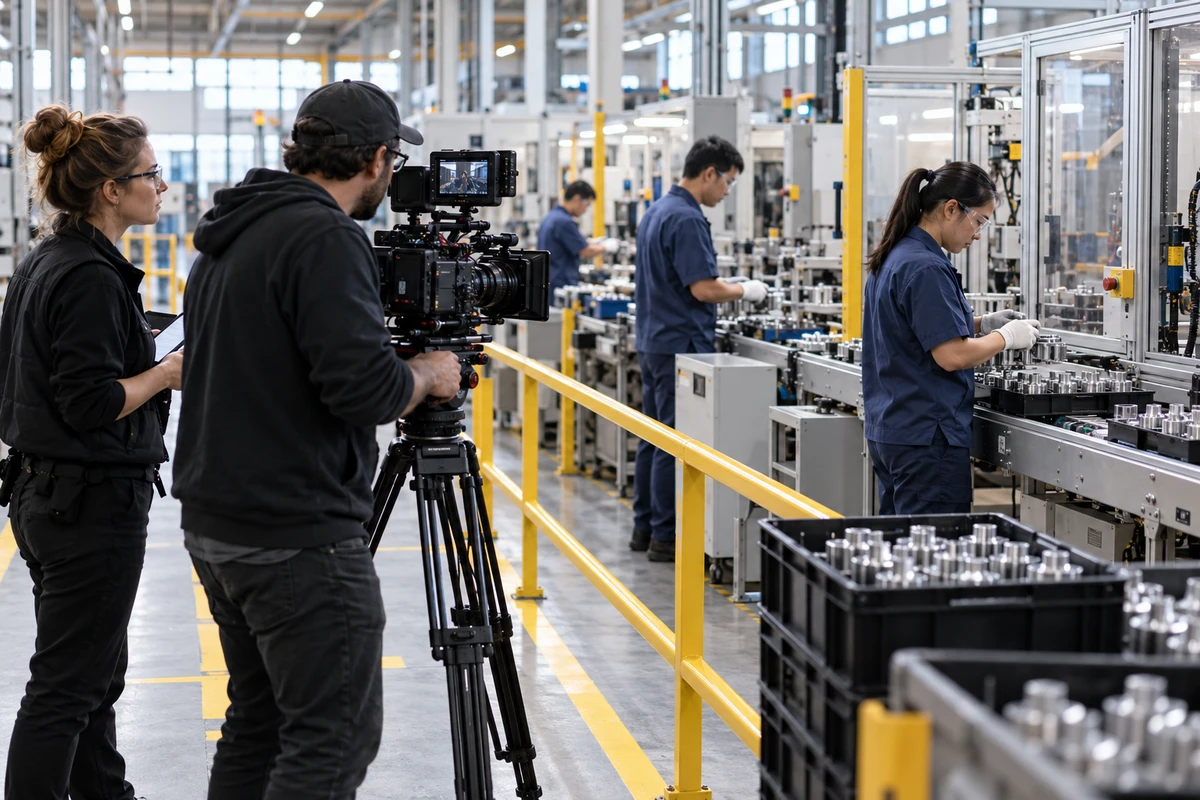
Equipment footage easily becomes a collection of meaningless moving parts. First define what the station changes: cutting, bonding, fastening, welding, filling, inspection or transfer. Then preserve both the object of the action and its result in the shot design.
A useful equipment sequence normally carries three layers of information. A wide shot locates the station in the line. A medium shot shows the operator-machine handoff. A close-up captures the critical contact, process or state change. A robot moving quickly may not explain what it does to the product; an operator pressing a button may hide the process altogether. The edit should establish cause and effect between them.
The crew must follow the factory’s own EHS rules and the instructions of the responsible site lead. It should not move machine guards or enter a hazardous zone to secure a camera angle. OSHA’s general machine-guarding requirement says guarding is intended to protect operators and other people in the machine area from hazards such as points of operation and rotating parts (OSHA 1910.212). This is not a substitute for local compliance requirements in China. It illustrates a production principle: a camera plan cannot depend on removing safeguards or crossing a safety boundary.
Proof point 4: show takt and handoffs without manufacturing speed in the edit
Takt is not demonstrated by speeding up the edit or showing ten machines for one second each. Continuity becomes visible when the output of one operation becomes the input of the next. Follow one recognisable product or carrier through two or three adjacent stations. Alternatively, lock the camera and record several repeated handoffs so viewers can see that the action recurs instead of being staged once.
If the line cannot stop, the production schedule should not say only “09:00 to 11:00.” It should be organised around production-state windows: what can be filmed before a changeover, during stable running, and during maintenance or cleaning. Use approved walkways, longer lenses and remote monitoring where appropriate. Pre-light safe areas, then wait for the approved batch. This reduces disruption and avoids altering real takt simply to make a shot happen.
Proof point 5: turn strict quality control into a visible decision
“Strict quality control” is often represented by an inspector posing with an instrument. A credible quality-control scene needs four elements: the item being inspected, the test action, the basis of the decision, and the item’s path after that decision. Within the factory’s disclosure rules, the film might show an instrument being zeroed, the location of a sample check, a nonsensitive portion of a reading, an approved status marker, or a rejected item being isolated for review.
Do not ask an operator to press a button that has no role in the real inspection. If the data itself is confidential, show the decision structure: who checks, when the check occurs, what category is evaluated, how approval is released, and where an exception goes. NIST’s smart manufacturing material connects final component specifications with inspection and in-process measurement systems (NIST Smart Manufacturing Operations Planning and Control). For a video, the important point is not to make the instrument look complicated. It is to make the consequence of measurement understandable.
Proof point 6: close the chain with finished-goods dispatch
The final proof point is not a wall of products. It is the way a product leaves manufacturing: final status confirmation, protective packaging, batch handoff, storage or dispatch. Customer labels, serial numbers, addresses and order quantities still belong on the confidentiality list. Use approved sample packaging, avoid sensitive fields, or frame only the hand action and cleared status indicator.
At this point, the six proof points form a complete chain. A viewer may not need to understand every operation, but they should be able to retell how the task begins, how materials enter, what the equipment changes, how operations connect, where quality is judged, and how the product moves into delivery.
Plan three uses before the same shoot
A website or exhibition film needs the process to remain coherent, usually using 16:9 frames to establish spatial relationships. A sales team needs shorter proof-point modules that can be paused or sent separately. Overseas social content needs close actions that remain legible in 9:16.
LinkedIn currently lists 16:9, 1:1, 4:5 and 9:16 among its recommended video-ad formats (LinkedIn Video Ads Specifications). Google Ads recommends separate 1920 x 1080, 1080 x 1920 and 1080 x 1080 assets and provides guidance on safe zones for important elements (Google Ads video specs). A vertical version should therefore not be treated as a centre crop made after the shoot. The shot list should identify which wide frames explain the full process, which medium and close shots can stand alone vertically, and where subtitles or identifiers may sit.
Footage can also be tagged by location, proof point, batch and confidentiality level. Adobe’s XMP documentation explains that descriptive metadata can be embedded in source files and travel across compatible applications (Adobe XMP metadata). Metadata will not create an asset-management system by itself, but it can make one production easier to reuse across sales, exhibitions and social versions.
If AIGC is used for explanatory visuals that cannot be filmed, distinguish between illustrating a principle and pretending that a generated scene is the real line. TikTok Ads Manager currently provides an AI-content disclosure setting for ads that are entirely generated or significantly modified by AI (TikTok Ads Manager). Platform requirements change, so confirm the rules for the relevant market and account before publishing. In manufacturing communication, real equipment, real processes and real quality decisions should retain their status as evidence. AI is better used for invisible structures, abstract principles or version extensions, with the boundary made clear.
Rehearse acceptance with a six-row table
Put six rows into the production brief: proof point, buyer judgment, filmable action, prohibited information, required aspect ratio, and final use. Then ask five questions for every row. Is the action real? Can the viewer see a state change? Does it connect to the preceding and following proof points? Can it be filmed without compromising production or safety? Who has authority to approve the shot?
If a row can only say “make it look more premium,” it is not ready. When all six proof points lead to real actions, a production line video does not need to fill every frame with large equipment. It can help a buyer understand how the factory works, how quality is judged, and how delivery is completed.
ONCE’s Factory and Corporate Video Production service connects R&D, manufacturing, teams and delivery into one evidence chain. If you are planning content for a factory website, trade show or overseas sales team, start with the six-row table. Bring the process map, available production windows, confidentiality scope and target channels, then define the shoot and version list around what buyers genuinely need to verify.