For an e-commerce brand with products manufactured in China, the next content brief rarely stops at one launch film. A new color needs a product-page clip. A feature needs a clear demonstration. The media team needs a different opening to test. Rebuilding the set, lighting and camera movement for every request can turn a manageable content program into repeated production expense.
ONCE uses robotic camera movement in product video production to make suitable parts of that work repeatable. When a product family can share a setting, lighting approach and visual language, an approved camera move becomes a reusable production foundation—not something the crew has to reinvent for every SKU.
That can create room in the budget for better product storytelling and more purposeful edits. It does not mean a robot makes every shoot cheaper. The value is in reducing duplicated work while delivering footage your marketing team can actually use.
Repeat the movement, not the message
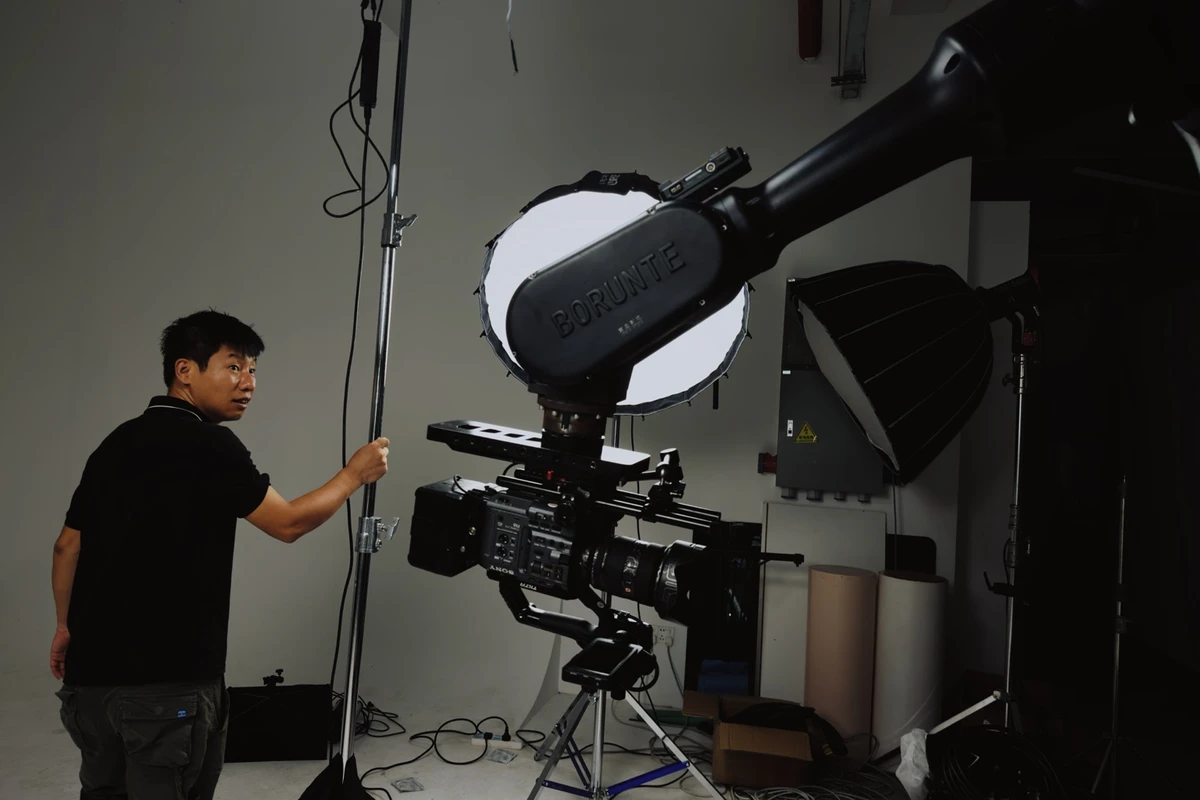
The supplied ONCE studio photographs show a robotic arm, a cinema camera, lighting equipment and crew working together. This is a production tool inside a human-led process, not a claim of unattended manufacturing.
Repeatable camera movement is a core motion-control capability. MRMC’s official “Flair” product documentation describes recording and replaying moves, keyframing and lens control. That explains the technology category; it does not establish that ONCE uses that software or shares the manufacturer’s equipment specifications. The relevant documentation was reviewed on September 30, 2026 and does not display a publication date.
For a product shoot, the practical opportunity is straightforward. Once the team has tested a move that reveals the silhouette, travels into a material detail and finishes on a key component, that move can provide a starting point for similar variants. Attention can then shift to product placement, reflections, focus and whether the benefit is readable.
A reusable path should never erase differences between products. A headphone color range might share an exterior presentation. Different models may still need separate demonstrations of fit, controls or included accessories. The robot executes a movement; creative planning determines what the customer needs to understand.
Batch by shared production conditions
ONCE recommends organizing a batch around four shared conditions and one product-specific requirement. Before commissioning the shoot, use this checklist to see which SKUs belong together:
| Production condition | What a batch may share | What still needs checking |
|---|---|---|
| Setting | Background, surface, props and visual style | Product size, placement and working space |
| Lighting | A baseline setup for similar materials | Highlights, shadows and reflections for each color |
| Camera path | Tested start and end frames, reveal order and pacing | Focus, silhouette, obstruction and safe clearance |
| Delivery rules | Naming, aspect ratios, text space, clean versions and edit list | Suitability for each intended placement |
| Product-specific benefit | Do not force a common answer | The function or difference each SKU must explain |
The principle is to share production conditions without flattening product differentiation.
Where practical, the schedule can move through shot families: capture the exterior sequence across the compatible products, then move to detail shots or demonstrations. That can avoid rebuilding the entire setup each time a new product arrives on the table. A reflective metal item, a glass product or a substantially larger model may need a separate group. Batch size should not come at the expense of image quality.
Build a footage library around buying questions
Smooth camera movement alone does not make an asset valuable. A useful package gives the marketing team material for different jobs:
- Appearance and finish: show shape, color, material and identifying details for a product page or brand presentation.
- Function: demonstrate a real action, installation step or control clearly. Camera movement cannot substitute for an explanation.
- Human context: add hands, people or a relevant use setting when scale and interaction matter. These shots do not all need a robotic arm.
- Creative testing: give different buying reasons their own openings, message order and ending. A new music track is not necessarily a new creative concept.
TikTok For Business’s creative guidance, updated in June 2025 and checked on September 30, 2026, recommends continuous testing, meaningfully different creative and a maintained asset library. It also emphasizes platform-native presentation. The production implication is to capture options for future editing rather than deliver only one tightly locked film.
Plan horizontal, vertical and square uses before the shoot. A product can look complete in a wide frame while its connector, base or operating hand disappears in a vertical crop. Sometimes a dedicated vertical shot is the better investment. Polished studio footage may also need to work alongside more natural creator-led content; one visual style should not be assumed to suit every channel.
Compare cost per usable asset—not export count
For procurement, ONCE proposes a simple measure:
Cost per usable asset = total project cost ÷ accepted assets with a defined use.
The numerator includes planning, setup and camera-path preparation, shooting, editing and channel adaptation, revisions, plus any required sample logistics, talent and music rights. Keep source footage and finished edits in separate counts. Multiple bitrate exports of the same edit are delivery files, not separate creative ideas.
A robotic workflow may carry more initial setup cost. It becomes commercially attractive only when enough subsequent shots or compatible products reuse that work, and the avoided adjustment or reshoot effort outweighs the additional investment. New materials, new sets or completely different concepts reduce that advantage.
Ask a supplier which setups will be shared, which shots require new work, how many genuinely different edits are included, and what must be paid for again when the next SKU is added. That is a more useful budget discussion than asking for a generic percentage saving.
For a few straightforward static shots, a conventional camera setup, slider or turntable may be the right choice. ONCE’s equipment decisions should serve the brief, not make every shot complicated simply because a robot is available.
Approve a representative sample before scaling the batch
An overseas brand working with a Chinese factory can send representative samples and the SKU list to ONCE’s Shenzhen team. Keeping suitable product work near the supply chain can avoid unnecessary international sample movement. Compare the actual logistics, taxes and localization requirements before treating that as a saving.
For remote collaboration, start with one representative product and a sample sequence covering appearance and a core function. Approve color, material highlights, the camera move’s start and end frames, the product explanation and the intended framing together. Then proceed with the compatible group. Approval of one model does not automatically validate a structurally different model.
Agree who approves product claims, who consolidates visual feedback and who accepts the deliverables. Clear decisions let the crew focus on execution instead of repeatedly interpreting requests to make the footage feel “more premium.”
To discuss a batch with ONCE, bring the SKU count, dimensions and materials, key benefits, target markets, placements, launch date and budget range. The first conversation can identify shared production conditions, followed by a representative sample and a defined delivery package.
Efficient production does not mean multiplying the same shot. It means doing less work twice, while giving each product’s important differences enough attention. That is where robotic camera production can create value for an e-commerce content budget.
The cover is adapted from a supplied photograph of ONCE’s production studio. The batching method and cost formula are planning recommendations, not measured efficiency, pricing or marketing results from the pictured shoot.