A robot product video can create a dangerous illusion: it can turn “the robot completed this action once” into “this capability has been proven.” A manipulator picks up an object, a mobile robot avoids an obstacle, or a service robot responds to a spoken instruction. Each shot may be genuine, yet the viewer cannot see the lighting, floor, payload, network, setup, or human preparation that made it possible—or what changes when one of those conditions changes.
That is why the most important pre-production document is not the storyboard. It is a capability card agreed by marketing, engineering, safety, and production: what triggers the robot, what continuous action it performs, what result the viewer can observe, and which exceptions the camera must not hide. The storyboard translates that card into images.
Work backwards from the credible image you need to deliver
Start by deciding what judgment the film must support. A launch film helps a non-technical audience understand the product’s role quickly. A sales demonstration helps a buyer follow the workflow and operating context. A capability-evidence cut preserves enough continuity for a technical reviewer to see that the result was not created by a convenient edit.
All three can come from one shoot, but one edit cannot carry every task equally well. The launch film can compress time, shape rhythm, use close-ups, and build emotion through sound. The evidence cut should preserve the start, decisive transition, and result—sometimes with an uninterrupted wide shot. Not every benefit needs to become a laboratory report. But claims such as autonomous recognition, obstacle avoidance, or stable grasping should be shown with the basic conditions under which they hold.
The US National Institute of Standards and Technology does something instructive in a different context. Its Robotics Test Facility abstracts real tasks into repeatable tests for mobility, manipulation, sensing, endurance, and human–robot interaction. Its response-robot programme then introduces controlled variables such as slope, light, and wet surfaces. These methods are for testing and procurement, not rules for marketing films. The transferable lesson is narrower: a capability becomes discussable when the task, conditions, and observable result are defined.
Write a trigger–action–result–exception card for every capability
Even a simple movement needs four fields:
- Trigger: a button, voice command, visual target, dispatch instruction, or manual placement—and who initiates it;
- Action: how the robot moves, grasps, recognises, or collaborates, including the steps that must remain visible;
- Result: where the object ends up, how task completion is confirmed, and what the interface or status lights show;
- Exception: whether a change in floor, lighting, payload, network, object pose, or safety zone causes a slowdown, retry, stop, or operator takeover.
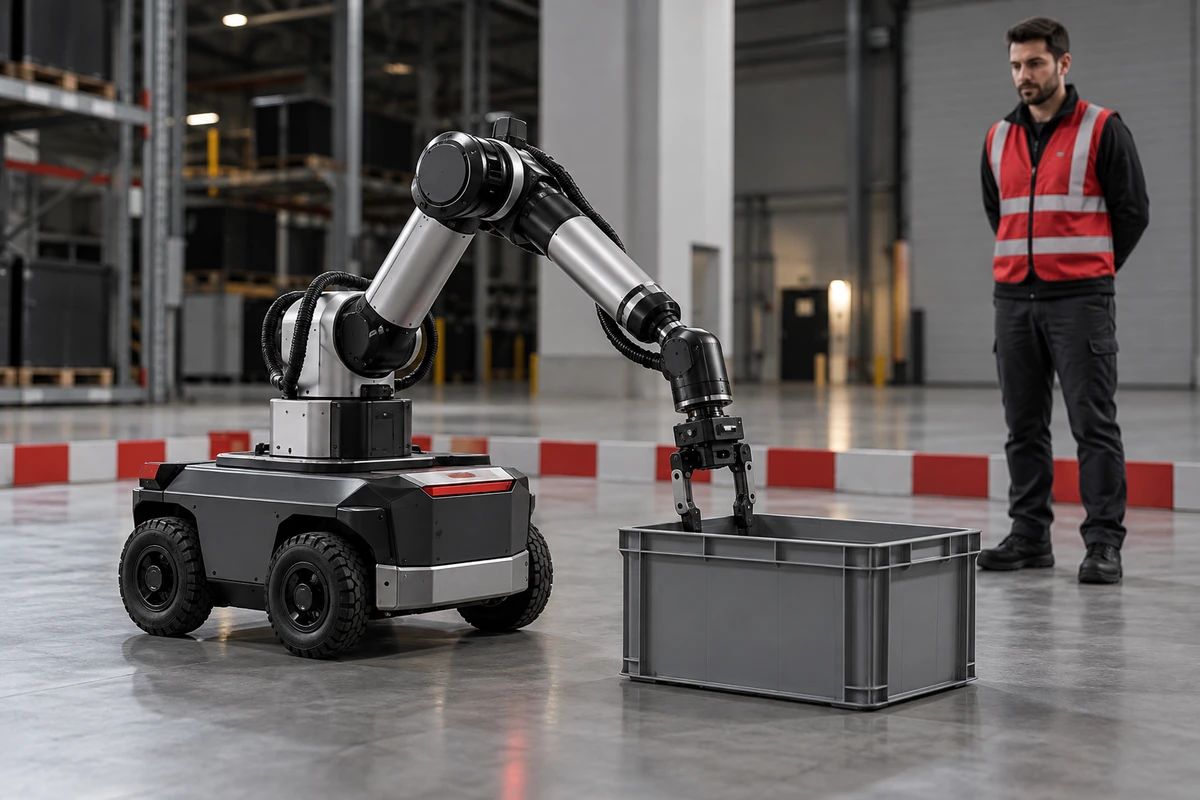
This card changes the camera plan. “The robot moves a tote automatically” cannot be proved by one elegant tracking shot. The team must know whether the tote was pre-positioned, how the target was recognised, whether people or temporary obstacles can enter the route, and what visible state confirms successful placement. If the edit keeps only the pick-up and drop-off, the audience sees an assembled outcome rather than the full capability.
Restraint matters here. Interface logs, maps, and sensor views can explain intelligent decisions, but they may expose unreleased product information. Engineering can approve a demonstration interface or an explanatory graphic layer, with a clear distinction between recorded data and illustration. For a prototype that is not production-ready, animation should not be used to complete a physical action the machine did not perform.
Capture the evidence cut before the more cinematic brand cut
The shoot order can be reversed: secure the highest-risk, hardest-to-repeat continuous actions first; then capture details, slow motion, lighting variations, and atmosphere. This does not turn the film into engineering CCTV. It protects the irreplaceable fact before styling it.
An evidence cut usually needs one stable view that contains the robot, task object, and essential environment. The brand cut can add low angles, moving shots, mechanical details, and tighter rhythm. Both use the same fact for different communication jobs. If an action succeeds only once in many attempts, the team should decide whether a successful result may be shown alone and how the copy avoids turning one demonstration into a promise of consistent performance.
The production log should record more than “shot completed.” Note the prototype and software version, end effector, task object, site condition, operator, reset time, and disclosure status. Following the logic behind repeatable robot performance tests does not make the video a certification report. It simply lets engineering know which set of conditions it is approving on screen.
Put the safety boundary into the production plan
Once the action involves people, workpieces, end effectors, or a travel path, camera blocking cannot be separated from application risk. The current ISO robotics catalogue treats industrial robots, system integration, service-robot navigation, manipulation, and legged locomotion as different safety or performance subjects. Universal Robots’ official risk-assessment guidance also states that application safety depends on the tool or end effector, obstacles, and other machinery, and that the integrator must assess the specific application.
A promotional film is not a compliance certificate. Still, camera positions, performer movement, demonstration speed, emergency-stop responsibility, restricted zones, and resets should be approved by someone who understands the equipment. Moving a safety barrier for composition or placing talent in the robot’s path for a more dramatic frame is not creative licence.
If the capability depends on a production line, upstream and downstream equipment, or real operators, decide whether the shoot needs a customer site. ONCE’s guide to smart-hardware product-video production recommends aligning prototype status, functional tests, on-site collaboration, and channel versions before the shoot. A controlled setup can establish a single action; an application site is more useful when the film must explain how the robot enters a business process.
Review whether viewers can repeat the conditions, not only admire the motion
Use five questions during final review:
- Can the viewer see where the action begins and what triggers it?
- Are decisive steps hidden by cuts, occlusion, or effects?
- Is the result observable, rather than announced only by narration?
- Are important operating conditions and limitations expressed appropriately in image, copy, or notes?
- Has a technical owner checked the interface, machine state, product version, and disclosure scope?
Also inspect whether parts, indicators, screens, and task objects remain consistent across shots. ONCE’s guidance on showing product features clearly can help teams turn each demonstration step, prop, condition, and safety measure into a practical shooting checklist.
A credible robot product film can still have light, speed, strength, and imagination. The difference is that the creative does not perform an unfinished task on the product’s behalf, and the edit does not erase the conditions that determine whether a capability is real. Define the failure boundary first, and the successful shot gains weight.
If you are preparing a robot or smart-hardware launch, share the product materials, application scenario, and planned channels through ONCE VISUAL’s video-production solutions to receive a shootable, reviewable technology-product video plan.
Production examples and next steps
Plan the product demonstration around what viewers need to understand. The realme GT7 film provides a reference for product detail and use scenes.
Review Ecommerce product video production in China. and realme GT7: Graphene Ice-Cooling Body Product Demo. To discuss your project, send the product sample, approved claims, use scenes and required formats through the English project enquiry form.