There is a simple way to review ecommerce product-page video production: turn the sound off, scrub through the timeline, and stop every few seconds. If the viewer sees polished transitions, a rotating product, and a list of specifications but still cannot explain what the product is, how it is used, or what changes after use, the film is not yet doing its job on a product page.
A product detail page is not a launch event or a brand manifesto. The shopper can already see the product name, price, images, and specifications. Video should make visible what static content struggles to explain. Sound can add emotion and context, but the buying logic should not depend on the voice-over being heard.
Above the fold, show what the product is doing before you play an intro
The opening group of shots should establish the product, the user action, and the direction of the result. It does not need to communicate every benefit at once, but it should not be only a logo, a slow packaging reveal, or an atmospheric shot unrelated to use.
Consider a portable tyre inflator as a hypothetical example. The opening can show the hose connecting to the valve, the pressure reading changing, and the device running steadily. Brand design and finish shots can follow. Even without sound, the viewer first understands how the product enters a real task. A sequence of metallic highlights, button close-ups, and music leaves the shopper to guess what those images mean.
As of 28 September 2026, Amazon’s official seller guidance says shoppable videos can appear in the main media block above the fold and elsewhere on the product detail page. It also advises showing the most important feature early. This does not impose one universal duration on every commerce platform. It does support a useful principle: the closer a video sits to a buying decision, the faster it should show product action rather than an opening ritual. See Amazon’s current guide to product videos on detail pages.
Order features around buying questions, not the specification sheet
A specification sheet is usually organised around engineering or category logic: power, material, ports, capacity, and accessories. A shopper’s sequence is different: What problem does it solve? How do I use it? Can I see the result? What are the limitations? What comes in the box?
Each feature segment can therefore be designed as an action–result–condition card:
- Action: who operates the product, in what setting, with the hands and product state clearly visible;
- Result: what changes after the action, proven with an observable shot rather than an adjective;
- Condition: the compatible product, mode, accessory, or environment that qualifies the claim, added in text only when needed.
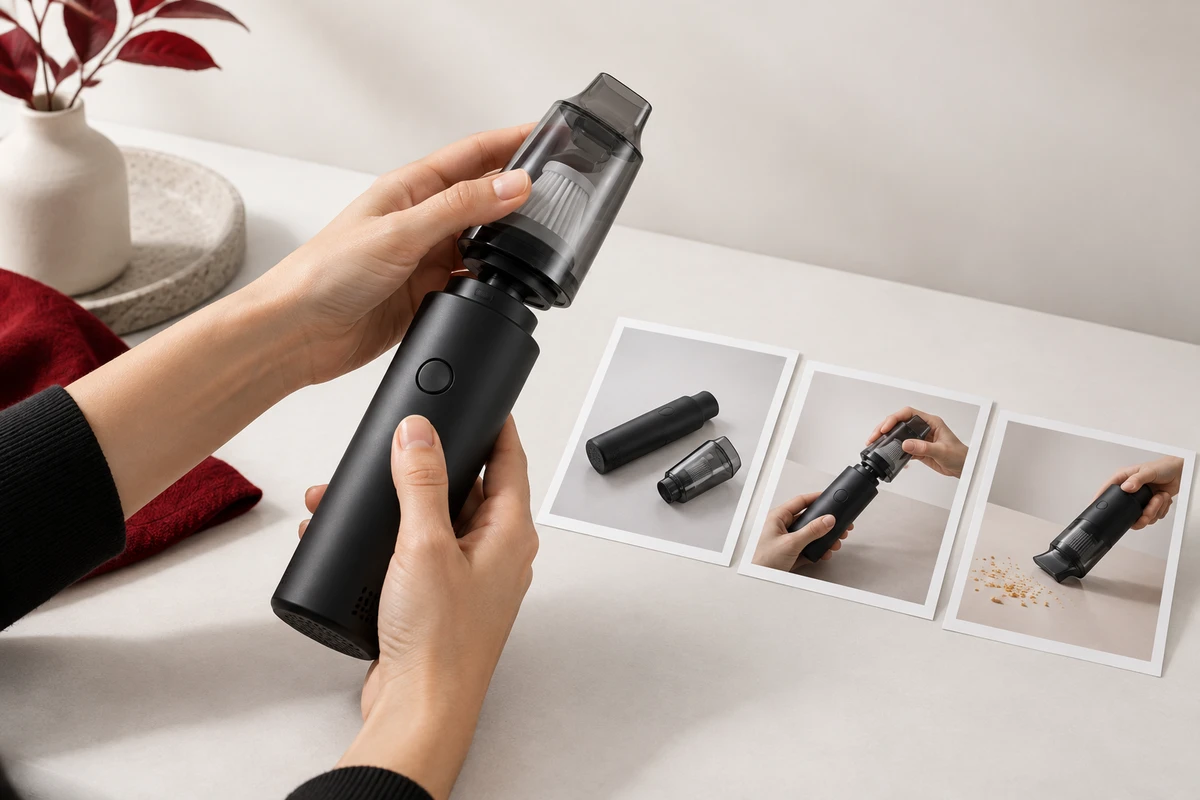
“Three operating modes” is a specification. Showing the mode change, the corresponding feedback, and the use case turns it into product-page information. The edit order should not be dictated by what was easiest to shoot. Production can group every shot from one set for efficiency; the final sequence should still follow the buyer’s questions.
For a related production method, ONCE’s guide to showing product features clearly in ecommerce video explains how to turn claims into visible demonstrations. The next step is deciding how those demonstrations should be ordered on the page.
Sound-off text is a second information layer, not a transcript of the voice-over
On-screen text often fails in one of two ways. Either there is none and every important point depends on narration, or the entire voice-over is burned into the frame, covering the product and moving faster than a shopper can read.
A more useful division of labour is to let the image carry the action and result, then use text for three things: numbers the image cannot confirm precisely, conditions that qualify the claim, and short conclusions worth remembering. Keep one information point per shot when possible. Time the words to the action, test them at real phone size, and keep them away from ports, indicators, controls, and the user’s hands.
Brands should also distinguish burned-in marketing text from a separate caption track. Burned-in text preserves visual hierarchy across players; a reviewed subtitle file supports player controls, language switching, and accessibility. The W3C’s guidance says captions are required at WCAG Level A when prerecorded audio information is necessary to understand synchronized media. Where the platform supports a caption track, deliver a checked SRT or VTT file as well. Where it does not, the visual story still needs to work without sound. See the W3C’s current captions and subtitles guidance.
Use three sound-off checks to make clarity reviewable
First, play the film from beginning to end with the sound off. Each section should reveal the product, the action, and the result. If text alone has to rescue the meaning, the demonstration is still too weak.
Second, stop watching continuously and jump ahead every three to five seconds. Product-page visitors scrub and skip. Each sampled moment needs enough context to help the viewer re-enter the story quickly. A missing product, an unclear pronoun in the caption, or an action stretched across too many edits can break comprehension.
Third, review the first frame, text, and key actions at real mobile width. Copy that is comfortable on a desktop monitor can become grey texture on a phone. Negative space that feels elegant in a landscape master can be covered by player controls. The objective is not to make every aspect ratio identical; it is to ensure that the subject, safe area, and information density work in each delivered version.
Do not accept only one final export
The expensive surprises often arrive after the shoot: ecommerce needs another language, the page team needs a lighter file, and paid social wants a vertical cut. The estimate and delivery schedule should state at least:
- aspect ratio, resolution, duration, and format for the primary page version;
- a clean text-free export and a version with burned-in text;
- reviewed caption files and required languages;
- a first-frame or custom-thumbnail asset;
- the key action footage and handles needed for later cutdowns;
- whether vertical and square versions are included rather than assumed to be simple crops.
Amazon’s upload route and Shopify’s product-media architecture also show why “product-page video” is not one universal deliverable. Shopify supports uploaded video as well as YouTube and Vimeo embeds, but the theme and player still determine how the media appears. TikTok and other social platforms require a fresh decision about vertical pacing, text safe areas, and the opening hook. TikTok’s own creative guide recommends captions or on-screen text so a story still lands with sound off, but that is guidance for social creative—not a universal product-page rule. Shopify’s current product media documentation and TikTok’s creative advertising guide are useful checks during version planning.
Return to the sound-off review at the end. Without audio, a shopper should still recognise the product, understand the decisive action, see the result, and notice any important conditions. When sound returns, music, effects, and narration should deepen that path—not explain a film that the images failed to make clear.
To turn an existing product page, benefit list, and channel plan into a shootable and reviewable brief, explore ONCE’s ecommerce product-video production service and contact ONCE VISUAL for an ecommerce video production checklist.