Your customer likes the product but does not want to appear on camera. Another can share a useful photo but cannot edit a video. Before raising the incentive for a brand ambassador mission, decide whether these people can participate at all. A consumer invitation should not be a professional production brief with a friendlier heading.
For overseas teams working with Chinese product suppliers, there are two distinct jobs here. Product and production specialists can establish what an example should show. The team running the customer relationship must make the invitation understandable and respond when someone gets stuck. More submissions do not remove either responsibility.
A current example—and a different kind of purchase
Pampers US lists an October 15–30, 2026 “Love Made Me Do It” mission with a limited $15 gift-card reward following verification. Participation involves posting from a public personal account. The page’s FAQ permits photos, does not require showing a baby’s face, and excludes AI-generated submissions. These are conditions of this particular programme, not universal ambassador rules.
Source: Pampers US, Pampers Ambassadors – Love Made Me Do It Mission, mission dates October 15–30, 2026; checked October 16, 2026.
The useful design question is how an invitation accommodates a participant’s circumstances. The page does not establish submission volume, actual reward fulfilment or commercial impact. We have not registered or tested the reward process.
Compare that with commissioned production. Billo’s How does Billo work?, checked October 16, 2026, describes a brand brief, creator selection, upload and approval workflow. Personal-account posting is not the default requirement. This comparison concerns the work being commissioned, not relative performance or licensing terms.
If a launch requires defined shots and approved versions by a fixed date, commission deliverables. If an existing customer community wants to share varied everyday experiences, consider a participation mission. You can run both, but issuing an invitation is not ordering a guaranteed number of ads. A gift-card amount is not an all-in production rate. Nor is this a plan for rewarding product reviews.
ONCE’s unfamiliar-participant walkthrough
This is a proposed pre-launch method, not a report of an ONCE client experiment. With consent, ask someone from the intended audience who did not help design the campaign to interpret and simulate the instructions. Do not require an actual public post or personal-data submission. Avoid coaching them through every ambiguity.
Record each pause for help: what was missing, who will resolve it, and what the revised instructions must explain. The subject is the participation journey, not whether the person is a talented filmmaker.
| Participant’s task | Question to rehearse | What the team must provide |
|---|---|---|
| Establish eligibility | Do purchase, location, registration or account visibility matter? | Clear conditions and preparation |
| Choose a contribution | Can someone participate without a face-to-camera performance or editing skills? | Allowed formats and intelligible examples |
| Finish submission | Does posting, uploading or registering a link complete the task? | One unambiguous completion instruction |
| Understand what happens next | How will receipt, a query, rejection or closure be communicated? | A responsible team, channel and response guidance |
A walkthrough is not live operational proof. One person’s successful attempt cannot predict a participation rate. It can expose instructions that should not have needed a support conversation in the first place. If the team cannot answer even a small group’s questions, repair that service before recruiting more people.
Reduce the assignment, not the truthfulness
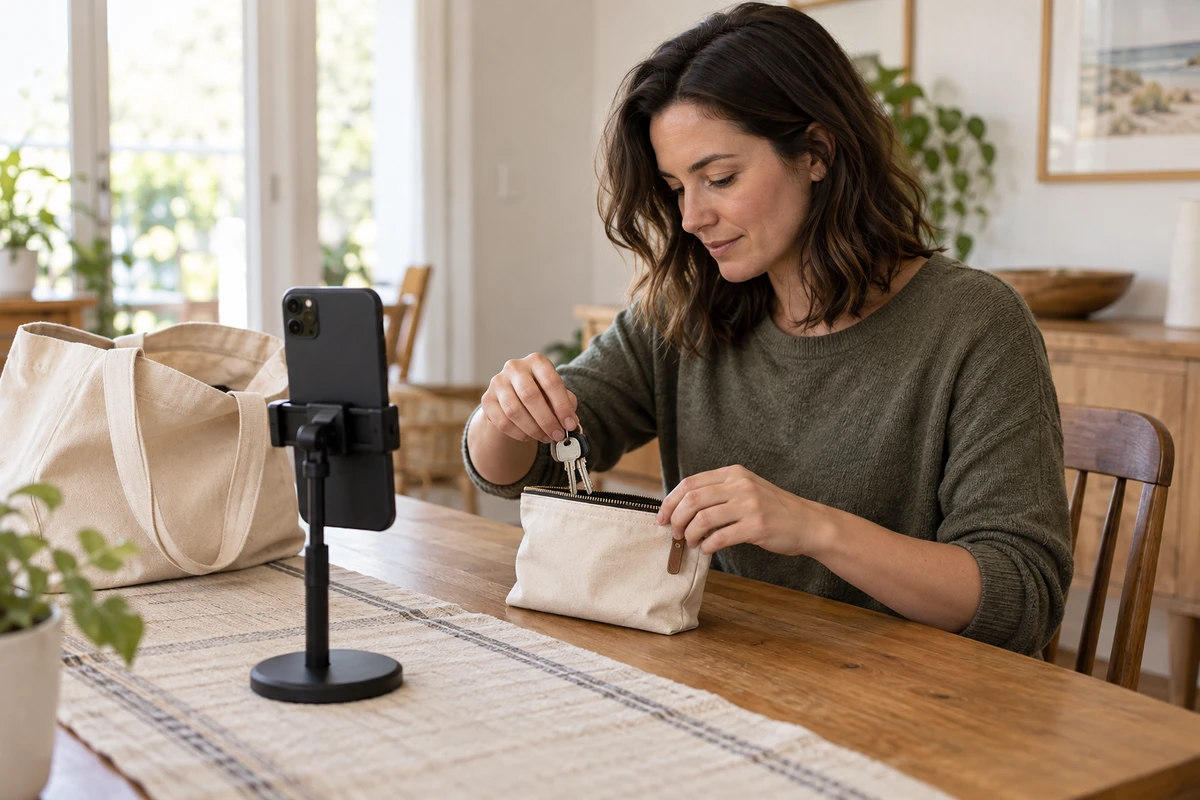
Imagine a household-storage brand asking existing customers to share one detail of their weekday routine. This is a fictional planning example. The initial brief demands a talking head, an unboxing, several feature demonstrations and elaborate transitions. It has accidentally commissioned an advert from people who only agreed to share a moment.
A smaller prompt might ask: “Show one item you keep in this pouch for your workday, and explain why.” If the objective permits it, allow a hands-only clip or a photo with a caption. Retain what is necessary to understand the contribution without prescribing praise or a professional visual finish.
Not every task should become looser. A product needing precise assembly or safety instruction may require a separately commissioned demonstration. An ambassador mission should not carry that responsibility merely because customer filming looks informal. Likewise, avoid soliciting household details or identities people do not want to make public. Have the brand and appropriate advisers confirm personal-information handling, people’s participation, commercial disclosures and intended content use.
Scope the invitation service separately from the films
Ask a supplier to identify three possible work packages rather than hiding everything inside “UGC support.” Preparation may cover participant-facing instructions, an accessible example, the walkthrough and a revision log. The example should clarify the task, not establish a cinematography standard ordinary customers cannot match.
Operational support needs a defined activity window, support and verification owners, communication channels, escalation and closure handover. Agree who funds, checks and distributes rewards, and how depleted availability or disputes will be handled. These are not decisions to leave with an editor after the campaign launches. Do not promise that every participant will remake content until the brand approves it; any additional production or reuse needs its own agreed arrangement.
For an initial run, record the questions people ask and the steps where they stop or need help. Use appropriately permitted records with minimal personal information. A post count alone does not show whether participation worked, and there is no basis for inventing a completion-rate target before observing the process.
For ONCE, this suggests a possible service beyond producing every asset: helping a brand design an invitation it can actually operate. It is not an announcement of an existing package or a guaranteed route to recurring revenue. Ongoing support only makes sense when the brand has a real customer relationship and enough operational capacity. Otherwise, a bounded creator-production project may be the better purchase.
Before briefing a partner, state which outcome you need: approved films, or customer participation in a story. For the latter, commission a walkthrough and identify who remains responsible when the activity ends. If you also need a hero film, product demonstration or task example, define that production separately using ONCE’s video production solutions as a starting point.