After a vertical product ad goes live, the comments often reveal what viewers did not understand: “Will it fit in a car cup holder?”, “How do I clean the blade?” or “Will it leak in my bag?” Those questions are useful inputs for Reels product-ad testing, but they are not conclusions about the whole audience—and they do not justify reshooting the entire video on their own.
A more disciplined approach treats a comment as a clue. First identify the missing piece of understanding. Then define what visible evidence the next asset must provide. Only then decide which shot to capture. The next version becomes a test of one creative hypothesis, not a vague attempt to “try a stronger hook.”
Comments show where to investigate, not what caused the result
Consider a hypothetical 15-second ad for a portable blender. The first version moves quickly through unboxing, adding fruit, blending and pouring. Three kinds of questions appear:
- “Will it fit in a car cup holder?” The scale relationship may be missing.
- “How do I clean the blade?” The operation may have been cut too quickly.
- “Will it leak in a bag?” The ad may state a sealing benefit without showing a process viewers can assess.
None of these comments proves that the video caused a buying objection. Commenters are not the full audience, and delivery, targeting, price, the product page and an offer can all affect what people ask. Compare the wording with customer-service questions, site search, product-page behaviour, return reasons or sales feedback to see whether the same uncertainty appears in more than one place.
Comments are still valuable because they preserve the audience’s language. “Strengthen the benefit” is too broad to film. “Show whether it fits the cup holder,” “show how many parts come off for cleaning,” and “show what happens when it is inverted” are much closer to executable shots.
Diagnose three information gaps before choosing a camera angle
Scale: the missing element is a reference, not another close-up
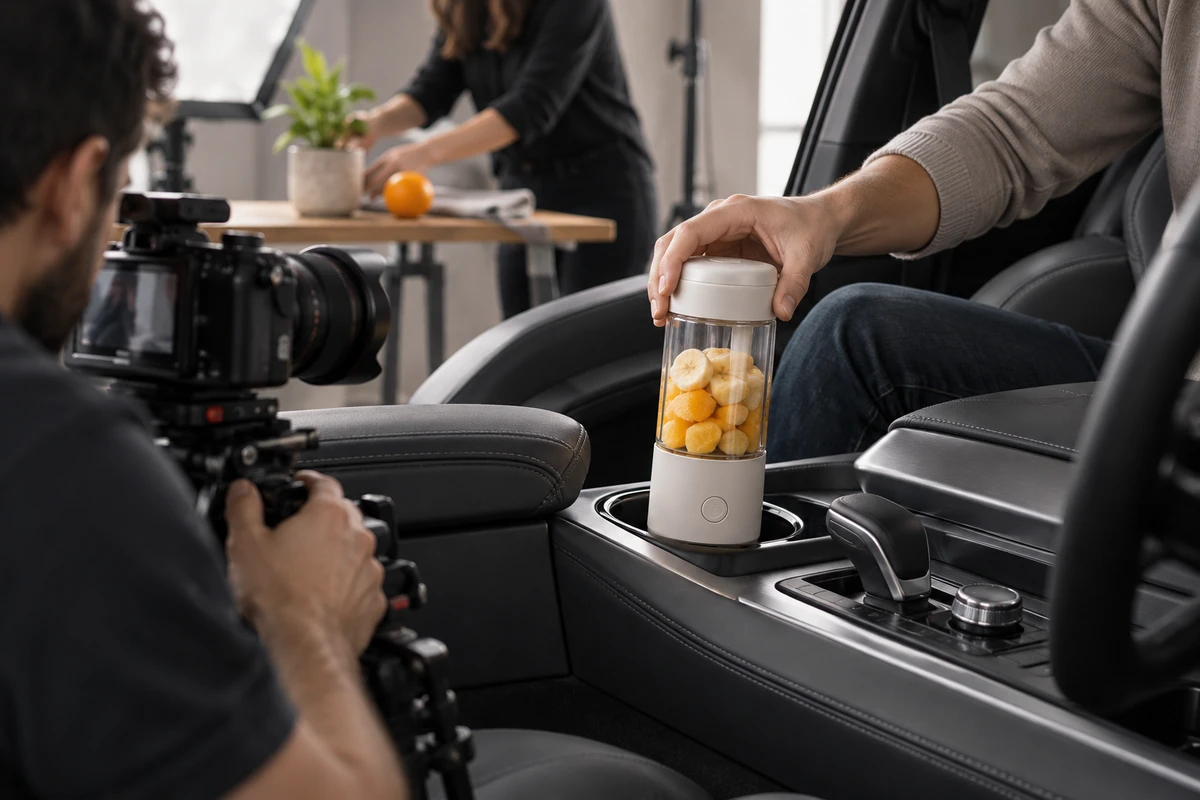
If viewers ask how large the product is, a tighter beauty shot usually will not help. A close-up can show finish and controls, but it removes scale. A more useful shot places the blender in a standard car cup holder or follows one hand lifting it and placing it in a bag’s side pocket. Keep both the product and reference object in frame.
The acceptance question is simple: without reading a caption, can a viewer judge the relationship between the product and the hand, cup holder or pocket?
Operation: the missing element is continuity, not faster pacing
“How do I clean it?” requires a sequence: power off, unscrew, remove the appropriate parts, rinse, and reassemble. A locked or gently elevated camera can keep both hands visible, with no jump cut across a critical connection. If the instructions prohibit rinsing a component or require a tool, the video must follow the approved product guidance.
Ask whether a first-time viewer could repeat the order of actions after watching. A montage of attractive fragments can still fail if it removes the relationship between steps.
Trust: the missing elements are conditions and outcome
An actor placing the blender in a bag communicates a use case; it does not prove sealing performance. A reshoot should define the approved test conditions first: liquid level, how the lid is locked, the duration or movement, and the result the camera may show. If the sample cannot support the demonstration, do not present the feature as settled.
The danger is a shot that looks like a test without functioning as one. Fast shaking, a confident reaction and a cut to a dry bag may be energetic, but they do not continuously show conditions and result.
Build a question-to-evidence reshoot map
Before the next round of short-form video production, turn audience questions into production tasks:
| Audience question and gap | Visible evidence and reshoot task |
|---|---|
| Will it fit a car cup holder? Scale is unclear. | Keep holder and product in one medium shot; show one complete placement action; avoid wide-angle distortion. |
| How is the blade cleaned? Sequence is unclear. | Use a fixed overhead or high angle; show power-off, disassembly, rinsing and reassembly without cutting across key connections. |
| Will it leak in a bag? Trust conditions are missing. | Follow approved liquid and locking conditions; film the agreed inversion or movement continuously; identify the sample and test limits. |
| Does it make sense without sound? Meaning depends on narration. | Keep the picture constant and add concise captions or action labels; check that text does not cover hands, controls or outcomes. |
Add four fields to every row: hypothesis, constants, single changed variable and acceptance condition. A scale hypothesis might be: “If the first use action establishes the cup-holder relationship, viewers will understand portability earlier.” Keep audience, objective, ending, duration and principal copy constant; change only product timing and the scale action.
TikTok’s January 2026 split-testing documentation says the groups should keep other variables consistent. Its variable guidance also states that one variable can be selected per split test. A production team does not have to use that exact tool, but the principle is useful: if the opening, talent, captions, music and offer all change together, it is difficult to attribute a result to one shot.
Separate product timing, captions and sound
The reshoot answers an information gap, but its position in the edit determines whether viewers see the answer.
If the audience cannot identify the product, introduce it inside the first meaningful action. If the product is already clear and the questions concern cleaning, test an earlier complete cleaning action instead of mechanically moving a logo or package to frame one. Showing the product earlier is not the same as revealing useful information earlier.
Sound and captions should not become one combined variable. Meta’s public Reels guidance highlights vertical creative, audio and safe zones. TikTok’s Creative Codes recommend 9:16 framing, space for the interface and deliberate use of music, voice and effects. Google’s current Shorts guidance also recommends vertical, sound-on, social-first assets. These platform documents shape version design; they do not make one edit universally portable.
Review the asset twice: once with sound, to judge whether operation sounds, interface feedback and narration improve comprehension; and once fully muted, to confirm that action and captions still explain the product. If text covers the lid lock, blade removal or test outcome, accurate copy is still weakening the evidence.
Cross-platform reuse is more than exporting three sizes
Reels, TikTok and YouTube Shorts all support vertical creative, but their interfaces, safe areas, campaign settings and viewing contexts differ. Google’s current Shorts documentation even distinguishes when an asset can be anchored to a particular format in different campaign types. A common 9:16 ratio does not mean identical delivery conditions.
One shoot can share product actions, close-ups and test processes. The opening information, caption placement, end action and duration still need a platform-specific review. A useful minimum handover includes clean footage without burned-in text, separate caption files, isolated narration and effects, extra handles around key actions, and a purpose code for every reshoot.
If product pages, ads and social versions need to be planned together, the ecommerce product-video approach starts with what buyers need to understand and then defines what the picture must demonstrate. Teams without a finished script can begin with the product, target market, channels and existing feedback through ONCE’s production services.
When a reshoot should not be the first response
Pause before filming in three situations. First, the question is coming from the wrong audience or an unintended placement; inspect delivery settings. Second, the product page lacks specifications, compatibility information or instructions that a video cannot carry alone. Third, the sample, packaging language or feature version is not final, so filming would turn a temporary state into a public claim.
Also separate creative signals, observable behaviour and commercial outcomes. Completion, clicks, comments, add-to-cart events and sales answer different questions. A heavily repeated doubt does not automatically prove the shot failed; silence does not prove the uncertainty is absent.
The next useful move is often not a wholly different ad. It is one new shot that answers one question well. Send ONCE the product link, platforms, target market, current assets, a small comment sample and the single variable you want to test. We can turn that input into a reshoot list, shared-footage plan and platform-version scope.