Video Production Budget Decisions 09/10
Low per-second generation prices do not automatically make an AI-led project cheaper to deliver. Buyers need to compare the total cost of an approved asset: strategy, control materials, generation and selection, live capture, compositing, versions, rights checks and rework after failure. In this portable espresso-maker scenario, the conditional answer is clear. The AI-first option looks cheapest at CNY 68,000, but rises to CNY 102,000 when four factual shots must be recaptured. A CNY 96,000 hybrid is then the lower-risk choice and remains within the client's cash ceiling. The CNY 128,000 live-action option only makes sense when lifestyle scenes must also serve as evidence, the asset needs a longer useful life, or more cash can be released.
Every CNY figure below is a hypothetical modelling assumption, not a market rate, supplier quote or ONCE price. Replace each line with like-for-like supplier quotes before procurement.
Hold the assignment constant before comparing methods
Assume an established but cash-constrained consumer hardware brand is launching a premium portable espresso maker through US ecommerce channels for six months. Every option must deliver the same package: one 30-second hero film, three 10-second cutdowns, 16:9 and 9:16 formats, and two end cards.
The film has twelve essential shots. Six are product facts that cannot drift: capsule or portafilter loading, the water reservoir, pressure display, extraction flow, charging method, scale and clean-up. Six are atmospheric travel, office and café moments. Product, legal and procurement teams must be able to confirm that the first group matches the production unit. The second group needs to pass mood, composition and brand review, but it is not functional evidence.
The client supplies a production sample, approved claims, the correct interface build and trademark files. The production partner owns the storyboard, shot routing, generation or filming, post-production, provenance records and delivery. A product, interface or copy change after lock is a new input; its rework should not disappear inside the original allowance.
The definition of done is not a number of generated seconds. It is six accurate factual shots, six on-brand atmospheric shots, eight usable delivery files, complete records for sources, people and music, one technical QC pass and one factual review.
Tool pricing is one line item, not the project quote
On 9 October 2026, Google's Gemini API pricing page lists Veo 3.1 Fast with audio at USD 0.10 per second for 720p and USD 0.12 for 1080p; standard 720p or 1080p is USD 0.40 per second. OpenAI's Sora 2 Pro page lists USD 0.30, USD 0.50 and USD 0.70 per second for 720p, 1024 and 1080p respectively. These models, resolutions, output conditions and billing rules are not equivalent, so the numbers do not establish which provider makes a cheaper commercial project.
Suppose a team runs 80 tests of eight seconds each, producing 640 generated seconds. At USD 0.10 per second that is USD 64; at USD 0.70 it is USD 448. There is no need to translate those figures into CNY to see the point: model usage may be a small line in the project, while storyboards, references, failed-output review, product correction, compositing, rights review and final versions remain. Adobe Firefly plans likewise price subscriptions, credits or video access; a software subscription is not a commercial-production quote.
Calculate the affordable ceiling before choosing the technique
Assume the launch has CNY 240,000 of available cash. The brand protects these uses first:
| Cash allocation | Hypothetical amount | Why it stays protected |
|---|---|---|
| Media and distribution | CNY 90,000 | Without distribution, the brand cannot observe whether the asset performs its task |
| Product page and retail activation | CNY 30,000 | Video does not replace the page, copy or channel launch |
| Research and measurement | CNY 10,000 | Factual review, basic testing and a post-campaign read still need resources |
| Operating contingency | CNY 10,000 | Future sales should not fund today's cash gap |
| Production-and-rights ceiling | CNY 100,000 | 240,000 − 90,000 − 30,000 − 10,000 − 10,000 |
The optimal choice is therefore not an abstract winner among three production methods. It is the option that crosses the acceptance floor without consuming the cash required to distribute and operate the launch.
Three equal-scope options, priced to accepted delivery
All local unit costs in this table are assumptions for the calculation. Official model prices remain in their original currency and are not presented as Chinese market rates.
| Cost line | AI-first | Hybrid | Live-action-first |
|---|---|---|---|
| Strategy, script, storyboard and routing | CNY 10,000 | CNY 12,000 | CNY 12,000 |
| Product-reference capture or controlled shoot | CNY 6,000 | CNY 28,000 | CNY 48,000 |
| Art, props, locations or control assets | — | CNY 7,000 | CNY 18,000 |
| Generation control, tests and model fees | CNY 14,000 | CNY 11,000 | — |
| Human selection, correction and compositing | CNY 20,000 | CNY 16,000 | — |
| Cast, hand model and agreed usage | — | — | CNY 12,000 |
| Edit, grade, sound and versions | CNY 12,000 | CNY 13,000 | CNY 24,000 |
| Rights records, QC and reserve | CNY 6,000 | CNY 9,000 | CNY 14,000 |
| Apparent total | CNY 68,000 | CNY 96,000 | CNY 128,000 |
| Delivered total after a critical failure | CNY 102,000 | CNY 96,000 | CNY 128,000 |
Lean option: AI-first, with a stated failure boundary
The AI-first route generates the six atmospheric shots and uses product photography, 3D or controlled reference material for the six factual shots. Its apparent production floor is CNY 68,000. If four factual shots misstate a connector, gesture, liquid path or scale relationship, however, “close enough” is not a valid acceptance standard.
Assume the recovery needs a CNY 20,000 one-day tabletop shoot, CNY 10,000 for four-shot compositing and re-editing, and CNY 4,000 for version-wide review. The extra CNY 34,000 brings the delivered total to CNY 102,000, slightly above the cash ceiling. In the adverse case, the failed control and review work does not become a reusable asset and cannot be recovered.
This route is suitable only when the product facts already have dependable 3D, controlled footage or an acceptable digital twin, and when the product owner will sign off factual tests shot by shot. If factual shots do not stabilise, stop buying more generations and switch to capture, reduce the assignment or pause.
Standard option: film the evidence and generate the non-evidence
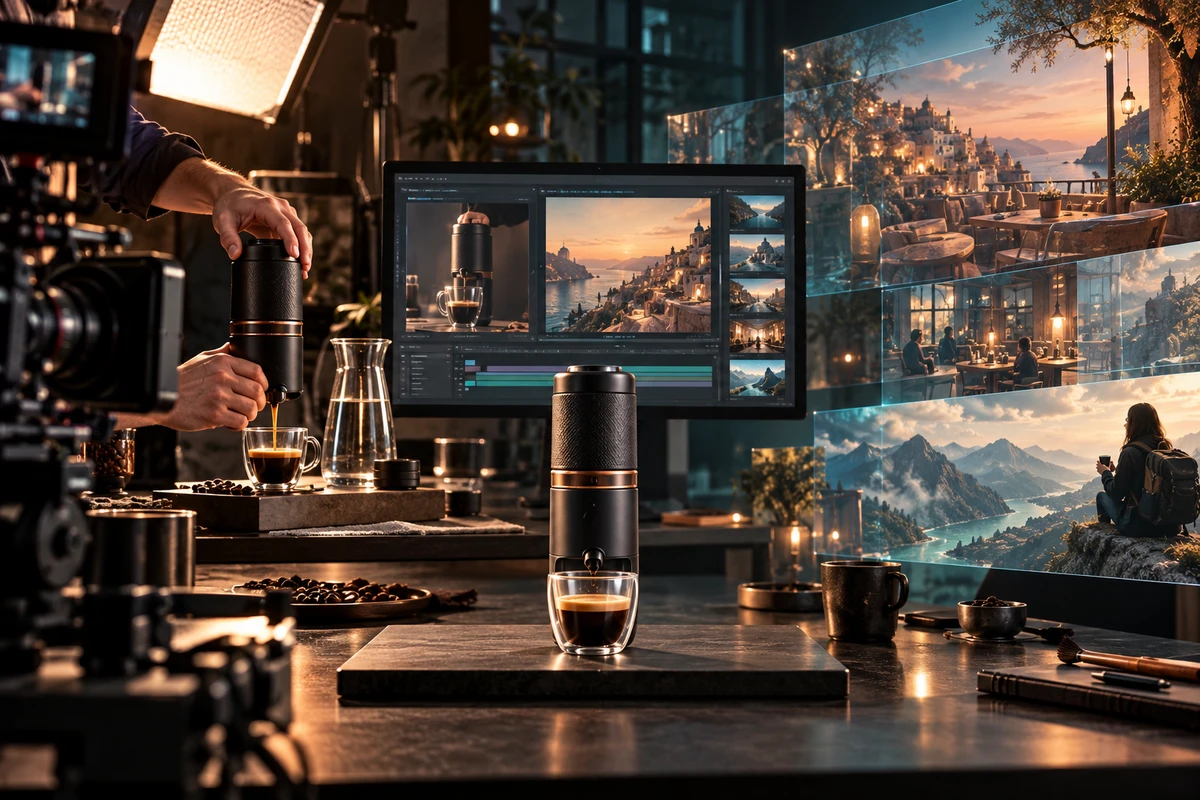
The hybrid uses one controlled shoot day for the six factual shots. AI supplies non-evidentiary environments, transitions and concept spaces. Separating what must be true from what may be designed produces a CNY 96,000 model, inside the CNY 100,000 ceiling.
It costs CNY 28,000 more than the apparent AI-first figure. That money does not buy a vague equipment upgrade; it buys one reliable source for the functional action, interface state, liquid path and scale. The increment is justified if expected capture-and-composite losses reach CNY 28,000, or the channel requires verifiable real operation. It is not justified if approved factual assets already exist.
ONCE's AIGC advertising service explains why product close-ups and precise operation often need live-action or verifiable assets, while the hybrid production workflow shows how the two methods can share one delivery system. This study adds a procurement lens: equal-scope failure cost and the buyer's cash ceiling.
Enhanced option: full live action is not automatically better
The live-action-first route uses two days to capture the product and lifestyle world. The model totals CNY 128,000, CNY 32,000 more than the hybrid and CNY 28,000 above the current ceiling. It has a clear purpose only when human interaction, real locations, fluid behaviour or a longer-lived footage library is part of the communication task.
For a commercial hurdle, define incremental contribution per order as selling price minus product cost, platform fees, fulfilment, expected return loss and the acquisition cost newly required by this project. Do not deduct the same cost twice. At a hypothetical CNY 260 contribution, the CNY 32,000 live-action increment requires at least 124 incremental contribution orders to break even. That is a hurdle, not a sales forecast, and it does not attribute every order to the film.
| Hypothetical contribution per order | CNY 28,000 hybrid increment | CNY 32,000 full-live increment |
|---|---|---|
| CNY 180 | 156 orders | 178 orders |
| CNY 260 | 108 orders | 124 orders |
| CNY 420 | 67 orders | 77 orders |
Where incremental measurement is not credible, use an observable task instead: Is real interaction required for channel acceptance? Does the extra spend avoid a confirmed CNY 32,000 rework or rights cost? Do not turn visual polish into an invented conversion promise.
Rights and platform rules can also trigger rework
Commercial-use permission is not the same as complete rights clearance. Runway's current usage-rights guidance says users retain rights in uploaded and generated content and may use it commercially, subject to its terms. A project must still review input assets, likeness, trademarks, music and third-party materials. Adobe offers conditional IP indemnification for some eligible enterprise features; that should not be read as a blanket guarantee for every output.
The US Copyright Office's 2025 report on AI copyrightability says protection may cover human-authored perceptible material and sufficiently creative human selection, coordination, arrangement or modification, while prompts alone do not provide sufficient control. This is US-specific analysis, not a global legal guarantee. The AICP Post Council's AI checklist separately recommends preserving prompt records, reviewing data settings and securing written consent for a person's voice or likeness.
Platform disclosure can affect delivery too. TikTok Ads' current policy requires labels or disclaimers for significantly edited or AI-generated ad content; the target account, market and legal team should confirm the rule at launch. Leaving disclosures, provenance and consent until final delivery can turn manageable administration into expensive rework.
Upgrade and stop gates
Use three gates at the test stage:
- Fact gate: if any of the six product-fact shots cannot be approved item by item, stop scaling generation and improve the reference, reroute the shot or film it.
- Cost gate: if AI-first spend-to-date plus estimated correction exceeds CNY 96,000, compare an immediate move to the hybrid instead of defending sunk cost.
- Distribution gate: if paid media, retail pages or channel versions are not locked, do not add cast, locations or complex visuals; reduce the master and version scope first.
The zero-lift case belongs in the decision. The finished film may produce no measurable incremental orders; it must still pass factual accuracy, file usability, rights records and schedule acceptance. The reverse is also true: if atmospheric scenes are short-lived and do not require authentic interaction, full live action can trap cash in settings that add no necessary task value.
A fill-in procurement model
Record the target market and channels, usage term, masters and versions, shots that must be real, shots that may be designed, sample and reference status, people and music rights, approvers, launch date, total available cash, and protected media and activation costs.
Then calculate:
- Production-and-rights ceiling = available cash − media − page and channel activation − measurement − operating contingency
- Delivered total cost = initial production + expected failed generation + human selection and correction + probability-weighted capture recovery + versions and rights review
- Incremental-order hurdle = added production cost ÷ incremental contribution per order, rounded up
- Stop condition = expected delivered total exceeds the ceiling and reuse, self-capture, reduced scope or phasing cannot make them overlap
To compare AI, live action and hybrid production for a real brief, share the product, market, use, available assets, sample status, timing, acceptable budget and only the business assumptions needed for the calculation. ONCE can separate factual from non-evidentiary shots and build a like-for-like budget model that you can replace with real quotes. Customer names, private contracts and other unnecessary sensitive data are not required.
Source note: Official prices, terms and platform policies were read on 9 October 2026. Google, OpenAI and Adobe publish service or model prices, not end-to-end production quotes. Runway, Adobe, the US Copyright Office, AICP and TikTok materials apply to their stated products, US legal context or platform. Recheck them with the relevant account, rights owner and legal adviser before launch. All CNY amounts, failure assumptions and contribution inputs are transparent model assumptions, not market averages, an ONCE price list or an outcome promise.