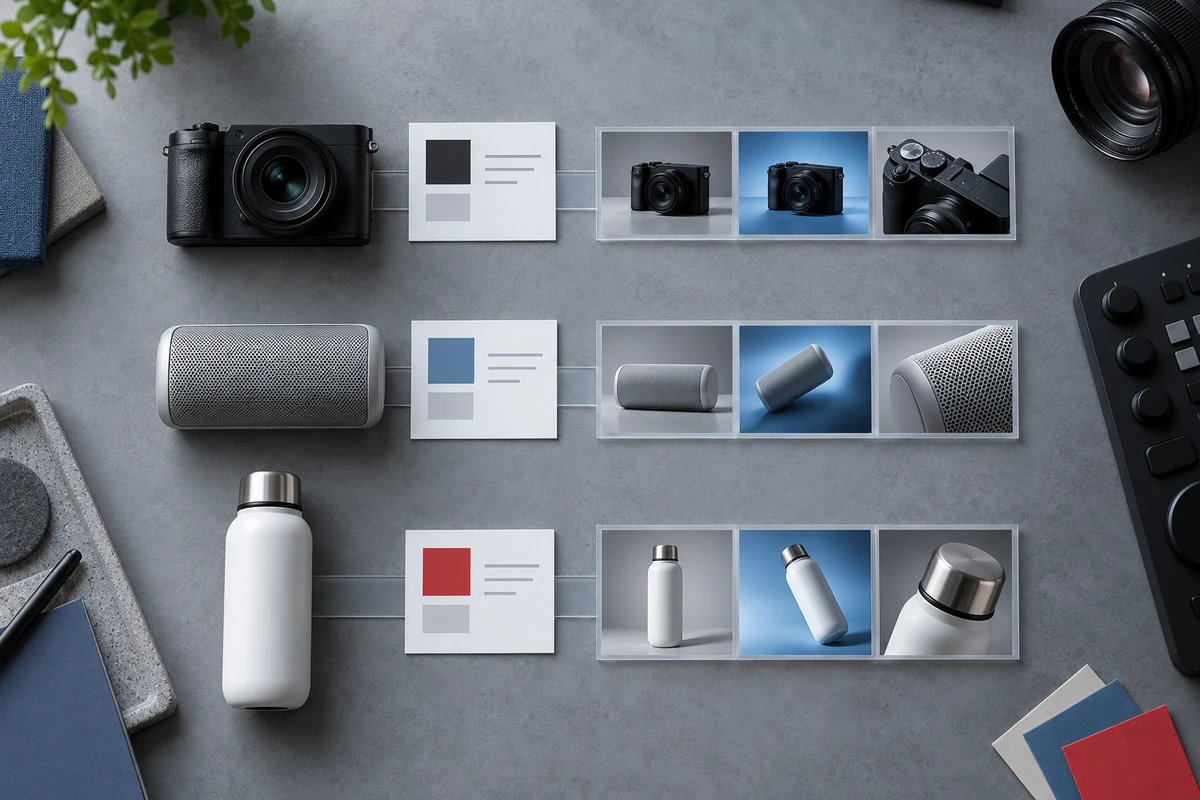
Most cross-border product-video deliveries end as a folder: a landscape master, vertical cutdowns, and perhaps a textless version. The catalog team opens that folder later and discovers that the harder questions were never answered. Which product ID does each clip belong to? Does the color or accessory shown apply to every variant? Can Googlebot reach the URL for years? When the product changes, should the team overwrite the file or issue a new URL?
Google Merchant Center's current video_link specification makes the shift explicit. Product video can now operate as a product-level feed attribute, not only as a player embedded on a product page. Linked videos may appear in free listings and can also be used in Google Ads; Google says the field can reduce manual asset entry in campaigns such as Demand Gen.
This does not guarantee distribution, and the attribute does not affect offer approval. It does change the production unit. A brand needs more than a finished film. It needs a video asset that stays correctly mapped to a product, market, URL, rights record, and retirement rule.
What the specification actually requires
The official Google Merchant Center video-link specification, checked October 3, 2026, defines video_link as an optional field for each product and allows up to ten repeated links. Eligible videos must run from 6 to 240 seconds, stay under 500 MB, use 9:16, 16:9, or 1:1, and provide at least 720p resolution.
A non-YouTube URL must point directly to a supported video file rather than to a landing page containing a player. The URL must be public, stable, crawlable without a login, and available to Googlebot without a robots.txt restriction. The merchant must own the marketing rights.
The update rule is especially important. Google recommends submitting a new unique URL when video content changes. That usually prompts a new crawl in 24 to 72 hours. Replacing the file behind an existing URL can take up to six weeks to be detected, and Google may continue serving the previous video while the replacement is processed.
Those are confirmed platform facts. The workflow below is ONCE's production and procurement interpretation of them.
The four-register handoff
1. Product-to-video map
Each row should identify the product ID, item group, exact variant visible on screen, target market and language, buyer question, and live video URL. The catalog operator should never have to infer that “blue-final-v3” belongs to a particular offer.
Variants can share a clip when the visible difference does not alter operation, fit, connector, capacity, supplied accessories, or claims. If any of those change, assign a separate video or state the eligible version clearly in the creative. Google's item-group guidance requires variants to have separate product IDs while sharing the correct item_group_id; the video map should follow the same catalog logic.
2. Master-to-output register
Capture a master that can survive several outputs: keep the product and hands inside multi-ratio safe areas, record complete action continuity, separate on-screen copy from the picture, and preserve a textless plate. Export 16:9, 9:16, and 1:1 versions deliberately rather than padding one edit with black bars.
Give each feed video one primary buyer question. “Does installation require tools?”, “Will it fit in carry-on luggage?”, or “Which parts detach for cleaning?” creates a clearer product asset than a condensed corporate story. Brand films and range overviews still have a role, but they should not replace product-specific demonstrations.
3. URL and version register
Treat the URL as part of the version identity, not as a generic storage location. Use an immutable naming pattern that combines product ID, market, ratio, language, and version date. Every material revision receives a new URL, with the previous URL, activation date, replacement reason, and rollback relationship recorded.
Silent overwrites create an invisible operations problem: an outdated video can continue to appear for weeks while the team has no clean record of which markets still use it. Stable, non-recycled URLs turn crawl delay into a manageable release window.
4. Rights and retirement register
Record marketing rights and expiry dates for talent, creators, music, fonts, and third-party material. Add the hosting owner, public-access status, and retirement action. A video being publicly crawlable does not grant the brand perpetual global advertising rights.
When rights expire, a product is discontinued, a certification claim changes, or the operating method is revised, remove the feed association before retiring the hosted file. Deleting a file that is still referenced leaves a broken catalog asset; leaving an inaccurate or unlicensed file active creates a different risk.
Compare quotes by verified catalog coverage
A useful internal formula is:
Effective cost per live product-video combination = strategy + production + outputs + rights + hosting + feed implementation + maintenance, divided by verified product ID × market × aspect-ratio combinations.
This is not an industry price benchmark. It is a way to compare delivery completeness within one project. Ten inexpensive cutdowns without product mapping, durable URLs, or rights records may produce no deployable feed assets. One polished hero film that accurately represents only one model should not be counted as coverage for an entire catalog.
Ask suppliers to separate shared shoot cost, each buyer-question unit, ratio outputs, language versions, hosting and URL administration, feed implementation support, and replacement pricing. That reveals the difference between creating more files and covering more sellable products.
Acceptance has three layers
Content acceptance confirms that the pictured product, parameter, color, connector, accessory, and action are accurate. Data acceptance verifies the mapping between product ID, item group, market, language, and URL. Public-access acceptance checks that the link works without authentication, remains available to Googlebot, and meets the required format, duration, ratio, resolution, and file size.
A simple single-product offer can start with one 16:9 demonstration and one vertical version. A catalog with several functional variants, markets, or frequent revisions should complete the four registers before deciding how many videos to produce. Otherwise, increasing output volume also increases the chance of silent mismatches.
ONCE's view is that once video enters the product feed, production becomes responsible for more than the picture. The deliverable must be identifiable, crawlable, replaceable, and retireable. The brief should specify both what the team will film and which sellable product each asset will represent.
Teams planning one China production for Merchant Center, Shopify, Amazon, and paid media can pair this system with our PPLV Shopify deployment method, review ONCE's ecommerce product-video scope, or continue with our video-marketing guidance.