If one production day must deliver twelve TikTok ads, should the call sheet list Ad 1 through Ad 12, or should it list hooks, performances, product proof, objection responses, endings and pickup shots?
Shooting each finished ad from beginning to end often repeats the most expensive parts of the day. A performer finally finds the right rhythm, then waits while the product is reset. A product close-up is lit, then the crew rebuilds the setup for a medium shot because the next script returns to the presenter. Liquids, stains, packaging seals, battery levels, app states and props may be reset for every “complete” take.
A more practical TikTok ad production schedule starts with the physical cost of resetting each shot. Footage that shares a camera, lighting setup, product state or performance task is captured together. Editors can recombine modules later, but production cannot pretend that product conditions and human reactions are infinitely interchangeable.
Lock platform constraints before designing creative differences
TikTok for Business currently recommends sound or music, vertical 9:16 framing, at least 720p resolution, UI-safe composition, an early hook and a clear call to action as general starting points for performance ads. Its auction in-feed specifications, updated in June 2026, add a more specific upload boundary for Non-Spark ads: vertical 9:16 is recommended, with a minimum of 540 by 960 pixels, and safe zones vary with aspect ratio, caption length and add-ons.
Those rules affect the shoot. Important actions cannot sit against the edge of frame. Product screens and hand gestures must avoid interface overlays. Production needs usable sound or room for post-produced audio, and compositions must leave space for captions. But cropping one video into 9:16, 1:1 and 16:9—or replacing three subtitle files—does not create three different reasons to watch.
The same TikTok guidance suggests three to five differentiated creatives per ad group during exploration and says larger creative differences are generally more useful when testing. That is platform guidance, not a production package every brand must copy. What production must preserve is identifiable difference: who speaks, which problem opens the ad, how the product proves its promise, and why the viewer should believe it.
List reset costs before writing the call sheet
Before the shoot, label four kinds of reset cost. Cost here includes time, continuity and reshoot risk, not just money.
Product-state resets
Opened packaging, consumed liquids, prepared stains, replaced filters, changing battery levels, app account states, screen messages, melting food and altered makeup can make the next take impossible to match. Each proof shot needs a documented starting state, operating sequence and reset method. With only one prototype, irreversible actions also need a deliberate order.
Performance resets
Surprise, urgency, first discovery and confident everyday use are different performances, even when the spoken line is similar. Group hooks by emotional intensity, wardrobe and relationship between characters. When real product operation matters, give the performer enough rehearsal to make the action repeatable instead of recording their learning process in every version.
Lighting and camera resets
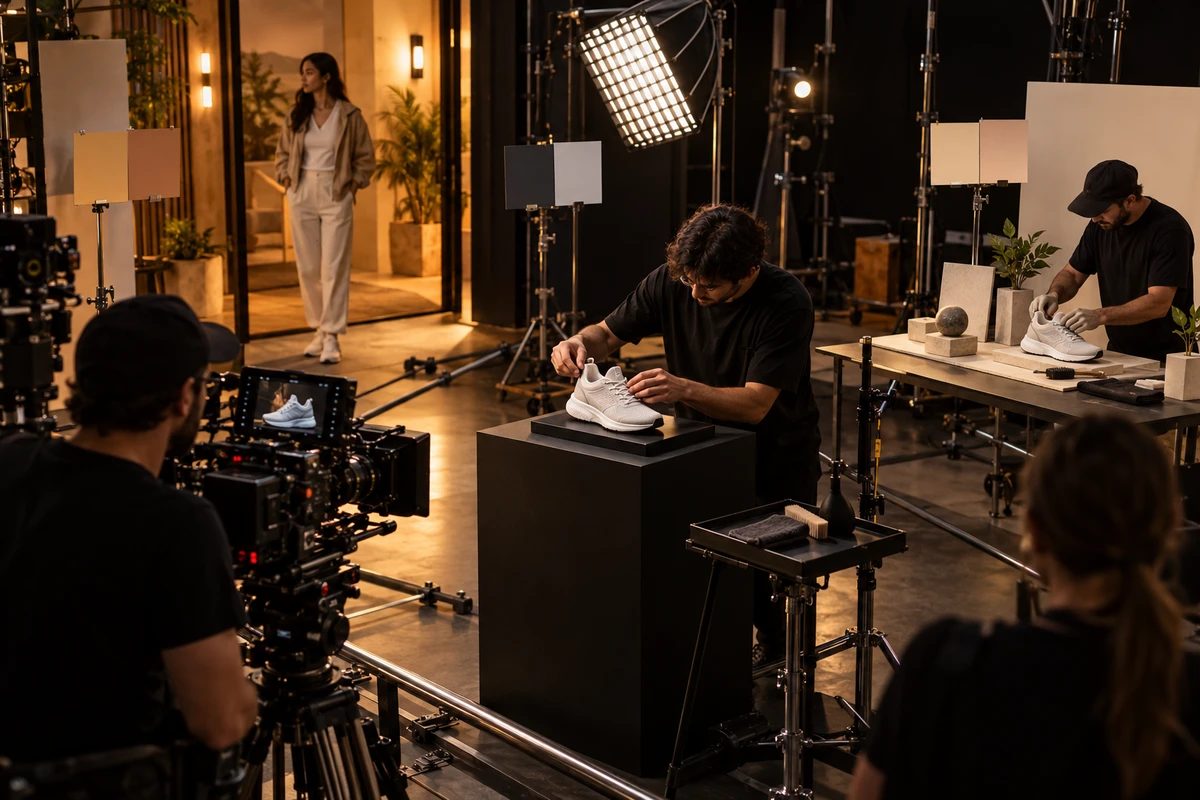
Material proof may need controlled reflections, screen-refresh management and precise detail exposure. A native-feeling presenter segment may need looser lighting and a different camera distance. Both can belong in one ad, but they rarely need to alternate on set. Schedule by lighting unit and camera unit, not by script number.
Information and version resets
Prices, offers, captions and calls to action change more quickly than product footage. Unless the information must be spoken by the performer or synchronized to an action, avoid locking every commercial detail into the picture. Clean plates, separate voice lines and replaceable endings move later changes into post-production instead of another casting call.
Decide what can be shared and what must be reshot
Modular production does not mean every shot can connect to every other shot. The test is whether the footage still supports the same promise.
Reusable material often includes product beauty shots, packaging, basic hand operations, location establishing shots, clean endings without a specific offer, and material details that do not change the product claim. These can become clearly numbered master modules.
Reshoot when:
- a hook targets a different emotional state and requires different eye line, pace or movement;
- the proof condition changes, such as indoor use versus bright outdoor use;
- the same action is meant to prove a different result and needs a documented new starting state;
- gestures, eye lines or dialogue must synchronize with an interface;
- a new objection is paired with an old reaction that visibly answers a different question.
The most dangerous combination is a strong new hook attached to irrelevant proof. The first seconds may look fresh while the argument breaks in the middle. Every reusable module should therefore be labeled by the question it answers, not simply as “general B-roll.”
A practical order for one production day
The following sequence suits many product-led social ads, but it is not universal:
- Capture irreversible proof first. Record the prototype state, conditions and complete operation so the proof can stand on its own.
- Batch presenter hooks. Under the same wardrobe, camera and lighting setup, group takes by emotion and viewing entry point, with a clean start and end for each.
- Batch objection responses. Record ease of use, compatibility and setup as separate answers rather than forcing several objections into one sentence.
- Capture transitions and clean plates. Include pick-ups, put-downs, turns, entrances, product-only shots and endings without captions.
- Finish with highly variable commercial information. Confirmed offers, localized lines, calls to action and synchronized statements come last so earlier footage is not locked to temporary information.
The production log should include more than a shot number. Record module type, product state, performance intention, intended audience, safe-zone requirement and compatible adjacent sections. Editors then receive bounded components, not a drive full of nearly identical clips.
Procure and accept three layers of delivery
A contract that only promises “20 short videos” makes it easy to fill the count with crops, subtitle swaps and music changes. A clearer scope has three layers:
- Master footage modules: selected and basically graded hooks, proof, objections, transitions and endings with stable IDs;
- Finished combinations: each video has a distinct entry point and relevant product proof; format adaptation is not presented as a new creative concept;
- Version map: platform, language, audience, hook, proof module, CTA, caption and music versions are linked so media results can be traced back to the source footage.
Acceptance should also check four things: key action remains inside the safe zone; the main idea is understandable with and without sound; captions, music and voice can be replaced within their licensing terms; and proof conditions remain consistent across versions.
TikTok describes creative fatigue as diminished attention and sentiment after overexposure and recommends refreshing creative based on sustained delivery trends rather than one universal number of days. The shoot does not need to predict the winner. It needs to leave a legible, reusable asset pool so a tired hook can be replaced without discarding product proof that remains credible.
Know when modular production is the wrong choice
Continuous dramatic performance, destructive tests, hazardous operations, comparisons that must be recorded without interruption and shots that depend on changing natural light should not be fragmented merely to increase version count. In those cases, protect one complete and credible narrative first, then extract shorter edits only where the evidence remains intact.
Modularity is not permission to create infinite combinations. A hook, proof section and CTA may be mathematically compatible but strategically wrong when they address different audiences, promises or landing pages. Efficiency ends where facts, performance and cause-and-effect begin to break.
If you are procuring a new batch of international paid-social assets, bring ONCE the product, target market, current media questions and launch date. Our short-form video production planning can define reset costs, shoot modules and the three delivery layers before deciding how many finished ads are actually useful. You can also review ONCE's video marketing approach and broader brand content system before submitting your campaign goal for an asset plan.
Sources reviewed: TikTok for Business, Creative best practices for performance ads, updated June 2025; TikTok Auction In-Feed Ads, updated June 2026; TikTok's official discussion of creative effectiveness and fatigue; and the May 2026 update on TikTok One. Platform rules can change; confirm the current requirements shown for the target region and ad account before launch.