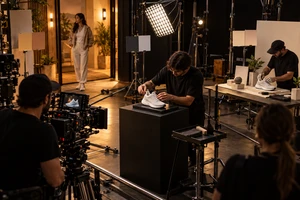
Ad platforms are starting to do more than accept finished creative. They are beginning to read product pages, brand rules and approved assets, then assemble display and video variations for different placements. For global marketing teams working with Chinese supply chains, that changes the production brief: the critical question is no longer whether AI can make an ad, but whether the inputs are accurate, governed and removable.
On September 30, 2026, Amazon Ads said its updated Responsive eCommerce Creative (REC) could use a logo, color palette, approved imagery and copy guardrails supplied once by the advertiser, then generate, optimize and deliver brand-governed display and video ads. Advertisers can preview output by product or ASIN, placement, size, language and specific asset. Amazon also stated that the new brand controls were US-only at launch, while previews were available across regions where REC is offered.
This announcement proves that Amazon launched the capability; it does not prove that every ad platform or advertiser has completed the same transition. It does, however, make a procurement shift visible: when a platform assembles the variations, production teams must deliver a controlled input system—not just finished masters.

A finished master is still valuable, but it is no longer the whole deliverable
Traditional scopes are easy to count: a 15-second cut, a 30-second cut, vertical, square and landscape versions. With dynamic assembly, one product image, one claim or one demonstration shot may be recropped, reordered or combined with other elements. The approval questions move upstream. Can this image survive a 9:16 crop? Is this claim valid in every market? When must old packaging disappear from the source pool?
ONCE’s conclusion is that platform-ready ad creative needs two outputs: human-approved masters and a reusable brand input package. The package is not a license for unlimited generation. It is the mechanism that limits generation to what the brand has already defined as true and usable. Teams can still commission ongoing short-form creative production, but the reusable inputs and restrictions should be in scope too.
The Brand Input Contract: six layers that a style guide cannot cover
1. Source Truth
For every SKU, ASIN or model, record the current specifications, core functions, package version, certification status, approved markets and authoritative product-page source. If the page is stale, faster generation only distributes the mistake faster.
2. Fixed
Define what must not change: logo clear space, brand colors, product proportions, ports, screen content, legal copy and required product naming. For hardware, beauty devices and appliances, product geometry and safe-use actions often matter more than stylistic consistency.
3. Flexible
Identify what may vary: background, crop, pacing, layout, shot order, CTA and language. Give each variable a range. Permission to change a background is not permission to change the product color; permission to shorten a demonstration is not permission to remove a safety step.
4. Claims
Attach every product claim to its substantiation, prohibited alternatives, eligible markets and expiry date. A flat list of “approved copy” is incomplete because the platform cannot infer why a claim is valid or where it stops being valid.
5. Review
Use a risk-based preview matrix rather than trying to inspect every possible combination. Amazon’s preview dimensions offer a practical starting point: sample by product, placement, size, language and asset. Review high-risk claims and new markets completely; sample low-risk changes such as format-only versions. Define stop conditions for distorted products, unsupported claims or unsafe demonstrations.
6. Expiry
Every package, licensed asset, price, certification and claim needs an owner and an end date. When a model changes or rights expire, the old input must be withdrawn from the callable pool—not merely removed from the latest campaign deck.
Platform-ready creative has a different cost equation
Platform-ready creative cost = truth capture + approved source production + guardrail encoding + variation QA + refresh and withdrawal.
This equation avoids two misleading comparisons. The first compares only the price of generating one video and ignores the preparation and review around it. The second locks every element so tightly that dynamic assembly loses its efficiency.
The real cost drivers are the number of SKUs, markets, regulated claims, variable dimensions and update cycles. A short campaign with one product and three placements may be cheaper as conventional finished masters. A multi-SKU, multilingual, always-on program is more likely to benefit from reusable inputs. For brands that need to align product shooting, versioning and review, ONCE’s global product content production provides a practical starting point.
Choose among platform generation, a hybrid model and human-led masters
- Use platform generation when product truth is stable, approved source coverage is strong, placements and languages are numerous, and changes to crop, pacing or background cannot alter product meaning.
- Use a hybrid model when demonstrations and claims need human approval but formatting, subtitles, backgrounds and short cutdowns can scale automatically.
- Keep human-led masters when claims are highly regulated, product geometry cannot drift, safe-use actions are essential, or performance, location and brand voice are the creative idea itself.
Google Ads described a comparable input-led workflow on August 26, 2026 for Gemini Omni in Asset Studio: import brand guidelines and a URL, generate storyboards or motion scenes from prompts or static assets, refine scenes, pacing and aspect ratios, then deploy multi-format assets. Together, the Amazon and Google announcements show that input quality is moving closer to the front of ad production. They do not remove the advertiser’s approval responsibility.
A monthly operating rhythm turns the package into an asset
A useful brand input package is maintained, not filed away. At the start of each month, freeze the active SKUs, markets and claims. Produce reusable product angles, demonstration actions and scene modules in batches. Review previews weekly according to risk. At month-end, use campaign results to decide which inputs to retain, reshoot or withdraw.
Review performance at the input level, not only by final ad. If one product angle repeatedly appears in strong combinations, produce more of that evidence. If a claim repeatedly fails legal review, remove it from the claims layer. If one language creates recurring ambiguity, raise the human-review requirement for that market.
The durable asset is not any single generated variation. It is a controlled definition of what can be combined, where and for how long. To turn product pages, source footage and campaign versions into that working system, start with ONCE’s advertising and product-content team and request a platform-ready creative input plan.
Sources and scope
Primary sources: Amazon Ads, Scale premium display ads with Responsive eCommerce Creative, September 30, 2026; Google Ads, From brief to on-brand video in Asset Studio: Meet Gemini Omni in Google Ads, August 26, 2026. The six-layer Brand Input Contract, cost equation, review rhythm and procurement guidance are ONCE’s analytical framework, not an official platform standard or a performance guarantee.